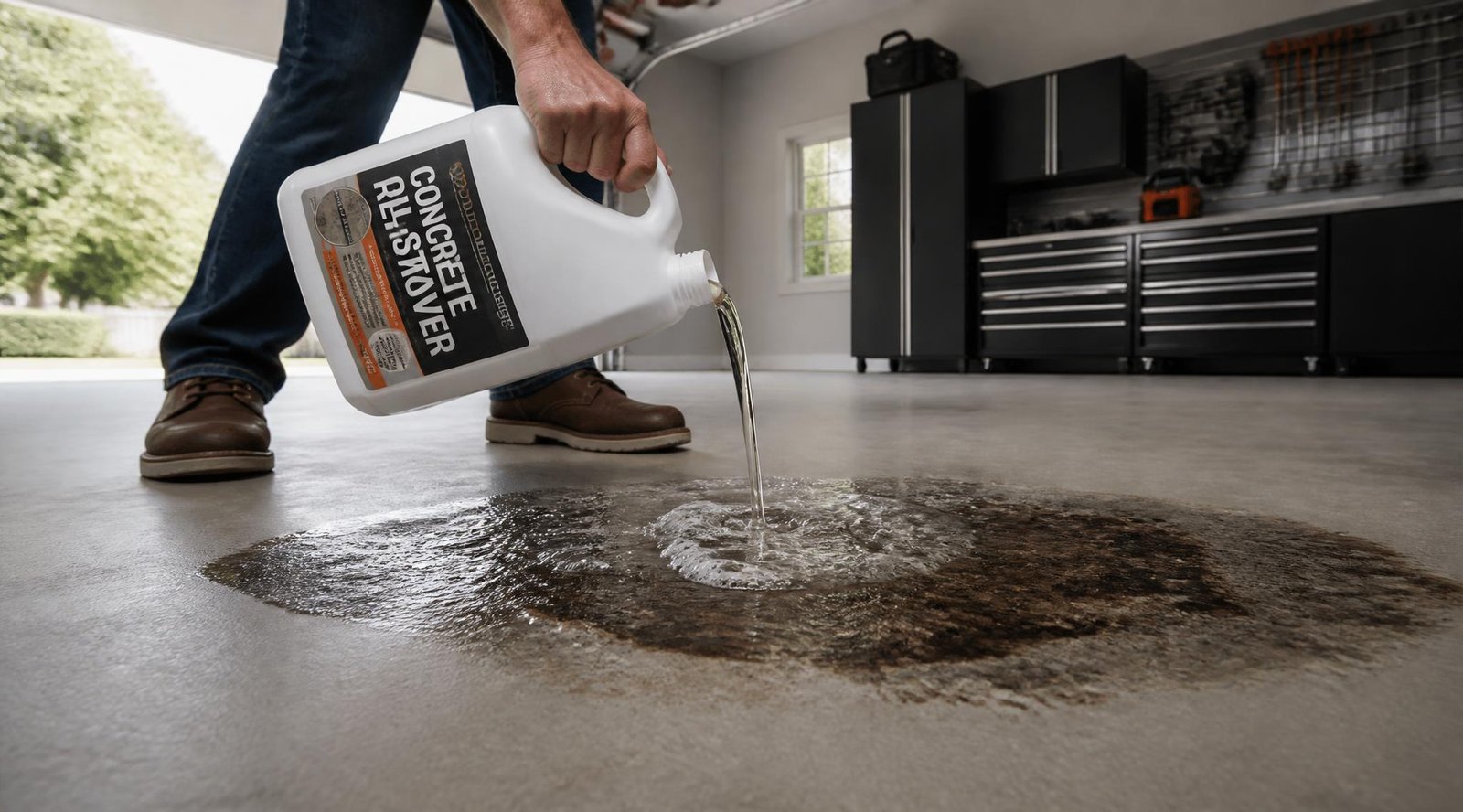
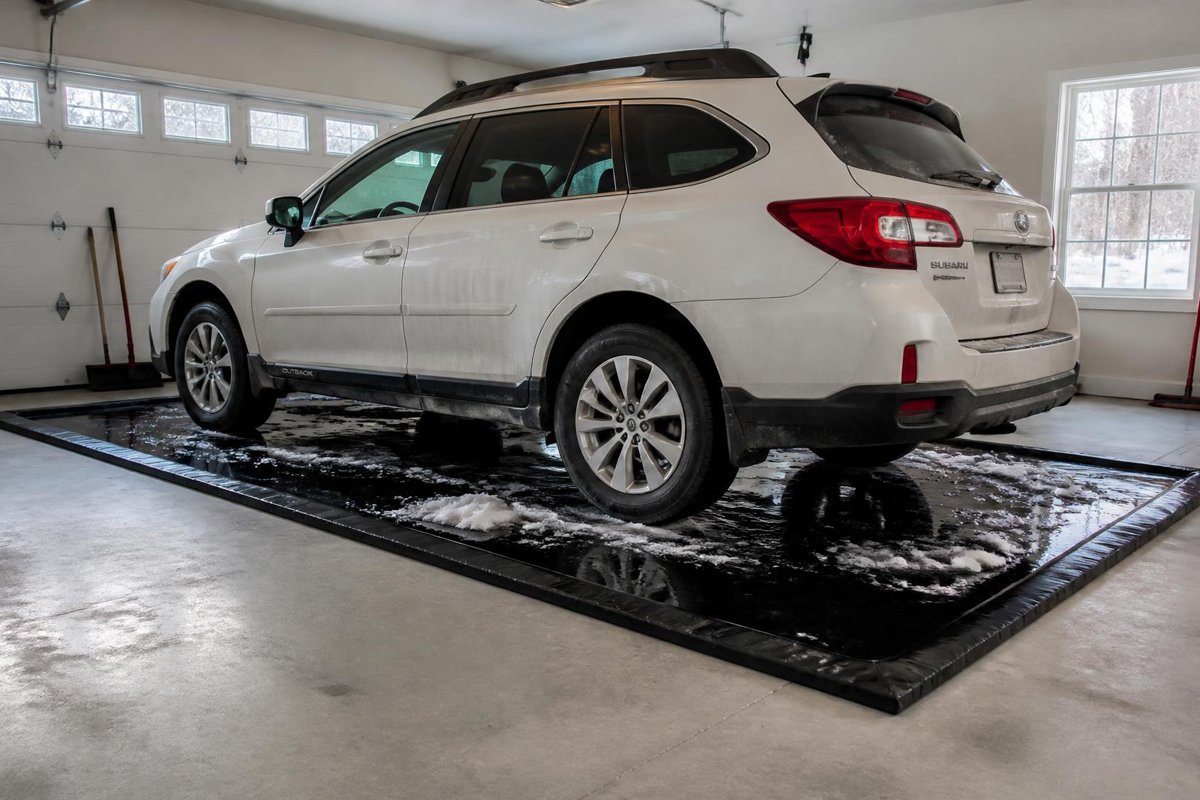
Every garage floor eventually tells on the car parked over it. A slow drip from a valve cover gasket, a splash during an oil change, or a leaking transmission line leaves a dark patch that no amount of sweeping will touch. The right oil stain remover for concrete can lift most of that discoloration, but only if it matches the age of the stain and the type of fluid that made it.
The problem is that concrete is porous. Oil does not sit on top of the slab; it wicks down into thousands of tiny capillaries and settles there. That is why a quick scrub with dish soap rarely works, and why a stain that has been left for a few months behaves very differently from a spill you catch in the first ten minutes.
This guide compares five proven options, explains how each one works, and walks through the application process step by step. If your floor is generally grimy and not just stained, start with our complete garage floor cleaning guide and come back here for the stubborn spots. And if you only need a general-purpose cleaner, our roundup of the best garage floor degreasers covers that ground; this article focuses specifically on lifting set-in oil out of the concrete itself.
Quick Answer
The best oil stain remover for concrete depends on how old the stain is. Fresh spills need an absorbent powder applied immediately, before the oil can sink in. Stains that are days or weeks old respond best to a dedicated concrete stain remover left to dwell overnight. Old, deep stains often need a poultice-style or enzymatic product and more than one round of treatment. Across all three cases, the same principle holds: the product has to pull oil out of the pores, not just clean the surface, and patience beats scrubbing.
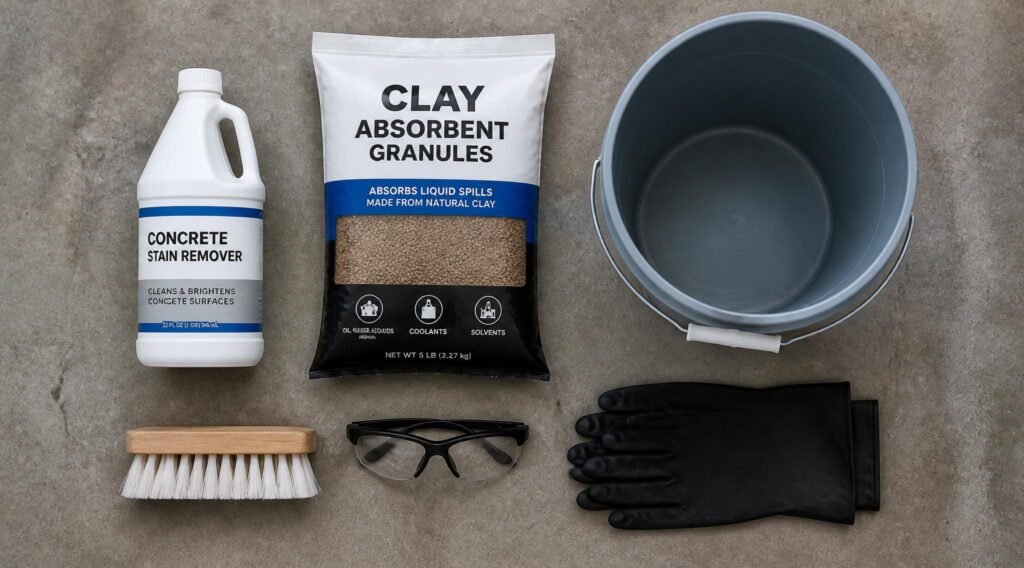
Table of Contents
- What Is an Oil Stain Remover for Concrete?
- How to Choose the Right Oil Stain Remover
- Best Oil Stain Removers for Concrete
- Comparison Table
- Best Approach for Different Stain Situations
- How to Remove an Oil Stain from Concrete Step by Step
- Common Mistakes
- Expert Tips
- Final Verdict
- Frequently Asked Questions
What Is an Oil Stain Remover for Concrete? {#what-is}
An oil stain remover for concrete is any product designed to break down, absorb, or draw out petroleum-based fluids that have soaked into a concrete surface. That includes motor oil, transmission fluid, brake fluid, hydraulic fluid, and grease. These products fall into a few families, and understanding the differences makes shopping much easier.
Absorbents are dry granules or powders that soak up fresh liquid before it penetrates. They are the first line of defense and the cheapest option, but they do very little for a stain that has already set.
Surfactant and solvent-based cleaners loosen oil so it can be rinsed or wicked away. Many are water-based and designed to sit on the stain for several hours, even overnight, so the active ingredients have time to work down into the pores.
Enzymatic and bio-based cleaners use biological agents to break hydrocarbons into smaller compounds over time. They work more slowly, but they tend to be gentler on the slab and are often chosen for older stains or for homeowners who want a lower-odor option.
Poultices are a paste made by mixing an absorbent powder with a cleaning agent. As the paste dries, it pulls oil upward and out of the concrete. This is the traditional method for the oldest, deepest stains.
It is also worth knowing what an oil stain remover will not do. It cleans and lifts, but it does not seal the floor. If you want to stop future spills from soaking in, you need a sealer or coating, which we cover in our garage floor coating kits guide.
How to Choose the Right Oil Stain Remover {#how-to-choose}
Before buying anything, ask yourself three questions:
- How old is the stain? Fresh spills call for an absorbent. Anything older than a few days needs a real remover with dwell time.
- What made the stain? Motor oil, brake fluid, and transmission fluid are all petroleum-based, but heavier greases and mixed-fluid spills tend to need stronger or repeated treatments.
- What is the floor going to be used for next? If you plan to coat or paint the floor, residual oil will cause adhesion problems, so thorough removal matters more than speed.
Used oil and oily cleanup waste also carry disposal rules. The EPA has basic guidance on handling and recycling used oil at home, and your local waste authority can tell you what to do with saturated absorbent and rags.
Best Oil Stain Removers for Concrete {#best-options}
The list below is organized by product type rather than a ranking of brand names, because the right choice depends on the stain. Where a specific product is named, it is a widely sold example of that category; confirm current formulas and prices before buying.
1. Oil Eater Overnight Stain Remover — Best Overall for Set-In Stains
Overview: This is a ready-to-use, biodegradable formula sold specifically for oil stains on concrete, driveways, pavers, and garage floors. It is designed to be applied and left to work overnight, which is exactly what porous concrete needs. A 32 oz bottle typically retails for roughly $12 at big-box home improvement stores, which makes it an easy first purchase for a single stubborn spot.
Key Features:
- Overnight dwell approach suited to porous surfaces
- Biodegradable formula
- Intended for concrete, brick, stone, and pavers
- Small bottle sized for spot treatment
Best For: A single set-in stain under a vehicle, or a few small spots
Pros: ✅ Inexpensive for spot treatment ✅ Easy to find ✅ Simple application Cons: ❌ A small bottle will not stretch across a whole floor ❌ Very old stains may need a second application
Our Verdict: The easiest starting point for most homeowners. Pair it with the prep steps in our guide on cleaning a garage floor without a pressure washer and give it the full overnight dwell time.
2. Quikrete Oil Stain Remover — Best for Larger Areas
Overview: Quikrete sells a heavy-duty, solvent-free oil and grease remover marketed for garage floors, driveways, patios, and masonry. It is a low-odor, low-VOC formula, which matters in an attached garage where fumes can drift into the house. Gallon pricing is commonly around $14, making it far more economical than small bottles when the stained area is large.
Key Features:
- Solvent-free, heavy-duty formula
- Low odor and low VOC
- Sold by the gallon
- Intended for concrete, pavers, and masonry
Best For: Multiple stains, a whole stained parking zone, or driveways and garage together
Pros: ✅ Best cost per square foot ✅ Low odor ✅ Works on a range of masonry Cons: ❌ Gallon jug is overkill for one small spot ❌ Availability varies by region
Our Verdict: A smart buy when the stained area is bigger than a dinner plate. Ventilate the space using the tips in our garage ventilation guide, even though the formula is low odor.
3. Pull It Out Concrete Stain Remover — Best Water-Based Option for Mixed Fluids
Overview: Pull It Out is a water-based, bleach-free, acid-free remover from Environmental Solutions International. It is formulated to lift motor oil, brake fluid, transmission fluid, hydraulic fluid, and other stain-causing materials from concrete, brick, wood, composites, and pavers. That range makes it useful when a floor has accumulated several different kinds of drips over the years.
Key Features:
- Water-based, bleach-free, acid-free
- Targets multiple automotive fluids
- Safe-for-many-surfaces positioning
Best For: Garage floors with stains from more than one fluid
Pros: ✅ Works on several fluid types ✅ No bleach or acid ✅ Can be used on other masonry surfaces Cons: ❌ May need repeat applications on old stains ❌ Priced above basic degreasers
Our Verdict: The most versatile pick if your floor has a “history.” Consider adding a containment mat under the vehicle afterward so the mess does not come back.
4. Enzymatic Concrete Cleaner — Best for Old Stains and Low Odor
Overview: Enzymatic oil stain removers (Terminator-HSD is one commonly cited example) use bio-based agents that gradually break down hydrocarbons in the concrete. They work slower than solvent-style products, often over several days, and usually reward patience with a more complete result on old, deep staining.
Key Features:
- Biological action rather than harsh chemical solvents
- Typically low odor
- Slower but often more thorough on aged stains
- Often applied, kept damp, and covered
Best For: Old stains that have survived other cleaners, and households that want a gentler product
Pros: ✅ Gentler on concrete and on the user ✅ Low odor ✅ Good on deep, old staining Cons: ❌ Slow, multi-day process ❌ Usually specialty-priced and may need online ordering
Our Verdict: Choose this when speed is not a priority. If the garage also has lingering smells, our guide to garage odor removal is a good companion read.
5. Oil-Absorbent Granules — Best for Fresh Spills
Overview: Clay-based absorbent granules, such as Oil Dri, are the emergency tool, not the cure. Poured onto a fresh spill, they soak up liquid before it can migrate deep into the concrete, which can turn a would-be permanent stain into a minor cleanup.
Key Features:
- Dry granules, no mixing
- Works immediately on fresh spills
- Inexpensive and widely available
- Sweep-up cleanup
Best For: Every garage, as a standing supply, and especially after oil changes
Pros: ✅ Cheapest option ✅ Prevents stains instead of treating them ✅ No chemicals to handle Cons: ❌ Does little for stains older than a few hours ❌ Used granules must be disposed of properly
Our Verdict: Keep a bag on the shelf. Store it with the rest of your supplies in a proper garage storage system so it is within arm’s reach when you need it.
Comparison Table {#comparison}
| Product Type | Best For | Speed | Approx. Price | Odor |
|---|---|---|---|---|
| Oil Eater Overnight Stain Remover | Single set-in stain | Overnight | ~$12 (32 oz) | Low to moderate |
| Quikrete Oil Stain Remover | Large stained areas | Hours to overnight | ~$14 per gallon | Low |
| Pull It Out Stain Remover | Mixed-fluid stains | Hours to overnight | Check current price | Low |
| Enzymatic Concrete Cleaner | Old, deep stains | Days | Varies | Very low |
| Oil-Absorbent Granules | Fresh spills | Minutes | Low | None |
Prices are approximate, based on typical retail listings, and change frequently.
Best Approach for Different Stain Situations {#use-cases}
Fresh Spill (Under a Few Hours Old)
Speed is everything. Cover the spill with absorbent granules, let them sit, then sweep up and dispose of them. Do not wipe with a rag, which pushes oil sideways and deeper. Once the bulk is gone, a light follow-up with a degreaser from our degreaser roundup will clean the residue. If the spill happened during a project, our guide to car ramps and jack stands can help you set up a safer, tidier work area next time.
Set-In Stain (Weeks to Months Old)
This is where a dedicated remover such as Oil Eater, Quikrete’s formula, or Pull It Out earns its place. Apply it generously, let it dwell the full recommended time, scrub with a stiff nylon brush, and rinse. If you have a pressure washer, our pressure washer picks for garages will make rinsing faster; if you do not, a bucket and a good wet/dry shop vac will handle the slurry. Expect to repeat the process on a stain that has had years to settle.
Old Stain on Sealed, Coated, or Painted Concrete
Coated floors behave differently. Epoxy and polyaspartic surfaces are far less porous, so oil usually sits on top and wipes off with a mild cleaner. Harsh removers can damage the coating, so check the label and follow the care steps in our guide to cleaning a polyaspartic garage floor. If you are deciding whether to coat at all, read should I paint my garage floor and our epoxy coating kit guide.
How to Remove an Oil Stain from Concrete Step by Step {#how-to}
Work in a ventilated garage, wear chemical-resistant gloves and eye protection, and keep any product away from open flames or ignition sources. If you use anything flammable, review our garage fire safety guide first.
Step 1: Prepare
Move vehicles and sweep the area completely. Remove loose grit and debris so the product can reach the stain. Read the product label for dwell times and surface warnings.
Step 2: Soak Up Free Oil
If any liquid oil remains, cover it with absorbent granules, wait, and sweep up. Never rinse free oil down a drain.
Step 3: Apply the Remover
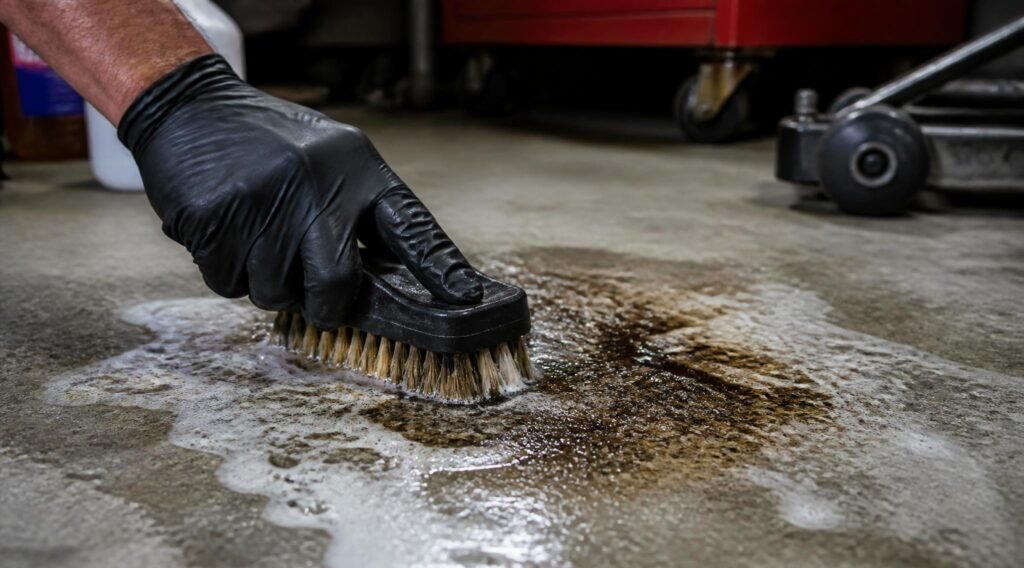
Pour or spray the product to fully saturate the stain and extend a little beyond its edges. Work it in with a stiff nylon brush so it contacts the pores.
Step 4: Wait
This is the step people skip. Let the product dwell for the time on the label, which is often several hours or overnight. For enzymatic products, keep the area damp and covered as directed.
Step 5: Scrub, Rinse, and Review
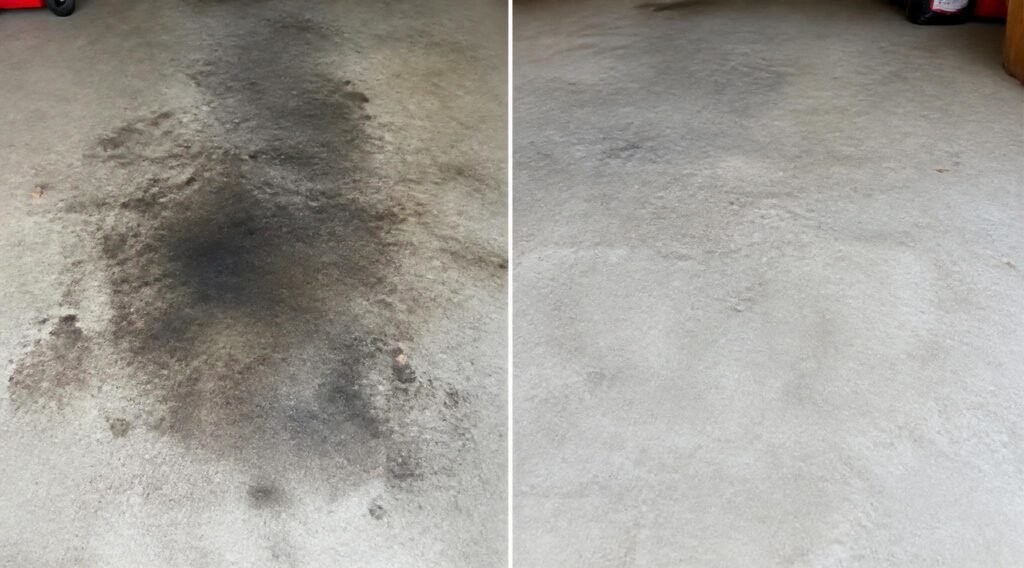
Scrub again, then rinse or wet-vacuum the residue. Let the floor dry fully, since concrete looks darker when wet, and judge the result only when it is dry. If a shadow remains, repeat. Dispose of waste according to local rules, and keep the oily rags in a metal container, as covered in our fire safety guide.
Common Mistakes {#mistakes}
Scrubbing without dwell time. Elbow grease cannot replace chemistry. If you rinse after ten minutes, the product never had time to work into the concrete. When a floor is also growing mildew from damp conditions, tackle moisture too; see our guide on why a garage floor sweats.
Using the wrong cleaner on a coated floor. Strong solvents can cloud or soften a floor coating. Always check compatibility, and use the cleaning approach in our garage floor cleaning guide for sealed surfaces.
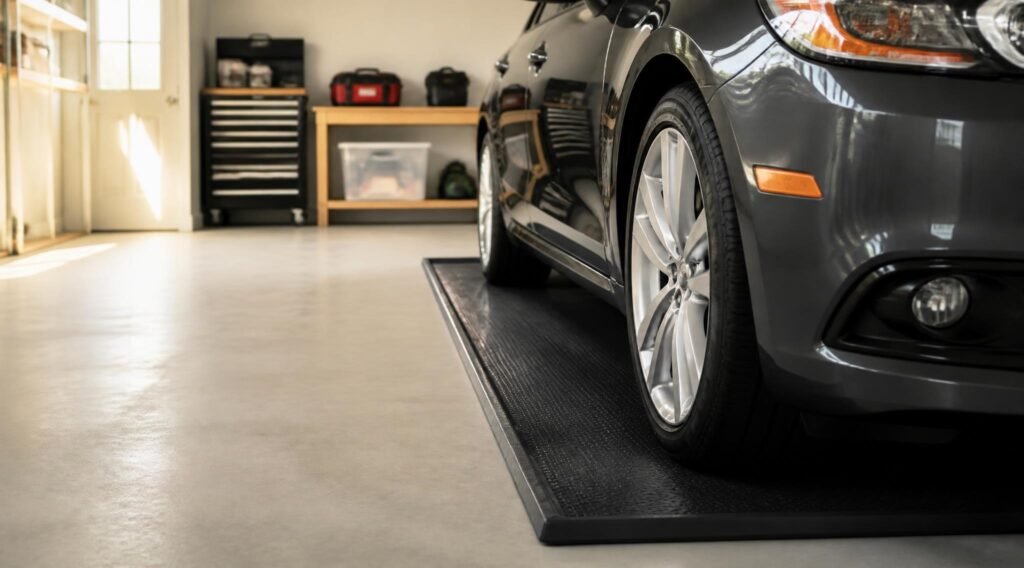
Ignoring the source of the leak. Cleaning a stain under a car that is still dripping is a losing game. Fix the leak or place a garage floor containment mat under the vehicle.
Expert Tips {#tips}
Test in a hidden spot first. Some removers lighten the surrounding concrete if used at full strength. Trying a small area near a wall avoids a “clean spot” that looks worse than the stain.
Warm weather helps. Most products work better when the slab is not cold. In winter, a garage that is warm enough to work in is also better for stain removal; our garage heater guide can help you get there.
Treat the whole stain once, not the center repeatedly. Oil spreads outward under the surface. Extending the treatment area past the visible edge captures the halo.
Final Verdict {#verdict}
Best Overall: Oil Eater Overnight Stain Remover for most single stains. Best Value for Large Areas: Quikrete Oil Stain Remover by the gallon. Best for Mixed Fluids: Pull It Out Concrete Stain Remover. Best for Old, Deep Stains: An enzymatic concrete cleaner with patience. Best for Prevention: Oil-absorbent granules kept on the shelf.
No product performs miracles on a stain that has been baking in for a decade, and a faint shadow is normal. But with the right remover and enough dwell time, most garage floors improve dramatically. To keep them that way, round out your setup with a few of the best garage cleaning tools, consider a floor coating, and store solvents and chemicals in a flammable storage cabinet.
Frequently Asked Questions {#faq}
Do I need a special oil stain remover for concrete, or will dish soap work? Dish soap helps on very fresh, light spills, but it rarely pulls oil out of porous concrete once it has set. A dedicated remover with dwell time reaches deeper. For a general cleaner, see our degreaser guide.
How long does it take to remove an oil stain from concrete? Fresh spills can be handled in minutes with absorbent. Set-in stains typically need an overnight dwell, and enzymatic products can take several days. Very old stains may need multiple rounds.
What is the difference between an oil stain remover and a degreaser? A degreaser cleans oily films on the surface, while an oil stain remover is built to draw oil out from within the pores. Many floors need both: the degreaser first, the stain remover second.
Why does the stain come back after I clean it? Oil deep in the slab can wick back toward the surface as the concrete dries, so the shadow reappears. Repeat the treatment, or use a poultice or enzymatic product on stubborn spots.
Can I use a pressure washer to remove oil stains? A pressure washer helps with rinsing but does not remove oil that is deep in the pores on its own. Use it after a remover has done its work. See our pressure washer picks.
Is oil stain remover safe to use in an attached garage? Choose low-odor formulas, ventilate well, and keep products away from ignition sources. Add a carbon monoxide detector if you run engines or heaters; our carbon monoxide safety guide explains placement.
Will an oil stain remover damage a coated floor? Some can. Harsh solvents may dull or soften epoxy and polyaspartic coatings, so always check the label and test a small area first.
How do I dispose of oily absorbent and rags? Used oil should be taken to a recycling location, and saturated absorbent and rags are governed by local rules. Check the EPA’s used oil guidance and your local waste authority, and store oily rags in a covered metal container.
Can I prevent oil stains in the first place? Yes. Use a containment mat, keep absorbent on hand, and consider sealing or coating the floor. See our coating kit guide.
What should I do about rust marks that sit alongside oil stains? Rust and oil need different treatments. Our article on the best rust remover covers that side of things.
Author: Danial Marquez Last Updated: October 2026