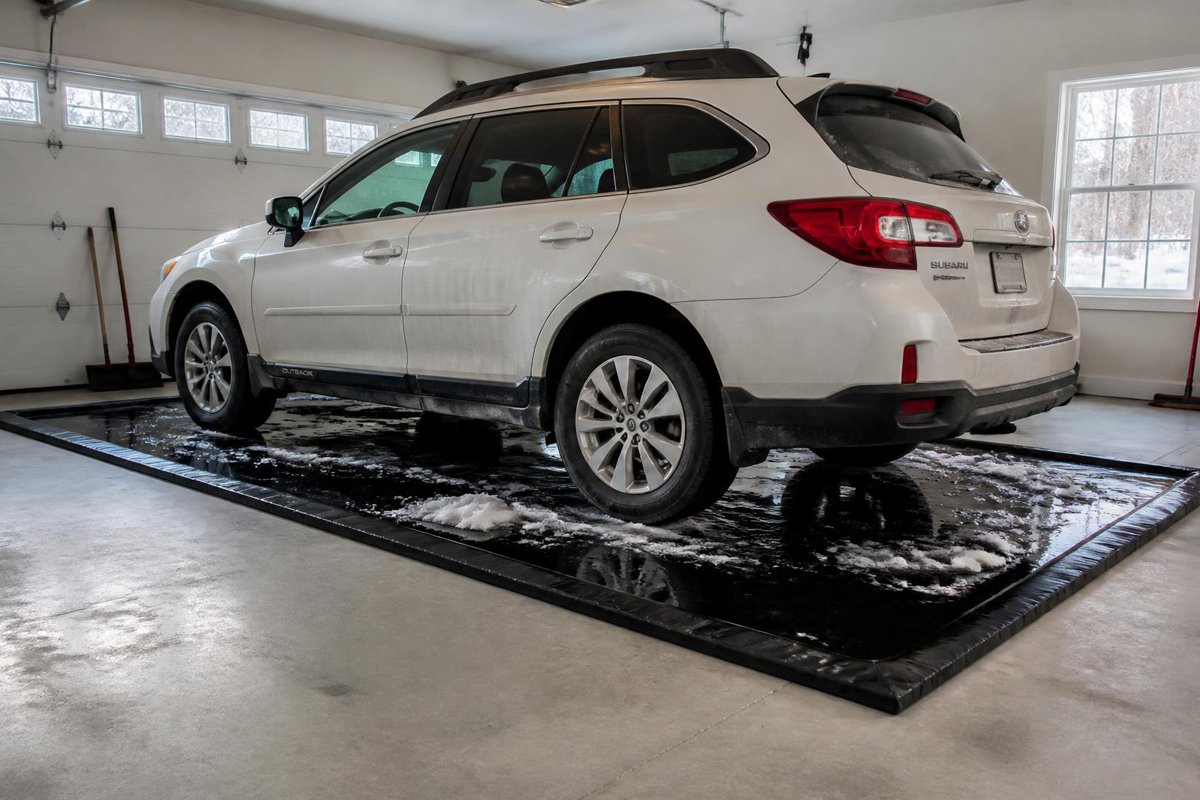
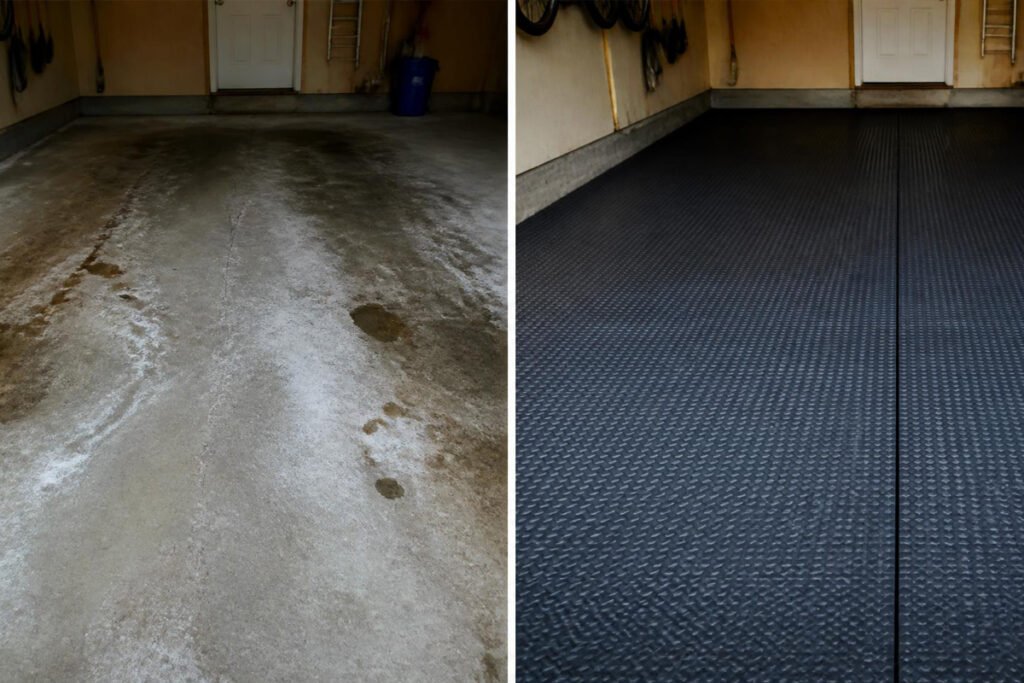
Every winter, the same routine plays out in garages across the country: a car pulls in covered in road salt and slush, and by morning there’s a puddle spreading across the concrete, working its way into every crack and pore. Road salt in particular does real, lasting damage to bare concrete — freeze-thaw cycles combined with salt corrosion are one of the most common causes of pitted, flaking garage floors, and it happens gradually enough that most homeowners don’t notice until the damage is done.
A containment mat solves this at the source: instead of scrubbing and squeegeeing melted snow off bare concrete, the mat catches it before it ever touches the floor. It pairs naturally with the rest of a garage cleaning routine, cutting down how often you need to break out a mop or shop vacuum in the first place.
This guide compares five containment mats that hold up to real winter and year-round garage conditions — snow melt, road salt, mud, and oil — and breaks down which one fits which situation.
Quick Answer
The best garage floor containment mat depends on your climate and vehicle size. For most homeowners dealing with regular snow and salt, the AutoFloorGuard Heavy-Duty Containment Mat is the benchmark pick — a raised foam edge, water-tight welded seams, and a free squeegee included for fast cleanup. If you want a comparable mat with a slightly more refined look and heavier scrim fabric, the TruContain Channeled Containment Mat is a close, well-regarded alternative. Budget-conscious buyers do well with the Drymate Garage Floor Mat, an absorbent option that skips the raised-edge design but still protects against everyday drips and light snow. For oversized vehicles or trucks, the AutoFloorGuard Heavy-Duty in an extra-large size covers the extra footprint. And anyone wanting a mat that also looks presentable year-round, not just in winter, should look at a DremGara commercial-grade PVC mat, built with heavier material for long-term durability.
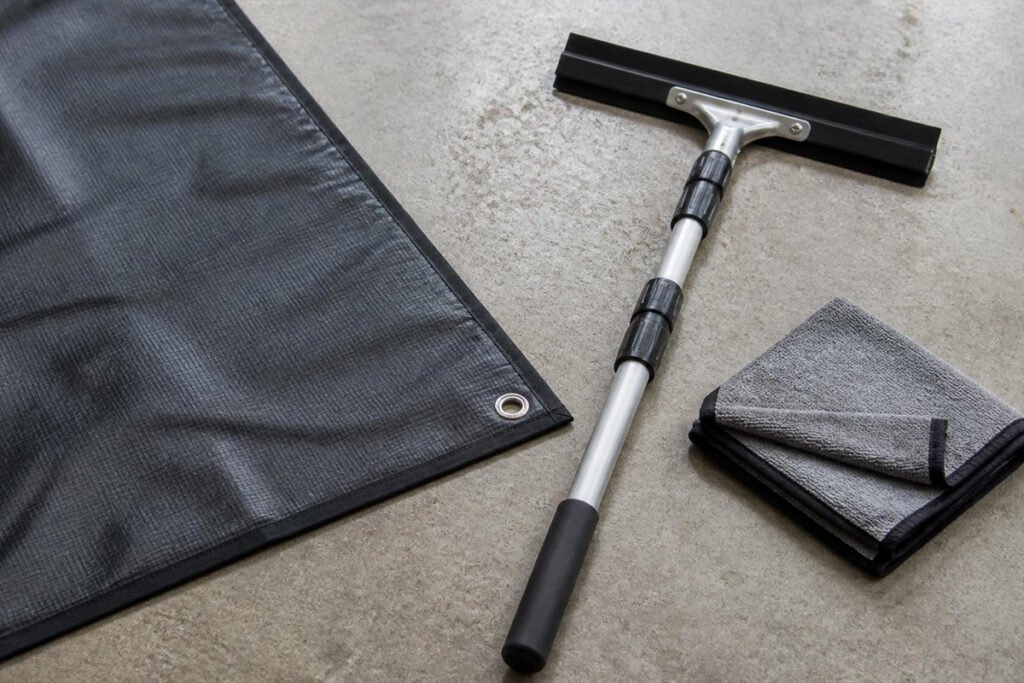
Table of Contents
- How Containment Mats Work
- How to Choose the Right Mat
- Best Containment Mats Available
- Comparison Table
- Best Mats for Different Garage Setups
- How to Install and Use a Containment Mat Correctly
- Common Mistakes
- Expert Tips
- Final Thoughts
- Frequently Asked Questions
How Containment Mats Work
A containment mat is essentially a large, waterproof mat with a raised foam edge running around its perimeter, designed to trap liquid rather than let it spread across the floor. The edge — typically an inch to an inch and a quarter of heat-welded, PVC-infused foam — acts as a dam, while the flat center surface collects snow melt, mud, and drips until you squeegee or vacuum it off. Seams are welded rather than sewn, since a stitched seam would let water through exactly where it matters most.
There are two broad categories: raised-edge containment mats, built specifically to hold standing liquid, and absorbent mats, which use a wicking top layer to soak up moisture rather than pool it. Containment mats handle heavier volumes of water — a car dripping snow melt for hours — better than absorbent mats, which are better suited to lighter, more frequent moisture like everyday drips and light rain.
If your garage floor is already epoxy-coated, a containment mat is still worth using — it protects the coating from prolonged exposure to road salt and standing water, which can dull or degrade a finish over time even when the coating itself is otherwise durable. Check our guide on epoxy floor coating for more on maintaining a coated floor’s finish.
How to Choose the Right Mat
Before comparing specific products, work through three questions:
What’s the biggest vehicle you need to cover? Measure the actual footprint, including some margin on all sides — a mat sized too tight to the vehicle defeats the purpose the moment a tire sits slightly off-center.
Is it mainly a winter problem, or year-round? Regions with real winters and road salt benefit most from a raised-edge containment mat. Milder climates with occasional rain or routine drips may be well served by a lighter absorbent mat instead.
Do you need to store it seasonally, or leave it down year-round? Some mats roll up easily for seasonal storage; others are heavy and better suited to staying in place permanently. Match the mat’s weight and format to how you’ll actually use it.
For general guidance on the effects of road salt and de-icing chemicals on concrete, the Portland Cement Association’s guidance on concrete durability is a useful, non-commercial reference for understanding why this kind of protection matters over the life of a garage floor.
Best Containment Mats Available
1. AutoFloorGuard Heavy-Duty Containment Mat — Best Overall
Overview: AutoFloorGuard has been one of the most consistently top-rated containment mats for years, and its Heavy-Duty version reflects continuous refinement — a heavier polyester scrim fabric for durability, a full year warranty (up from 90 days on earlier versions), and a free telescoping squeegee included for fast cleanup. Its “Stay-Put Corners” — Velcro pads that anchor the mat to the floor — genuinely reduce the bunching and mat creep that plagues cheaper competitors.
Key Features:
- Heavy polyester scrim fabric for improved durability
- Raised foam edge with heat-welded, water-tight seams
- Stay-Put Corners reduce mat creep and bunching
- Included telescoping squeegee for cleanup
- One-year limited warranty
Best For: Most homeowners in regions with real winter snow and road salt looking for the most complete, well-supported option.
Pros: ✅ Consistently rated as one of the most durable containment mats available ✅ Stay-Put Corners meaningfully reduce bunching compared to competitors ✅ Included squeegee and stronger warranty add real value
Cons: ❌ Priced higher than basic absorbent mats ❌ Heavy and bulky if you plan to remove and store it seasonally
Our Verdict: For most winter-climate garages, this remains the mat to beat — the combination of durability, anti-bunching design, and included accessories justifies the higher price for anyone dealing with real seasonal mess.
2. TruContain Channeled Containment Mat — Best Alternative Pick
Overview: TruContain emerged as AutoFloorGuard’s closest direct competitor, and the two brands have pushed each other to improve over the years — TruContain’s welded seams sit on the underside rather than the top, which some reviewers consider a more protective placement, and its heavier scrim fabric and refined gray color give it a slightly more finished look than AutoFloorGuard’s black.
Key Features:
- Patented parallel channel design directs liquid away from the vehicle
- Heavy-duty PVC-infused fabric with a 1.18-inch foam containment edge
- Underside-welded seams for added protection
- Available in a heavy-duty version for larger vehicles
Best For: Homeowners who want AutoFloorGuard-level protection with a slightly more refined appearance, or who prefer the channeled drainage design.
Pros: ✅ Thoughtful channel design actively directs liquid rather than just containing it ✅ Underside seam placement is a genuine design advantage some reviewers prefer ✅ More refined look than typical black containment mats
Cons: ❌ Larger sizes are frequently out of stock ❌ Some reports of bunching over time, similar to other containment-style mats
Our Verdict: This is a close, credible alternative to AutoFloorGuard rather than a clear step up or down — pick based on which specific feature (channels vs. Stay-Put Corners) matters more for your garage.
3. Drymate Garage Floor Mat — Best Budget / Absorbent Pick
Overview: Rather than a raised-edge containment design, the Drymate uses an absorbent top layer to soak up moisture directly — a simpler, lower-profile approach that works well for everyday drips, light rain, and moderate snow melt without the bulk of a full containment mat.
Key Features:
- Absorbent top layer wicks moisture rather than pooling it
- Low-profile design, easier to walk on than raised-edge mats
- Lighter weight, easier to move or store seasonally
- Machine washable in most sizes
Best For: Milder climates, everyday drip protection, or anyone who wants a simpler, more affordable option than a full containment mat.
Pros: ✅ More affordable than raised-edge containment mats ✅ Low profile is easier underfoot and doesn’t create a tripping edge ✅ Washable, simpler maintenance than squeegeeing standing water
Cons: ❌ Not built for heavy, sustained snow melt the way a raised-edge mat is ❌ Can become saturated and need more frequent washing in wet climates
Our Verdict: For light-to-moderate moisture, this is a genuinely sensible, lower-cost alternative — just recognize it’s a different category of product than a true containment mat, not just a cheaper version of one.
4. AutoFloorGuard Heavy-Duty (Extra-Large Size) — Best for Trucks & Large SUVs
Overview: The same AutoFloorGuard design that tops this list scales up into larger dimensions built specifically for full-size trucks and large SUVs, addressing the most common complaint with containment mats generally sized for sedans: a vehicle that simply doesn’t fit within the mat’s footprint.
Key Features:
- Extended width and length options for full-size vehicles
- Same heavy-duty fabric, Stay-Put Corners, and welded seams as the standard version
- Wide enough to keep large tires within the containment edge
- Included squeegee, same one-year warranty
Best For: Full-size trucks, large SUVs, or anyone whose vehicle has outgrown a standard-sized containment mat.
Pros: ✅ Purpose-sized for large vehicles rather than an awkward stretch of a standard mat ✅ Same proven design and warranty as the standard AutoFloorGuard ✅ Solves the single most common sizing complaint in this category
Cons: ❌ Higher price than the standard size ❌ Takes up correspondingly more storage space if removed seasonally
Our Verdict: If a standard containment mat has ever left part of your vehicle’s tires outside the protected zone, sizing up within the same trusted product line is the straightforward fix.
5. DremGara Commercial-Grade Containment Mat — Best Heavy-Duty Construction
Overview: Built from a heavier 610 GSM PVC material than most residential-focused competitors, the DremGara leans toward commercial-grade durability — a sensible option for a garage that sees heavier use, multiple vehicles rotating through the same spot, or general workshop traffic beyond just parking.
Key Features:
- 610 GSM commercial-grade PVC construction
- Raised containment edge with welded seams
- Built to handle heavier foot and vehicle traffic than standard residential mats
- Competitive value relative to material weight
Best For: Heavier-use garages, workshops with vehicle traffic beyond simple parking, or anyone prioritizing raw material durability.
Pros: ✅ Noticeably heavier-duty material than most residential mats at a similar price ✅ Holds up well to repeated heavy use over time ✅ Good value for the material weight included
Cons: ❌ Less brand recognition and review history than AutoFloorGuard or TruContain ❌ Heavier material means more effort to move or reposition
Our Verdict: For a garage that gets genuinely heavy use — not just a car parked overnight, but real workshop traffic — the commercial-grade material here is worth the trade-off in weight and portability.
Comparison Table
| Product | Best For | Edge Design | Included Extras | Approx. Price |
|---|---|---|---|---|
| AutoFloorGuard Heavy-Duty | Best Overall | Raised foam edge | Squeegee, 1-yr warranty | $180–$250 |
| TruContain Channeled | Best Alternative | Raised edge + channels | Varies by retailer | $170–$240 |
| Drymate Garage Floor Mat | Best Budget/Absorbent | Absorbent, no raised edge | Machine washable | $60–$100 |
| AutoFloorGuard XL | Best for Trucks/SUVs | Raised foam edge | Squeegee, 1-yr warranty | $220–$300 |
| DremGara Commercial-Grade | Best Heavy-Duty | Raised foam edge | Varies by retailer | $150–$220 |
Prices are approximate and vary significantly by size and retailer — containment mats are typically priced by square footage.
Best Mats for Different Garage Setups
Standard Sedan or Crossover in a Snowy Climate
The AutoFloorGuard Heavy-Duty in its standard size covers this use case well, and pairs naturally with a broader garage cleaning routine for the rest of the space.
Full-Size Truck or Large SUV
Size up to the AutoFloorGuard XL or a comparably large TruContain option — a mat that doesn’t fully cover the vehicle’s footprint defeats much of the purpose, letting drips or slush fall just outside the containment edge.
Mild Climate or Light, Everyday Drips
The Drymate’s absorbent design is a better fit here than a full containment mat — simpler to maintain, more affordable, and well-matched to lighter, more frequent moisture rather than heavy sustained snow melt. This pairs well with the lighter maintenance habits covered in our garage door maintenance checklist.
How to Install and Use a Containment Mat Correctly
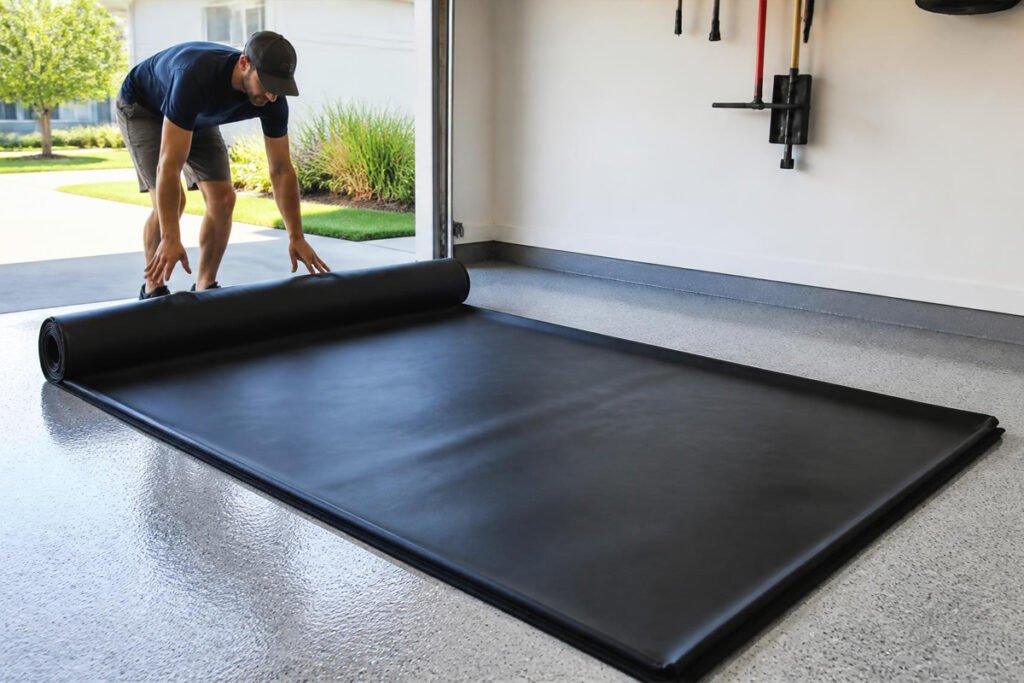
Step 1: Clean and Dry the Floor First
Sweep and, if needed, clean the concrete before laying the mat — debris trapped underneath can create uneven spots and accelerate wear on the mat’s underside.
Step 2: Measure Before You Buy, Not After
Measure your vehicle’s actual footprint with margin on all sides, plus the space available in your parking spot, before ordering — an undersized mat is the most common regret with this category of product.
Step 3: Lay the Mat Dull-Side Up (or Per Manufacturer Instructions)
Most mats have a specific orientation for the textured or dull side to face up — check the manufacturer’s instructions, since this affects both grip and cleaning ease.
Step 4: Secure the Corners
Use included Velcro or adhesive corner pads if provided — this meaningfully reduces bunching and mat creep, especially in spots where a vehicle’s wheels turn while stationary.
Step 5: Squeegee or Vacuum Regularly, Don’t Let Water Sit Indefinitely
Standing water on the mat for extended periods can still affect the concrete underneath if there’s any imperfection in the seal — regular squeegeeing keeps the mat doing its job as intended.
Common Mistakes
Buying a mat sized too close to the vehicle’s exact footprint. Without margin, a slightly off-center parking job puts part of the vehicle — and its drips — outside the containment area. Size up rather than cutting it close.
Ignoring bunching or wrinkling instead of addressing it early. A bunched mat creates low spots where water pools unevenly and can eventually seep past the edge. Use anchor corners and address bunching as soon as it starts.
Skipping mat maintenance entirely. A containment mat still needs periodic cleaning — built-up salt, mud, and debris left on the mat long-term can degrade the material faster than regular squeegeeing and occasional washing would.
Expert Tips
Pair the mat with a squeegee routine, not just passive containment. A mat catches the liquid, but actively squeegeeing it toward a drain or off the mat after each use keeps things genuinely dry rather than just contained.
Check for a warranty and seam quality before buying on price alone. Welded, water-tight seams are the actual functional difference between a mat that works long-term and one that leaks at the seams within a season — don’t judge purely by size or sticker price.
Store the mat clean and fully dry if removing it seasonally. Rolling up a mat with residual moisture or road salt trapped inside can lead to mildew smell or material degradation by the time you unroll it again next winter.

Final Thoughts
Best Overall: The AutoFloorGuard Heavy-Duty earns its position through consistent, proven durability and thoughtful details like the Stay-Put Corners and included squeegee.
Best Budget: The Drymate proves a simpler absorbent mat is a genuinely sensible choice for lighter, milder-climate needs.
Best for Large Vehicles: The AutoFloorGuard XL solves the sizing problem that undermines standard mats for trucks and large SUVs.
Whichever mat you choose, pair it with regular squeegeeing and the broader cleaning habits in our garage cleaning tools guide — the mat protects the floor, but it still needs a little upkeep to do that job well over years, not just one winter.
Frequently Asked Questions
Are garage floor containment mats actually worth the cost? For most homeowners in snowy or salt-heavy climates, yes — they meaningfully reduce road salt corrosion and freeze-thaw damage to concrete, and most users recoup the cost through avoided floor damage within a winter or two.
Do I need a containment mat if my garage floor is already epoxy-coated? It’s still worth using one — prolonged exposure to standing salt water and snow melt can dull or degrade even a durable epoxy finish over time, and the mat reduces how often you need to clean the coated surface.
How do I clean a garage floor containment mat? Use the included squeegee (or any squeegee) to push standing liquid toward a drain or off the mat after each use, and periodically hose it down or wipe it clean, depending on the specific material — most PVC-based mats clean easily with water alone.
What size containment mat do I need? Measure your vehicle’s actual footprint and add margin on all sides — a good rule of thumb is roughly a foot of extra width and length beyond the vehicle’s exact dimensions to account for imperfect parking.
Can a containment mat handle a truck or large SUV? Standard-sized mats are usually built around sedan and crossover dimensions, so trucks and large SUVs need an XL or extended-size version specifically designed for larger footprints.
Will a containment mat prevent my garage floor from ever getting wet? It significantly reduces exposure, but isn’t a complete seal against every scenario — regular squeegeeing and periodic mat maintenance are still part of keeping the floor genuinely dry underneath.
Absorbent mat vs. raised-edge containment mat — which do I need? Raised-edge containment mats handle heavier, sustained moisture like real snow melt and standing puddles better. Absorbent mats are a simpler, more affordable fit for lighter, more frequent moisture like everyday drips or light rain.
Can I leave a containment mat down year-round, or should I store it seasonally? Either works — some homeowners leave it down permanently for ongoing protection, while others store it in warmer months once the seasonal risk of snow and salt has passed. Base the choice on your climate and available storage space.
Do containment mats work for oil and other fluid leaks, not just snow? Yes — the same raised-edge design that contains snow melt also captures oil drips and other fluid leaks, making these mats useful year-round in garages with any vehicle that has occasional minor leaks.
Why do some containment mats bunch up over time? Bunching typically happens when a mat isn’t anchored at the corners and a vehicle’s tires shift the material while turning in place. Corner anchoring pads, when included, meaningfully reduce this over time.
Author: Danial Marquez Last Updated: September 2026