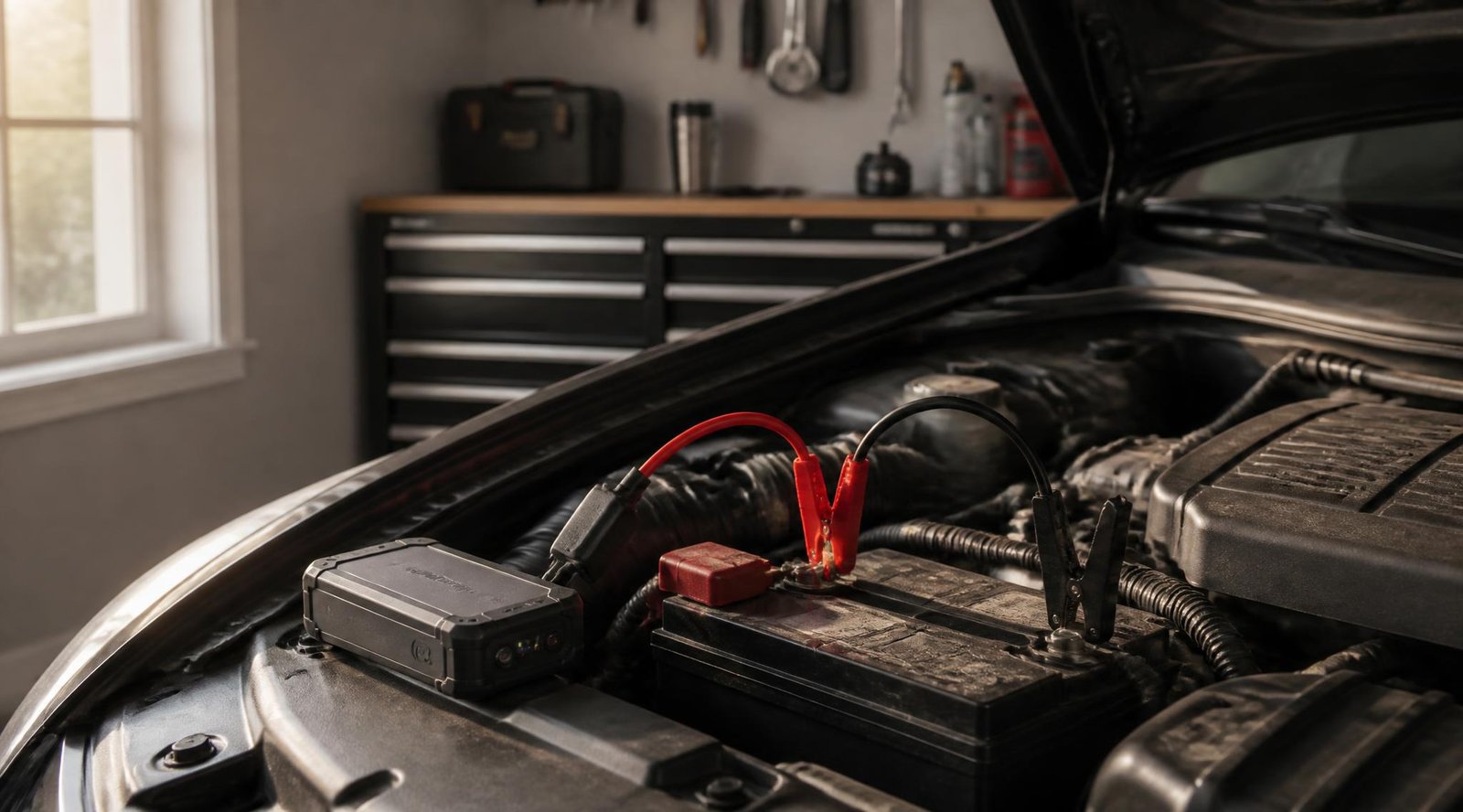
A dead battery always seems to pick the worst moment, usually a cold morning in the garage or a parking lot with nobody around. A good jump starter fixes that in about a minute, without a second car, without jumper cables and without waiting for a tow truck.
The trouble is that the market is full of boxes that advertise huge numbers. Some of those numbers mean very little, and some jump starters are simply too small for the engine you actually drive. This guide compares five of the best portable jump starters by engine coverage, safety features, extra functions and price, so you can match the right unit to your vehicle. Specs and prices change often, so confirm the latest details on the product page before you buy.
Quick Picks: Best Jump Starters at a Glance
- Best overall (cars and small SUVs): NOCO Boost Plus GB40
- Best for big engines and diesel: NOCO Boost HD GB70
- Best for trucks and as a power bank: WOLFBOX MegaVolt24
- Best for the garage or shop: Clore Jump-N-Carry JNC325
- Best budget jump starter: AstroAI S8
Table of Contents
- Comparison table
- How we picked these jump starters
- The 5 best portable jump starters in detail
- How to choose the right jump starter
- How to use a jump starter safely
- How to store and maintain your jump starter
- Common mistakes to avoid
- Frequently asked questions
- Final verdict
Jump Starter Comparison Table
| Jump starter | Rating | Max engine (gas / diesel) | Extras | Best for | Approx. price* |
|---|---|---|---|---|---|
| NOCO Boost Plus GB40 | 1,000A peak | 6.0L / 3.0L | USB charging, LED light | Most cars and SUVs | About $100 |
| NOCO Boost HD GB70 | 2,000A peak | 8.0L / 6.0L | Heavy-duty clamps, up to 40 jumps | V8s, larger diesels | Check current price |
| WOLFBOX MegaVolt24 | 4,000A peak (claimed) | Up to 10L (gas and diesel) | 88.8Wh battery, 65W USB-C | Trucks, road trips | About $178 |
| Clore Jump-N-Carry JNC325 | 450 start-assist amps | 8.0L / 6.0L | Override button, dual USB, DC outlet | Garage and shop use | Check current price |
| AstroAI S8 | 1,500A peak | 6.0L / 3.0L | LED light, USB port | Light budgets, backup unit | About $60 |
*Approximate prices seen in October 2026. They vary by seller, color and bundle.
How We Picked These Jump Starters
We did not rank by the biggest number on the box. Each jump starter below had to meet these standards:
- Honest engine coverage: a clear gas and diesel engine rating from the manufacturer, since this matters more than peak amps.
- Safety protections: spark-proof connections, reverse polarity protection and overheat protection where listed.
- Everyday usability: clear controls, a usable clamp design and a way to handle a fully dead battery.
- Useful extras: USB charging, a flashlight, or a built-in power bank, without hurting the main job.
- Value: price compared with what the unit actually delivers, plus warranty.
This list is based on manufacturer specifications, retailer listings and published reviews, including a hands-on Car and Driver test of several units. Always read your own manual and your vehicle owner’s manual before using any jump starter.
The 5 Best Portable Jump Starters in Detail
1. NOCO Boost Plus GB40: Best Overall Jump Starter
The NOCO Boost Plus GB40 is the jump starter most buyers should start with. It is a compact lithium unit rated at 1,000 peak amps, and it handles gas engines up to 6.0 liters and diesel engines up to 3.0 liters. That covers the large majority of cars, crossovers, SUVs and many light trucks.
At roughly 2.4 pounds it fits in a glove box or a door pocket. NOCO lists up to 20 jump starts on a single charge, and retailers describe it as holding its charge for up to a year in storage. The spark-proof and reverse polarity protection makes it easy to use even if you have never jumped a car, and it includes a 100-lumen LED flashlight with several modes, including SOS. A manual override lets you force power to a deeply discharged battery when the unit does not detect one.
Key specs
- Rating: 1,000A peak
- Engine coverage: up to 6.0L gas, up to 3.0L diesel
- Jump starts per charge: up to 20
- Weight: about 2.4 lb
- Extras: USB power output, 100-lumen LED flashlight
- Approximate price: about $100 from many sellers
Pros
- Compact and light enough to keep in any vehicle
- Simple, safe hookup with built-in protections
- Covers most everyday vehicles
- Solid track record and widely available
Cons
- Not rated for large diesel trucks
- No built-in display of charge percentage
- Prices vary a lot between sellers, so compare before buying
Who it is for: daily drivers who want a reliable, no-fuss jump starter for a sedan, crossover or midsize SUV.
2. NOCO Boost HD GB70: Best for Big Engines and Diesel
If your vehicle has a large engine, the NOCO Boost HD GB70 steps up the power. It is rated at 2,000 peak amps and supports gas engines up to 8.0 liters and diesel engines up to 6.0 liters, with up to 40 jump starts per charge. It is a larger, heavier unit at around 5 pounds, but it still fits in a trunk or storage bin.
It makes sense for V8 pickups, full-size SUVs, and many diesel trucks. One thing to check before buying: a 6.7-liter diesel pickup is above the GB70’s 6.0-liter diesel rating, so confirm your exact engine size against the manufacturer’s chart.
Key specs
- Rating: 2,000A peak
- Engine coverage: up to 8.0L gas, up to 6.0L diesel
- Jump starts per charge: up to 40
- Weight: about 5 lb
- Extras: heavy-duty clamps, USB output, LED light
Pros
- Handles V8 gas engines and many diesels
- More jump starts per charge than the GB40
- Same protection features as the smaller NOCO units
Cons
- Bigger and heavier than the GB40
- Costs noticeably more than compact models
- Still too small for the largest diesel pickups
Who it is for: owners of V8 trucks, SUVs and diesels up to 6.0 liters who want a lithium unit that still packs easily.
3. WOLFBOX MegaVolt24: Best for Trucks and as a Power Bank
The WOLFBOX MegaVolt24 is the pick for larger vehicles and for anyone who wants the jump starter to double as a serious power bank. WOLFBOX lists it at 4,000 peak amps with coverage for gas and diesel engines up to 10 liters, an 88.8Wh battery, a 65W USB-C port, a 200-lumen LED light and an IP64 rating. The manufacturer also advertises a lifetime warranty. TechGearLab named it a top overall pick for 2026, and it sells for around $178.
A word of caution on the big number: peak amps are a brief maximum, not what the unit delivers continuously. Some owners on forums are skeptical of 4,000A claims for a unit this size, and one manufacturer blog notes that a pack listing 2,000 peak amps may deliver only a few hundred effective cranking amps. Treat the 10-liter engine rating as the more useful figure, and confirm it on the WOLFBOX product page before you buy.
Key specs
- Rating: 4,000A peak (manufacturer claim)
- Engine coverage: up to 10L gas and diesel (manufacturer rating)
- Battery: 88.8Wh with 65W USB-C
- Extras: 200-lumen LED light, IP64 rating
- Approximate price: about $178
Pros
- Wide engine coverage, including big trucks
- Large battery that works as a road-trip power bank
- Water and dust resistance
- Strong warranty terms
Cons
- Peak amp claims are optimistic, as with most jump starters
- Larger and pricier than compact units
- Overkill for a small car
Who it is for: truck and large SUV owners, and anyone who wants one device for jump starts, phone charging and camping power.
4. Clore Jump-N-Carry JNC325: Best for the Garage or Shop
Clore Automotive is a long-time shop brand, and the JNC325 is its lithium jump starter built for repeated use. It is rated for gas engines up to 8.0 liters and diesel engines up to 6.0 liters, and it can force-start a battery that reads 0 volts using an override button. It includes reverse polarity, backfeed, over-voltage, short-circuit and overheat protections, full-size clamps, an LED charge indicator, dual USB outputs, a 10A DC outlet, a USB-C charging port and a built-in flashlight.
Clore rates the unit at 450 start-assist amps rather than a headline peak number, which is a more honest way to describe starting power. Some marketplace listings advertise it with a much larger peak figure, so rely on the manufacturer’s rating. In a Car and Driver hands-on test with beater cars, the JNC325 started the vehicle after the override button was pressed, and it was named the best overall pick in that test. Distributor specs list it at roughly 4.4 pounds.
Key specs
- Rating: 450 start-assist amps (Clore specification)
- Engine coverage: up to 8.0L gas, up to 6.0L diesel
- Extras: override for 0V batteries, dual USB, 10A DC outlet, USB-C input, LED light
- Weight: about 4.4 lb (distributor listing)
Pros
- Built for repeated shop and garage use
- Handles fully dead batteries with the override button
- Plenty of ports and a clear charge indicator
- Strong brand reputation among technicians
Cons
- More expensive than compact consumer units
- Heavier than the NOCO GB40
- Pricing varies, so check current listings
Who it is for: home mechanics, small shops and anyone who jumps vehicles often. If you are setting up a work area, our garage workshop setup guide shows where a unit like this fits.
5. AstroAI S8: Best Budget Jump Starter
The AstroAI S8 is the pick when you want protection from a dead battery without spending much. It is rated at 1,500 peak amps for gas engines up to 6.0 liters and diesel up to 3.0 liters, and it sells for about $60. It weighs under a pound, uses a 10,000mAh battery, includes jumper cables, a three-mode flashlight and a USB port, and is small enough to tuck anywhere.
As with any budget unit, set expectations. A published review notes that the specs are optimistic, particularly in cold weather, and buyers have pointed out that the battery capacity is modest at roughly 37Wh. It is a good fit for regular cars and occasional use, but it is not the best choice for a vehicle with a large engine or a harsh winter climate.
Key specs
- Rating: 1,500A peak
- Engine coverage: up to 6.0L gas, up to 3.0L diesel
- Battery: 10,000mAh
- Weight: under 1 lb
- Approximate price: about $60
Pros
- Very affordable
- Light and easy to store
- Covers most four- and six-cylinder vehicles
Cons
- Real-world power is lower in cold weather
- Smaller battery than premium models
- Not for big engines or heavy daily use
Who it is for: budget buyers, second cars, and anyone who wants a backup unit in the trunk.
How to Choose the Right Jump Starter
Match the engine rating, not the peak amps
The most useful number on any jump starter is the engine size it is rated for. Peak amps describe a brief maximum output, not what a unit delivers while cranking, and manufacturers measure and advertise it differently. Check the largest engine you plan to start, not just your daily driver.
| Vehicle example | Suggested jump starter class |
|---|---|
| 2.0L four-cylinder car | GB40 or AstroAI S8 |
| 3.5L V6 SUV | GB40 or Clore JNC325 |
| 5.7L V8 pickup | GB70 or WOLFBOX MegaVolt24 |
| 6.7L diesel pickup | WOLFBOX MegaVolt24 or similar 10L-rated unit |
These are general starting points. Always confirm the manufacturer’s engine rating for your exact vehicle.
Lithium vs lead-acid
Most modern consumer jump starters use lithium batteries. They are far lighter and smaller than the old lead-acid jump boxes and can double as power banks. Consumer Reports noted when it tested compact units that the newer lithium models replaced the bulky lead-acid boxes, and that they also charge phones and tablets. Lead-acid packs are still found in some pro units, but they are heavy.
Look for safety features
Spark-proof connections and reverse polarity protection prevent the most common mistakes. Overheat and short-circuit protection add a second layer of safety. A manual override is useful, but only use it after confirming the clamps are connected correctly.
Consider the extras
A flashlight, USB ports and a power bank function are helpful, but they should not come at the expense of starting power. If you want a built-in air compressor, expect to pay more and carry a larger unit.
Check temperature and warranty
Manufacturers list maximum storage and operating temperatures. Consumer Reports found that recommended limits vary a lot between models, from about 120°F to 185°F, which matters if you keep the unit in a hot car. Look at the warranty length too, since lithium packs wear out over time.
For a deeper look at how testing works, see the Consumer Reports jump starter buying guide.
How to Use a Jump Starter Safely
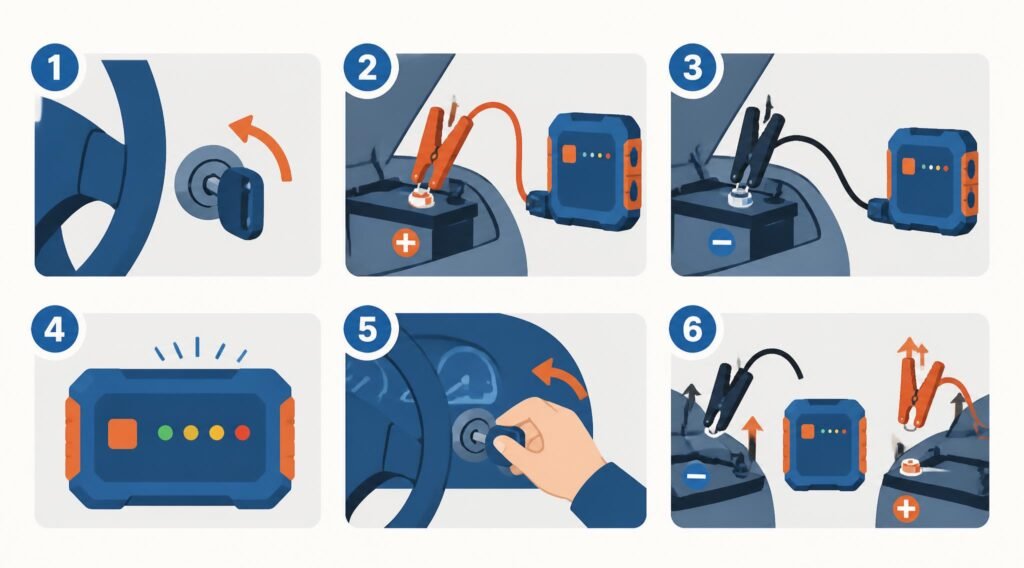
Always follow your jump starter manual and your vehicle owner’s manual. The general steps are:
- Turn everything off. Switch off the ignition, lights, radio and accessories in the dead vehicle.
- Check the battery. Do not jump a battery that is cracked, leaking or frozen.
- Connect the red clamp to the positive terminal, then the black clamp to the negative terminal or a recommended ground point.
- Confirm the indicator. Wait for the green or ready light on the unit before you try to start.
- Start the engine. If it does not start in a few seconds, wait before trying again so you do not overheat the unit.
- Disconnect in reverse order, black first, then red, once the engine is running.
- Let the car run for a while so the alternator can recharge the battery, and have the battery tested if it keeps dying.
If you drive a hybrid or electric vehicle, check the owner’s manual first. Many have specific jump-start points for the 12-volt battery. Our EV charger installation guide also covers garage setups for electric vehicles.
How to Store and Maintain Your Jump Starter
A jump starter only helps if it is charged when you need it. Build a habit around a few simple rules:
- Charge it fully after purchase, then top it up on a regular schedule. Follow the interval in your manual, since lithium units vary.
- Avoid heat. Do not leave it in a hot car all summer. Check the maximum storage temperature listed for your model.
- Keep it dry and protected. Store it in its case, away from loose metal tools that could touch the clamps.
- Check it before winter. Cold weather reduces battery power, so confirm it is charged before the first freeze.
- Inspect the clamps and cables for damage, and stop using the unit if it is swollen, cracked or leaking.
- Check recalls. Search your model on the CPSC recalls page once in a while.
If you store it in the garage, put it somewhere easy to reach. Our garage wall storage ideas show simple hooks and shelves that keep emergency gear in sight. A bright work light also makes any jump easier after dark, so see the garage lighting guide.
Common Mistakes When Buying and Using Jump Starters
- Buying by peak amps alone. Check the engine rating and the real-world specs.
- Choosing a unit that is too small. A compact pack will not start a large diesel.
- Forgetting to recharge it. A dead jump starter is useless in an emergency.
- Leaving it in extreme heat or cold. Temperature hurts both capacity and battery life.
- Skipping the manual. Hookup order and override rules differ between models.
- Ignoring the cause. If the battery keeps dying, the problem may be the battery, alternator or a parasitic drain, not just a one-time mistake.
Frequently Asked Questions About Jump Starters
What is the best portable jump starter for most people?
For most cars, crossovers and midsize SUVs, the NOCO Boost Plus GB40 is a strong all-around choice. It is compact, simple to use and rated for gas engines up to 6.0 liters.
How many amps do I need in a jump starter?
Engine size matters more than the peak amp number. A four-cylinder car is fine with a compact unit, a V8 needs a larger rated unit, and a diesel truck needs a unit explicitly rated for its engine size.
Can a jump starter start a completely dead battery?
Some can. Units like the NOCO GB40 and the Clore JNC325 have a manual override for batteries at 0 volts. Only use it after you confirm the clamps are attached correctly, and note that a battery that stays dead may need replacement.
How long does a jump starter hold its charge?
It depends on the model. NOCO says the GB40 holds its charge for up to a year, but you should still check it on a regular schedule and follow your manual.
Are jump starters safe to keep in a car?
Yes, if you follow the temperature limits. Avoid leaving a lithium unit in a very hot car for long periods, and keep it in its case.
Can I use a jump starter on a hybrid or electric car?
Many hybrids and EVs have a 12-volt battery that can be jumped, but the procedure and jump points vary. Check your owner’s manual first.
Is a jump starter better than jumper cables?
A jump starter does not need another vehicle, so it works anywhere, and its built-in protections reduce the risk of reversed connections. Jumper cables are cheaper but depend on another car and careful hookup.
Final Verdict: Which Jump Starter Should You Buy?
The best jump starter depends on your vehicle and how you use it:
- For most drivers, the NOCO Boost Plus GB40 is the easiest recommendation.
- For V8s and diesels up to 6.0 liters, the NOCO Boost HD GB70 adds the power you need.
- For big trucks and all-in-one power, the WOLFBOX MegaVolt24 offers the widest engine coverage.
- For a garage or shop, the Clore Jump-N-Carry JNC325 is built for repeated use.
- For a low price, the AstroAI S8 is a capable backup for small and midsize vehicles.
Whichever you choose, charge it, check the engine rating, and keep it somewhere you can reach. A few minutes of preparation is far cheaper than a tow.