Garages are one of the most fire-prone rooms in a home, yet they’re also one of the most overlooked when it comes to fire safety planning. Between stored fuel, power tools, old wiring, and stacks of cardboard, a garage often has every ingredient a fire needs — fuel, heat, and oxygen — sitting just a few feet apart. According to fire safety data compiled by the National Fire Protection Association, home structure fires that start in garages tend to cause more property damage on average than fires starting in most other rooms, largely because they often go unnoticed longer and spread into attached living spaces.
The good news is that the vast majority of garage fires are preventable. In this guide, we’ll cover the most common causes of garage fires, how to fireproof your storage and workspace, what safety equipment every garage should have, and what to do if a fire does start.
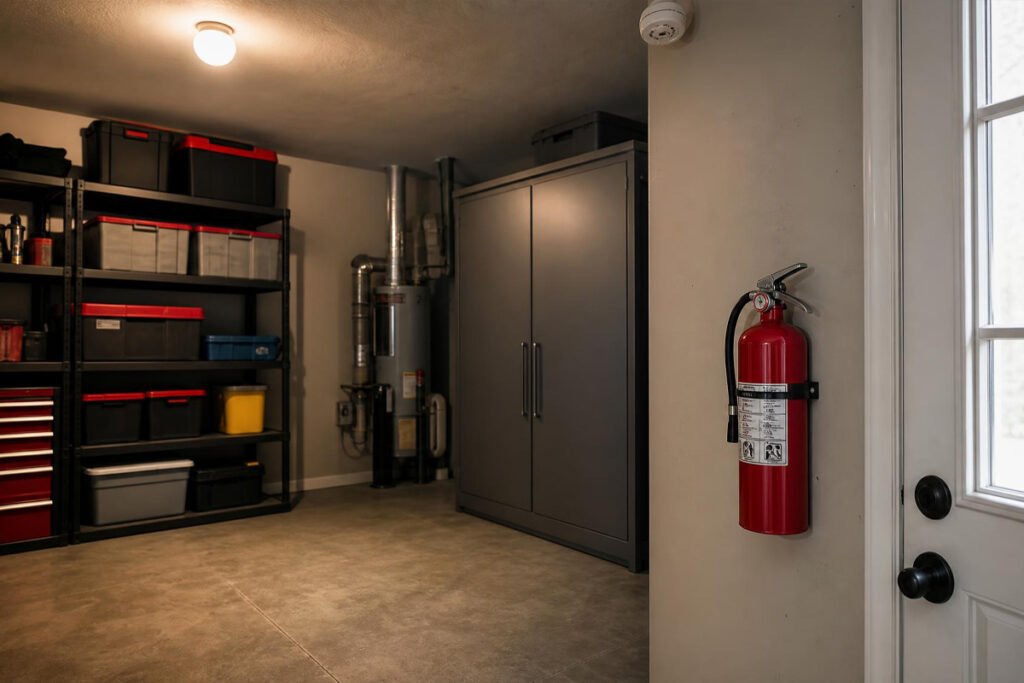
Why Garages Are a Fire Risk
Garages combine several fire hazards that rarely coexist elsewhere in a home:
- Flammable liquids like gasoline, paint thinner, and motor oil are commonly stored there.
- Electrical equipment — power tools, chargers, chest freezers, and garage door openers — runs on outlets that are often older or less protected than those inside the house.
- Combustible clutter such as cardboard boxes, paper, and fabric provides fuel that can help a small spark become a serious fire.
- Poor ventilation in many garages means smoke and heat build up quickly before anyone notices.
- Limited monitoring — garages are visited far less often than kitchens or living rooms, so a fire can grow significantly before it’s detected.
Understanding these risk factors is the first step toward addressing them directly.
Common Causes of Garage Fires
1. Improperly Stored Flammable Liquids
Gasoline, propane, paint, and solvents are the single biggest fire risk in most garages. These materials produce vapors that can ignite from something as small as a pilot light, a spark from a power tool, or even static electricity.
2. Faulty or Overloaded Electrical Wiring
Older garages often have outdated wiring that wasn’t designed for today’s power tools, freezers, and space heaters. Overloaded outlets and extension cords left plugged in long-term are a leading cause of electrical garage fires.
3. Space Heaters and Portable Heating Equipment
Space heaters are convenient in a cold garage workshop, but they’re also involved in a disproportionate number of home fires. Placing one too close to stored materials — or leaving one running unattended — is a common and preventable mistake.
4. Battery Chargers and Lithium-Ion Batteries
Charging power tool batteries, e-bikes, or scooters in the garage has become increasingly common — and increasingly risky. Damaged or low-quality lithium-ion batteries can overheat and ignite, especially if left charging unattended overnight.
5. Rodent and Pest Damage to Wiring
This is a hazard many homeowners never consider: rodents chewing through electrical wiring insulation can expose live wires, creating a fire risk that’s completely invisible until it’s too late. If you’ve noticed chew marks, nesting material, or droppings in your garage, it’s worth addressing the underlying pest problem before it compounds into an electrical hazard — see our guide on how to get rid of garage pests for safe removal methods.
6. Clutter Blocking Ventilation and Heat Sources
A cluttered garage doesn’t just look messy — it actively increases fire risk. Boxes stacked against a water heater, furnace, or electrical panel restrict airflow and create direct fuel sources right next to heat-generating equipment. A well-organized garage with clearly defined storage zones is one of the simplest ways to reduce this risk; our guide on how to organize a garage covers zoning strategies that keep flammable clutter away from ignition sources.
Fire-Safe Storage Practices
Store Flammable Liquids Correctly
- Keep gasoline, propane, and solvents in approved, tightly sealed metal containers.
- Store them away from any heat source — water heaters, furnaces, and electrical panels included.
- Never store more fuel than you need for immediate use; excess fuel should be kept in a detached shed if possible.
- Keep flammable liquids off the floor and on a stable, ventilated shelf.
Separate Fuel-Powered Equipment
Lawnmowers, generators, and other gas-powered equipment should be stored with empty or nearly empty tanks whenever feasible, and always away from open flames or heat sources like a furnace pilot light.
Use Fire-Resistant Storage Cabinets
For anything combustible — paint, solvents, oily rags — a certified fire-resistant storage cabinet dramatically reduces risk. Oily rags in particular can spontaneously combust if balled up and left in a pile, so store them flat, spread out, or in a metal container with a sealed lid.
Keep a Clear Perimeter Around Heat Sources
Maintain at least three feet of clearance around water heaters, furnaces, and any other heat-generating appliance. This is one of the easiest fixes and one of the most commonly ignored.
Electrical Safety in the Garage
- Don’t overload outlets or extension cords. If you’re regularly running multiple power tools, a freezer, and lighting off one circuit, it may be time to have an electrician add a dedicated circuit.
- Unplug chargers and tools when not in use, especially battery chargers left running overnight.
- Inspect wiring periodically, particularly if you’ve had any pest activity, since chewed insulation is a serious and often hidden hazard.
- Use GFCI outlets in garages, as required by most modern electrical codes, since they cut power quickly if a short circuit or ground fault is detected.
- Avoid daisy-chaining extension cords or power strips, which increases resistance and heat buildup along the circuit.
If your garage was built or wired more than 20 years ago and you’re doing a significant renovation — such as insulating your garage or converting your garage into a living space — it’s worth having an electrician evaluate the wiring as part of that project, since upgraded insulation and drywall can make future inspection and repairs more difficult.
Essential Fire Safety Equipment for Every Garage
| Equipment | Why It Matters |
|---|---|
| ABC-rated fire extinguisher | Handles ordinary combustibles, flammable liquids, and electrical fires |
| Smoke detector | Provides early warning; garage-rated detectors handle temperature swings and dust better than standard indoor models |
| Heat detector | Useful in garages where dust or exhaust can cause false alarms with standard smoke detectors |
| Fire-resistant storage cabinet | Contains flammable liquids and materials safely |
| Carbon monoxide detector | Essential if you ever run a vehicle, generator, or gas equipment inside, even briefly |
Mount your fire extinguisher near the exit, not buried behind storage, so it’s accessible even if a fire has already started to spread. Check the pressure gauge every few months and replace or recharge it according to the manufacturer’s guidelines.
Fireproofing Structural Elements
Fire-Rated Drywall
If your garage is attached to your home, building codes in most areas require fire-rated drywall on shared walls and ceilings. This slows the spread of fire from the garage into living areas, buying critical time for escape and emergency response.
Self-Closing Doors
The door connecting your garage to your house should be a self-closing, fire-rated door — never a standard interior door. This single detail can significantly limit how quickly smoke and fire spread into the home.
Sealed Gaps and Penetrations
Any gaps around pipes, wiring, or vents that pass through the garage wall into the house should be sealed with fire-rated caulk. These small openings are often overlooked but can allow fire and smoke to travel quickly between spaces.
Insulation Materials Matter
If you’re planning to insulate your garage, choose insulation with a good fire safety rating, and make sure it’s installed with the appropriate vapor and fire barriers. This is especially important if you’re also planning to soundproof your garage, since some soundproofing materials are more combustible than others — always check the fire rating before installing.
What to Do If a Garage Fire Starts
- Get everyone out immediately. Don’t attempt to fight a fire that is already spreading beyond its point of origin.
- Call 911 first, then attempt to extinguish only a small, contained fire if you have a working extinguisher and a clear escape route behind you.
- Never use water on a flammable liquid or electrical fire. Water can spread burning liquid or create a shock hazard around live wires.
- Close the door between the garage and the house if you’re evacuating, to slow the fire’s spread.
- Stay low if there’s smoke, since smoke inhalation is often more dangerous than the fire itself.
- Don’t re-enter the garage for belongings. No stored item is worth the risk.
A Seasonal Garage Fire Safety Checklist
- Test smoke and heat detectors and replace batteries
- Check fire extinguisher pressure gauge
- Inspect visible wiring for wear, especially after any pest activity
- Confirm flammable liquids are sealed and properly stored
- Clear at least three feet around any heat source
- Remove excess cardboard and paper clutter
- Check that the door between garage and house closes and latches fully
- Review your household’s fire escape plan, including the garage exit route
Pairing this checklist with your regular garage door maintenance routine — since a functioning, quickly operable garage door is itself an important emergency exit — helps keep the whole space genuinely safe, not just organized.
Fire Safety Considerations for Specific Garage Uses
Not every garage is used the same way, and your fire safety priorities should shift depending on what the space is actually doing for you day to day.
Garages Used as a Workshop
If your garage doubles as a woodworking or metalworking shop, sawdust, wood shavings, and metal filings add an extra layer of combustible material to manage. Sawdust in particular is highly flammable and can accumulate quickly around saws and sanders. Empty dust collection bags and sweep up shavings regularly rather than letting them pile up in corners. Keep welding or grinding work well away from any stored fuel or paint, since sparks can travel farther than expected.
Garages Converted Into Home Gyms
A garage gym often introduces new electrical equipment — treadmills, ellipticals, and sound systems — that draws significant power. Make sure any dedicated circuit added for gym equipment is properly rated, and avoid running multiple high-draw machines off a single extension cord. If you’ve insulated or soundproofed the space as part of the conversion, double-check that the materials used are fire-rated, since some acoustic foams and insulation products are more flammable than standard building materials.
Garages Converted Into Living Spaces
Once a garage becomes a bedroom, office, or studio, fire safety essentially needs to meet the same standard as the rest of your home. That means interconnected smoke detectors, a clear secondary escape route (not just the original garage door), and compliance with local building codes for fire-rated separation between the new living space and any remaining garage storage or utility areas. This is one of the most important — and most frequently overlooked — steps when converting a garage into a living space, and it’s worth having a licensed inspector confirm the work meets code before you treat the space as fully livable.
Garages With a Vehicle Charging Station
Electric vehicle charging has become increasingly common in home garages, and while EV charging equipment is generally safe when properly installed, it should always be installed by a licensed electrician on its own dedicated circuit. Avoid using extension cords or adapters not specifically rated for EV charging, and keep the charging area free of stored combustibles.
Garage Fires: Understanding the Real Risk
Fire safety organizations have long flagged attached garages as a specific concern because of how directly they connect to living spaces. Unlike a detached shed fire, a garage fire has a much shorter path to spreading into bedrooms, kitchens, and living rooms — often through shared walls, ductwork, or the connecting door. This is precisely why building codes treat the garage-to-house boundary as a critical fire barrier, requiring fire-rated drywall and self-closing doors rather than standard interior materials.
It’s also worth noting that many garage fires don’t originate from dramatic causes like exploding fuel canisters — they more often start small, from an overloaded outlet, a forgotten space heater, or a battery left charging, and grow because no one notices until the fire has already spread past the point where a small extinguisher can help. This is exactly why early detection (working smoke and heat detectors) and a decluttered, well-organized layout matter just as much as having the right extinguisher on the wall.
Insurance and Documentation Considerations
Beyond physical prevention, a little paperwork can make a real difference if the worst does happen:
- Photograph and inventory valuable items stored in your garage, including tools, equipment, and any vehicles, in case you ever need to file an insurance claim.
- Check your homeowner’s policy to confirm what’s covered in an attached versus detached garage, since coverage limits sometimes differ.
- Keep receipts for major garage investments — new wiring, insulation, storage systems, or a garage conversion — as these can support a claim and may even qualify for insurance discounts if they include fire-safety upgrades.
- Ask your insurer about smoke detector or fire-safety discounts, since some providers reduce premiums for homes with monitored smoke detection or fire-rated garage construction.
Building Codes and Local Requirements
Fire safety requirements for garages vary by location, but most jurisdictions in the U.S. following the International Residential Code require, at minimum:
- Fire-rated drywall (typically 1/2-inch on shared walls, 5/8-inch Type X on the ceiling if there’s living space above)
- A self-closing, fire-rated door between the garage and the home
- No direct duct openings connecting the garage’s HVAC to the rest of the house without a fire damper
- Proper venting for any gas-fired appliances located in the garage
Before undertaking any major renovation — especially one that involves insulating your garage or converting it into a living space — it’s worth checking with your local building department to confirm current code requirements, since these details are easy to overlook in a DIY project but are exactly what an inspector will check first.
Frequently Asked Questions
What type of fire extinguisher should I keep in my garage? An ABC-rated extinguisher is the best all-purpose choice, since it’s effective on ordinary combustibles, flammable liquids, and electrical fires — the three most common ignition sources in a garage.
Can I store gasoline in my garage? Yes, but only in small quantities, in an approved sealed container, and away from any heat source or open flame. Most safety guidelines recommend storing no more than a few gallons at a time.
Do garages need a separate smoke detector from the house? Yes. Garage-rated smoke or heat detectors are designed to handle dust, temperature swings, and occasional exhaust fumes without triggering constant false alarms, which makes them more reliable in this environment than standard indoor units.
Is it safe to charge an e-bike or power tool battery in the garage overnight? It’s safer to charge batteries while you’re home and able to monitor them, ideally on a non-combustible surface away from other stored materials, rather than leaving them charging unattended overnight.
How often should I inspect my garage for fire hazards? A seasonal inspection — at minimum four times a year — is a reasonable baseline, with additional checks after any pest activity, electrical work, or major storage reorganization.
Does homeowner’s insurance cover garage fires? In most cases, yes — a garage is typically covered under the same policy as the main structure, though coverage details, limits, and exclusions vary by insurer. It’s worth confirming your specific policy’s terms, especially if you’ve converted the garage into a living space or workshop with significant equipment inside.
What’s the difference between a smoke detector and a heat detector, and which do I need in my garage? Smoke detectors sense airborne smoke particles and react quickly to smoldering fires, but they’re prone to false alarms in dusty or exhaust-heavy environments like garages. Heat detectors instead respond to a rapid rise in temperature, making them a better fit for spaces where dust, fumes, or temperature swings would otherwise trigger nuisance alarms. Many fire safety professionals recommend installing both in a garage for the most reliable coverage.
Can I install a fire extinguisher myself, or do I need a professional? Installing a fire extinguisher is a simple DIY task — mount the bracket near an exit at an accessible height and keep the area clear. No professional installation is required, though it’s worth having the extinguisher itself inspected or serviced periodically according to the manufacturer’s recommendations, and replaced or recharged after any use.
Is a fire blanket a useful addition to garage fire safety equipment? Yes. A fire blanket is a simple, inexpensive tool that can smother small fires — particularly ones involving cooking equipment, small electrical fires, or a person whose clothing has caught fire — without the mess or pressure risk of a discharged extinguisher. It’s a worthwhile addition alongside, not instead of, a proper fire extinguisher.
Final Thoughts
Garage fires are almost always preventable with a bit of proactive attention: proper storage of flammable materials, sound electrical practices, the right fire safety equipment, and a home structure that’s built to contain fire if it does start. Because garages combine fuel, heat sources, and infrequent monitoring in one space, they deserve the same fire safety attention most homeowners already give their kitchen — if not more.
Take an afternoon to run through the checklist in this guide, address any hazards you find, and make fire safety a standing part of your regular garage maintenance routine.