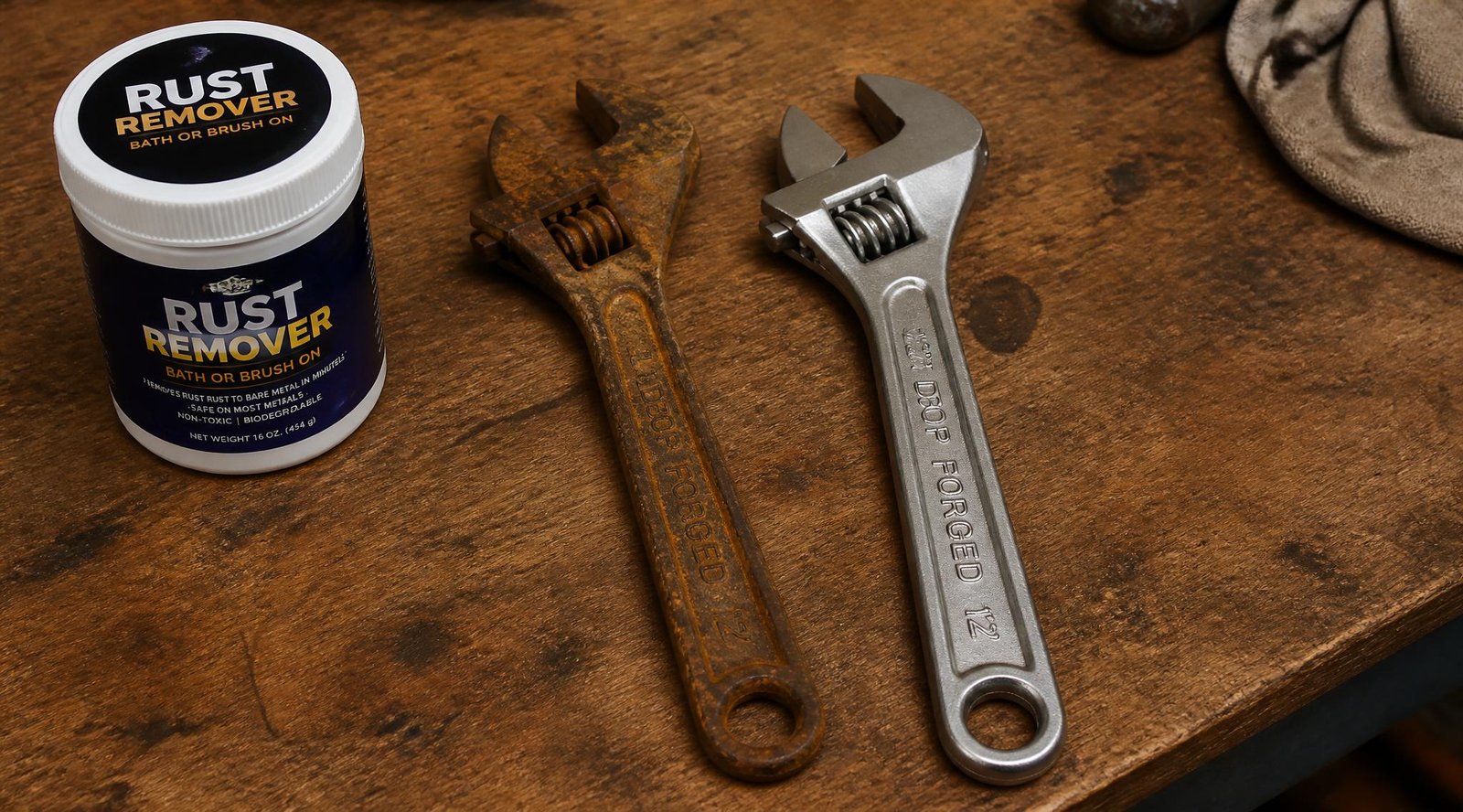
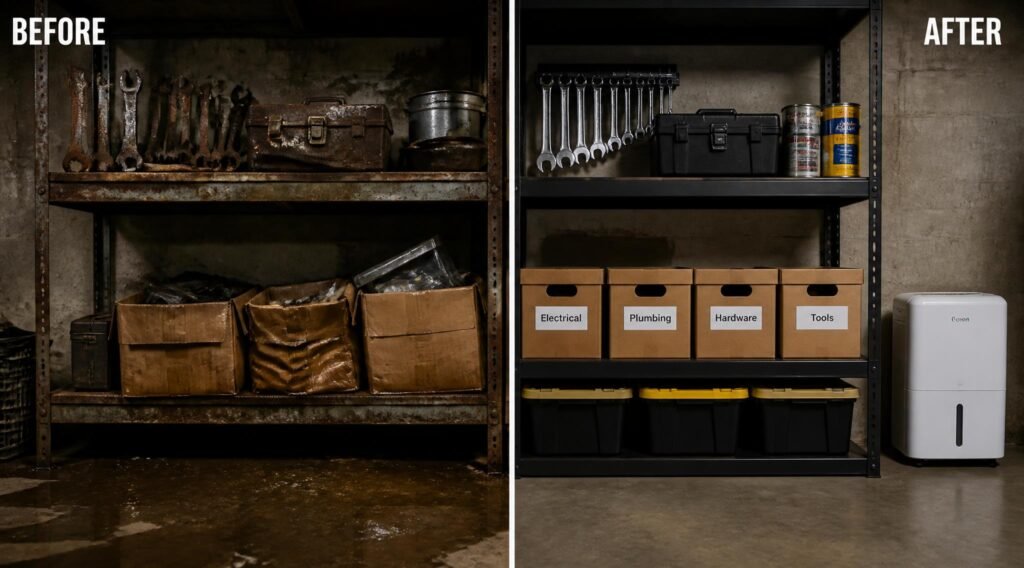
Rust creeping across a wrench that sat untouched all summer, a musty smell that never quite goes away, cardboard boxes going soft at the bottom — a damp garage causes slow, quiet damage most homeowners don’t connect to humidity until they see the results. Unlike a leak or a flood, excess moisture builds gradually, especially in an unheated, uninsulated garage where temperature swings create condensation on cold concrete and metal surfaces.
A dehumidifier addresses the actual cause rather than the symptoms — instead of repeatedly wiping down rust or scrubbing mildew, it pulls the moisture out of the air before it settles on tools, cardboard, or a parked car. It’s a natural complement to the airflow basics covered in our garage ventilation guide, since ventilation and dehumidification solve overlapping but distinct parts of the same moisture problem.
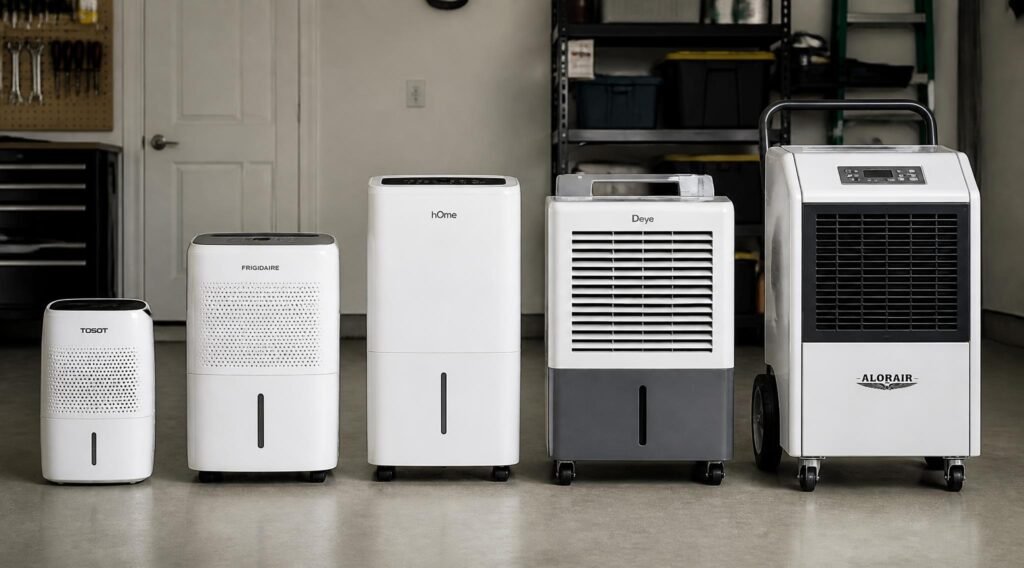
This guide compares five dehumidifiers that hold up to real garage conditions — larger, often uninsulated spaces with wider temperature swings than a typical basement — and breaks down which one fits which situation.
Quick Answer
The best dehumidifier for a garage depends on the size of the space and how damp it typically gets. For most one- or two-car garages with moderate humidity, the Frigidaire FFAD5033W1 (50-Pint) is the long-running reliability benchmark — a washable filter, precise humidity control, and a continuous-drain option that avoids constant bucket-emptying. For genuinely large or very damp garages, step up to a high-capacity unit like the hOmeLabs 4,500 Sq. Ft. Dehumidifier, which is built specifically for larger rooms and workshops. Anyone wanting smart features and a larger water tank should look at the Midea Cube 50-Pint, which adds Wi-Fi control and a lift-and-twist bucket that holds significantly more water than a standard tank. Budget-conscious buyers do well with a compact unit like the Vremi 22-Pint, sized for smaller garages or workshops. And for genuinely large commercial-style spaces or garages that double as a full workshop, the Waykar 120-Pint delivers serious capacity most residential units can’t match.
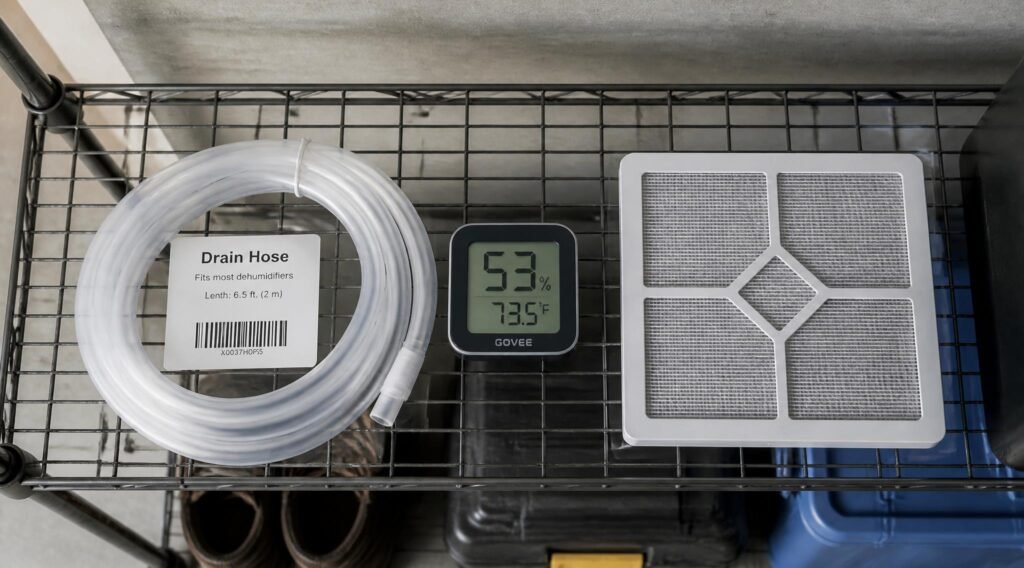
Table of Contents
- How Garage Dehumidifiers Work
- How to Choose the Right Dehumidifier
- Best Dehumidifiers Available
- Comparison Table
- Best Dehumidifiers for Different Garage Setups
- How to Set Up a Garage Dehumidifier Correctly
- Common Mistakes
- Expert Tips
- Final Thoughts
- Frequently Asked Questions
How Garage Dehumidifiers Work
Most consumer dehumidifiers use a compressor-based refrigeration cycle, pulling humid air across a cold coil that condenses moisture out of it, similar to how an air conditioner removes humidity as a side effect of cooling. The collected water either drips into a removable tank you empty manually, or drains continuously through a hose — a genuinely important distinction for a garage, since manually emptying a tank in an infrequently visited space is easy to forget.
Capacity is rated in pints of moisture removed per 24 hours at a standard test condition, and it needs to scale with both square footage and how damp the space actually runs. A garage is a meaningfully different environment than the basement most dehumidifiers are marketed for — often larger, less insulated, and subject to wider temperature swings, all of which mean garages frequently need a higher-capacity unit than a similarly sized finished room.
It’s also worth checking a unit’s low-temperature operating range specifically for garage use. Many standard dehumidifiers stop working efficiently, or at all, below roughly 65°F, which is a real limitation in an unheated garage through fall and spring. Models marketed for basement or garage use often include a low-temperature or “frost-free” mode built to keep working in cooler conditions. For general guidance on moisture control and mold prevention beyond the dehumidifier itself, the Environmental Protection Agency’s mold and moisture guidance is a useful, non-commercial reference.
How to Choose the Right Dehumidifier
Before comparing specific units, work through three questions:
How big is the garage, and how damp does it typically get? Match pint capacity to square footage first, then adjust upward if the space runs consistently damp, has poor ventilation, or deals with a lot of moisture from vehicles and outdoor storage.
Will you be around to empty a manual tank regularly? If not, prioritize a unit with a continuous-drain option or a built-in pump that can push water to a nearby drain, so the dehumidifier doesn’t shut off and sit idle for days waiting to be emptied.
How cold does the garage get in the off-season? An unheated garage in a cold climate needs a unit rated for lower-temperature operation, or it may struggle or shut down exactly when humidity control matters most, during damp spring and fall transitions.
Best Dehumidifiers Available
1. Frigidaire FFAD5033W1 (50-Pint) — Best Overall
Overview: The Frigidaire FFAD5033W1 has earned a reputation as a long-running reliability benchmark across independent testing, combining a washable filter, precise humidity control, and a continuous-drain option that removes the need to constantly check and empty a bucket. It’s a proven, no-surprises pick backed by years of consistent reviews.
Key Features:
- 50-pint moisture removal capacity per 24 hours
- Continuous-drain hose option alongside a removable tank
- Washable, reusable filter
- Precise digital humidity control with auto shut-off
Best For: Most one- or two-car garages with moderate to fairly high humidity.
Pros: ✅ Long track record of reliability across independent tests ✅ Continuous drain option genuinely reduces maintenance hassle ✅ Precise humidity control avoids running longer than necessary
Cons: ❌ No Wi-Fi or smart app control on standard versions ❌ Standard operating range may struggle in a very cold, unheated garage
Our Verdict: For most garages, this is the safe default — the combination of proven reliability and a genuine continuous-drain option matters more day to day than flashier features on competing models.
2. hOmeLabs 4,500 Sq. Ft. Dehumidifier — Best for Large or Very Damp Garages
Overview: hOmeLabs built a strong reputation on value, and its larger-capacity models scale that reputation up to genuinely large spaces — rated for up to 4,500 square feet, well beyond what a standard basement dehumidifier is designed to cover, with the tank capacity and drainage options to match sustained heavy moisture removal.
Key Features:
- Rated coverage up to 4,500 square feet
- Large water tank with continuous drainage hose option
- Simple, straightforward digital controls
- Strong review history and value relative to capacity
Best For: Larger garages, workshops, or spaces that run consistently damp and need sustained high-capacity moisture removal.
Pros: ✅ Genuinely sized for large spaces, not a stretched basement unit ✅ Strong value for the capacity delivered ✅ Extensive positive review history for reliability
Cons: ❌ Physically larger and heavier than compact models ❌ Compressor noise is noticeable at higher settings, per independent testing
Our Verdict: For a genuinely large or persistently damp garage, this covers ground smaller units simply can’t — the size and capacity are worth the extra footprint if your space actually needs it.
3. Midea Cube 50-Pint — Best Smart Features
Overview: Independent testers have repeatedly rated the Midea Cube among the very best dehumidifiers available, citing fast moisture removal and a distinctive lift-and-twist bucket design that holds roughly three times the water of a traditional tank before needing to be emptied. Wi-Fi and Alexa integration let you monitor and adjust it remotely — useful for a garage you don’t walk through daily.
Key Features:
- 50-pint capacity, rated coverage up to 4,500 sq. ft.
- Lift-and-twist bucket holds significantly more water than standard tanks
- Wi-Fi and Alexa smart home integration
- Fast moisture removal in independent testing
Best For: Anyone who wants to monitor and control garage humidity remotely, or who wants to minimize how often the tank needs emptying.
Pros: ✅ Top-rated performance in independent testing ✅ Oversized bucket design meaningfully reduces emptying frequency ✅ Smart app control is genuinely useful for a space you don’t check daily
Cons: ❌ Priced higher than comparable non-smart units ❌ Smart features require reliable Wi-Fi coverage reaching the garage
Our Verdict: If remote monitoring and reduced maintenance frequency matter to you, the smart features and oversized bucket genuinely earn the premium over a standard unit.
4. Vremi 22-Pint — Best Compact / Budget Pick
Overview: For a smaller garage or workshop that doesn’t need a full 50-pint unit, the Vremi 22-pint model delivers meaningful moisture control in a smaller, more affordable package — rated for spaces up to roughly 1,500 square feet, which covers most single-car garages and smaller workshop areas.
Key Features:
- 22-pint capacity, rated for spaces up to ~1,500 sq. ft.
- Compact size, easier to store or relocate
- Simple, straightforward controls
- Lower price point than full-size 50-pint units
Best For: Smaller garages, single-car spaces, or anyone who wants a lower-cost entry point into dehumidification.
Pros: ✅ Genuinely affordable compared to larger units ✅ Compact footprint suits smaller spaces well ✅ Simple to operate without extensive settings
Cons: ❌ Undersized for larger garages or genuinely damp conditions ❌ Smaller tank means more frequent emptying without a drain hose setup
Our Verdict: For a smaller garage with moderate humidity, this is a sensible, low-cost way to get real moisture control without overbuying capacity you don’t need.
5. Waykar 120-Pint — Best for Commercial-Scale Spaces
Overview: When a garage functions more like a genuine workshop or commercial-adjacent space — rated for up to 6,000 square feet — the Waykar 120-pint model delivers capacity most residential dehumidifiers simply don’t offer, suited to large detached garages, barns, or multi-bay workshops with serious, sustained moisture problems.
Key Features:
- 120-pint capacity, rated coverage up to 6,000 sq. ft.
- Intelligent touch control with multiple drainage options
- Built for sustained heavy-duty moisture removal
- Portable design despite the large capacity
Best For: Large detached garages, barns, multi-bay workshops, or any space well beyond a standard one- or two-car garage’s square footage.
Pros: ✅ Capacity genuinely suited to large or commercial-adjacent spaces ✅ Multiple drainage options for hands-off, continuous operation ✅ Still portable despite the high capacity
Cons: ❌ Significant overkill, and a poor value, for a standard-sized garage ❌ Higher price and physical footprint than residential-focused units
Our Verdict: This is the right category of unit once your space is genuinely larger than a standard garage — for anything smaller, it’s more capacity (and cost) than most homeowners need.
Comparison Table
| Product | Best For | Capacity | Coverage | Approx. Price |
|---|---|---|---|---|
| Frigidaire FFAD5033W1 | Best Overall | 50 pints | ~4,500 sq. ft. | $230–$280 |
| hOmeLabs 4,500 Sq. Ft. | Best Large/Damp Garages | 50 pints | ~4,500 sq. ft. | $200–$250 |
| Midea Cube 50-Pint | Best Smart Features | 50 pints | ~4,500 sq. ft. | $270–$320 |
| Vremi 22-Pint | Best Compact/Budget | 22 pints | ~1,500 sq. ft. | $170–$210 |
| Waykar 120-Pint | Best Commercial-Scale | 120 pints | ~6,000 sq. ft. | $400–$500 |
Prices are approximate and vary by retailer. Coverage ratings assume standard testing conditions — very damp spaces may need higher capacity than the square footage alone suggests.
Best Dehumidifiers for Different Garage Setups
Standard One- or Two-Car Garage
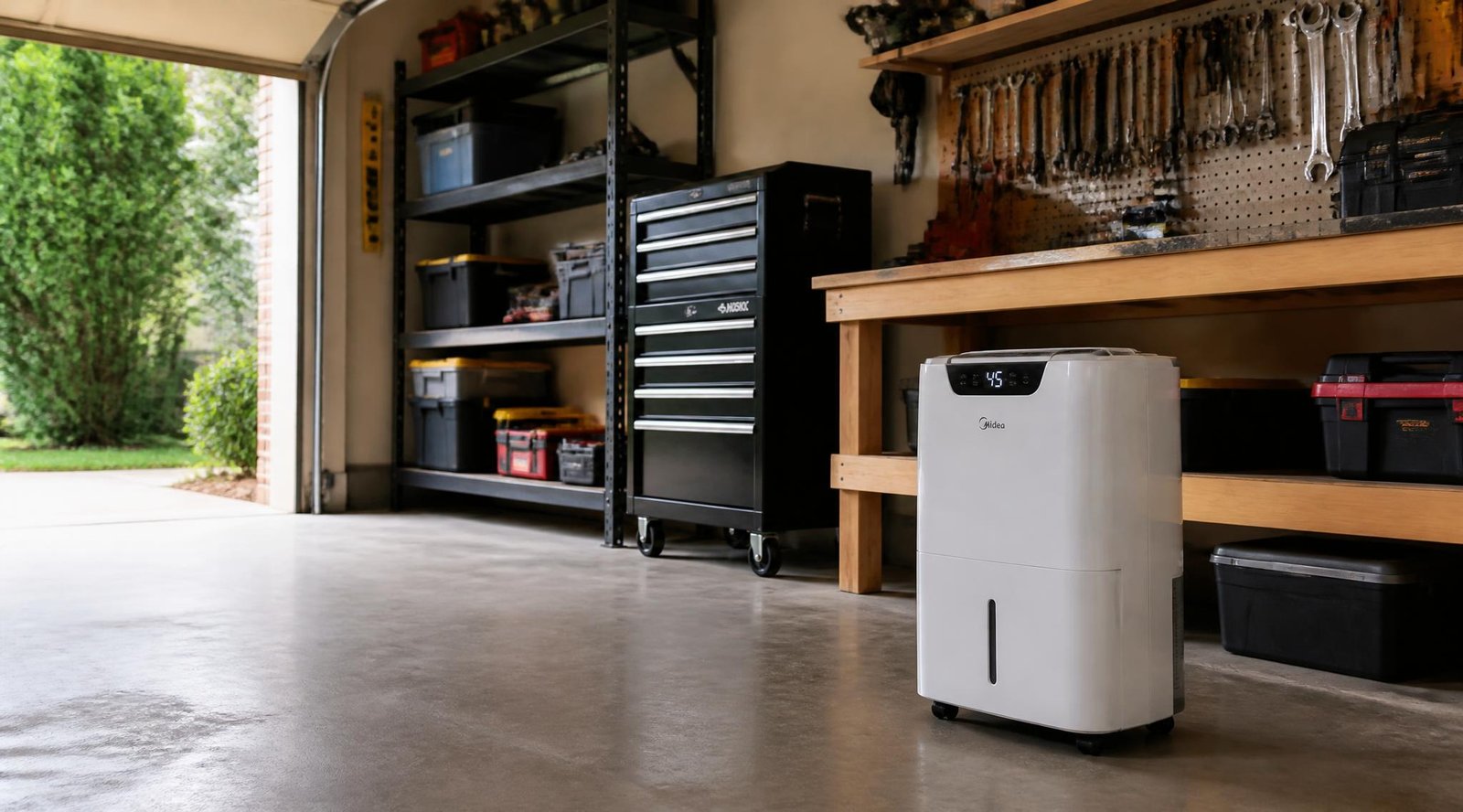
The Frigidaire FFAD5033W1 covers this use case well for most homeowners, with the continuous-drain option removing much of the ongoing maintenance hassle. Pair it with the broader garage ventilation guide for complete moisture control.
Large Workshop or Detached Garage
For genuinely large or persistently damp spaces, the hOmeLabs 4,500 sq. ft. model or, for truly large spaces, the Waykar 120-pint unit handle sustained moisture removal that smaller units can’t keep up with. This is worth reviewing alongside your full garage workshop setup.
Garage Prone to Mold or Storing Sensitive Items
If you’re storing documents, electronics, or anything moisture-sensitive, pair a dehumidifier with the mold prevention basics in our garage mold removal guide and consider a fireproof safe with independent water protection for anything genuinely irreplaceable.
How to Set Up a Garage Dehumidifier Correctly
Step 1: Choose a Central, Unobstructed Location
Place the unit away from walls and stacked storage so air can circulate freely around it — a dehumidifier crammed into a corner behind boxes works significantly less efficiently.
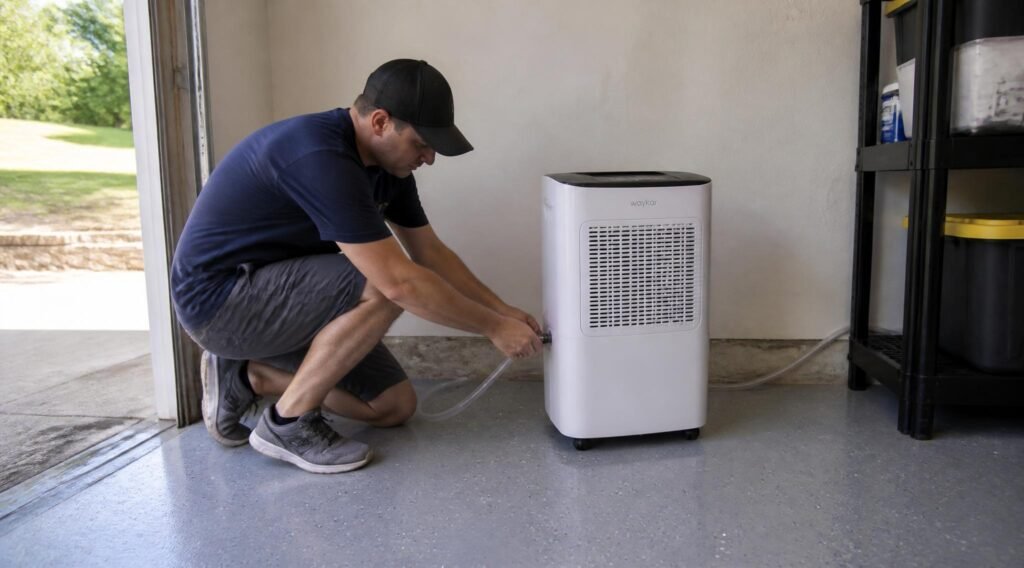
Step 2: Set Up Continuous Drainage If Possible
If a floor drain or suitable disposal point is nearby, connect a drain hose (or use the built-in pump on models that include one) rather than relying on manual tank emptying, especially for a space you don’t check daily.
Step 3: Close Up the Space as Much as Practical
A dehumidifier works far more efficiently in a space that isn’t constantly exchanging air with the outdoors — keep the garage door closed when possible and check for obvious gaps or drafts.
Step 4: Set a Target Humidity Level
Most units let you set a target relative humidity, typically in the 45–55% range for general moisture and mold prevention. Setting a target rather than running constantly on high also reduces wear and energy use.
Step 5: Check and Clean the Filter Regularly
A clogged filter reduces airflow and efficiency over time. Check and clean it on the schedule recommended in the manual, more often in a dusty garage environment than a typical basement.
Common Mistakes
Undersizing the unit for the actual space and dampness level. A dehumidifier rated for a small bedroom won’t keep up with a damp, uninsulated garage of similar square footage. When in doubt, size up rather than buying the bare minimum.
Running the unit in temperatures it’s not rated for. Standard compressor dehumidifiers can struggle or stop working efficiently below roughly 65°F. Check a model’s low-temperature rating specifically if your garage goes unheated through colder months.
Forgetting to empty a manual tank in an infrequently visited garage. Many units auto-shut-off once the tank is full, meaning days of lost dehumidification if no one checks it. A continuous-drain setup avoids this entirely and is worth prioritizing for garage use specifically.
Expert Tips
Use a separate hygrometer to verify actual humidity, not just the unit’s built-in reading. A simple, inexpensive hygrometer placed elsewhere in the garage gives an independent check that the dehumidifier is actually reaching your target level throughout the space, not just near the unit itself.
Combine dehumidification with basic ventilation, not as a replacement for it. A dehumidifier removes existing moisture from the air; it doesn’t address the source if there’s an active leak or poor airflow. Review both together as part of a complete garage ventilation setup.
Clean or replace the filter more often in a garage than you would in a basement. Dust and debris from tools, sawdust, and general garage activity clog filters faster than in a typical finished room — check it more frequently than the manual’s default recommendation if your garage is dusty.
Final Thoughts
Best Overall: The Frigidaire FFAD5033W1 remains the reliability benchmark — proven performance, a genuine continuous-drain option, and precise control for most garages.
Best for Large Spaces: The hOmeLabs 4,500 Sq. Ft. model and, for truly large spaces, the Waykar 120-pint unit scale up to cover what smaller dehumidifiers can’t.
Best Budget: The Vremi 22-Pint proves a smaller, more affordable unit is a genuinely sensible choice for a smaller garage with moderate humidity.
Whichever unit you choose, pair it with good ventilation habits and regular filter maintenance, and it’ll quietly prevent the slow rust, mildew, and musty-smell damage most garages accumulate without anyone noticing. For the rest of your moisture-control setup, see our full garage ventilation guide.
Frequently Asked Questions
Do I really need a dehumidifier in my garage? If you notice rust on tools, a musty smell, condensation on cold surfaces, or store cardboard and paper items, a dehumidifier is genuinely worth it — garage humidity damage tends to be gradual and easy to overlook until it’s already done meaningful damage.
What size dehumidifier do I need for a garage? Match pint capacity to square footage as a starting point — roughly 22 pints for smaller garages up to 1,500 sq. ft., 50 pints for standard one- or two-car garages, and higher for larger or consistently damp spaces. Size up if the space runs particularly humid.
Can a dehumidifier work in an unheated garage during winter? Standard compressor units often struggle or shut down below roughly 65°F. Check for a model with a specific low-temperature or frost-free mode if your garage regularly gets cold, particularly during damp spring and fall transitions.
How do I avoid constantly emptying the water tank? Set up continuous drainage using a hose connected to a nearby floor drain, or choose a model with a built-in pump that can push water further than gravity alone allows — both remove the need for manual tank emptying entirely.
What humidity level should I target in a garage? Most guidance for general moisture and mold prevention points to roughly 45–55% relative humidity. Most dehumidifiers let you set this as a target rather than running continuously on the highest setting.
Will a dehumidifier stop rust from forming on my tools? It significantly reduces the moisture that causes rust, though it’s not a complete guarantee — combining it with basic tool care, like wiping down metal surfaces occasionally, gives the best protection.
Is a smart, Wi-Fi-enabled dehumidifier worth the extra cost? It depends on how often you actually check the garage — if it’s a space you rarely walk through, remote monitoring and alerts genuinely add value. For a garage you’re in daily, a standard non-smart unit performs the same core function for less money.
How often should I clean the dehumidifier’s filter? Check the manufacturer’s schedule as a baseline, but garages tend to be dustier than basements, so plan to check and clean the filter more frequently than the default recommendation, especially if you do woodworking or other dust-generating projects.
Can I run a dehumidifier and a space heater in the garage at the same time? Yes, generally, though it’s worth checking your garage’s electrical capacity — running multiple higher-draw appliances on the same circuit can trip a breaker. Confirm your outlet and circuit capacity before running both continuously.
Does a dehumidifier replace the need for good garage ventilation? No — the two solve related but different problems. Ventilation addresses airflow and can prevent moisture from building up in the first place, while a dehumidifier actively removes moisture that’s already in the air. Most garages benefit from both together.
Author: Danial Marquez Last Updated: September 2026