Every winter, and every time the power goes out, the same story plays out in emergency rooms across the country: someone parks a car in an attached garage and lets it run “just for a minute,” or fires up a portable generator too close to the house and doesn’t realize anything is wrong until it’s too late. Accidental carbon monoxide poisoning killed more Americans in 2022 than in any year since at least 1999, and portable generators alone are tied to roughly 40% of consumer-product-related CO deaths.
The garage sits at the center of this risk. It’s where cars idle, where generators get stored and sometimes run, where gas-powered tools live, and for an attached garage, it’s separated from your bedrooms by a single door and a few inches of drywall. This guide covers where carbon monoxide actually comes from in a garage, whether you need a detector inside the garage itself, exactly where to place one, how to choose the right type, and what to do if an alarm goes off.
None of this requires a big renovation or a big budget — most of it comes down to a handful of $20–$40 detectors placed in the right spots and a few habit changes around vehicles and equipment. What it does require is understanding that the garage isn’t a separate structure as far as air is concerned; it’s functionally one more room in the house, and it deserves the same level of attention as a kitchen or a furnace closet when it comes to combustion byproducts.
Why Your Garage Is a Carbon Monoxide Hot Spot
Carbon monoxide (CO) is a colorless, odorless gas produced whenever fuel burns incompletely, which makes a garage one of the most CO-dense rooms in a typical home. A few common sources show up in almost every garage at some point:
Detached garages carry lower risk to the house itself, but not zero risk to the people inside the garage. A detached workshop or hobby space with the same idling car or running generator can still reach dangerous CO concentrations for anyone working in it, even though the house next door stays clear. The prevention habits in this guide apply whether or not the garage shares a wall with your living space — the difference is mainly in who’s exposed, not whether exposure can happen.
How CO Detectors Actually Work
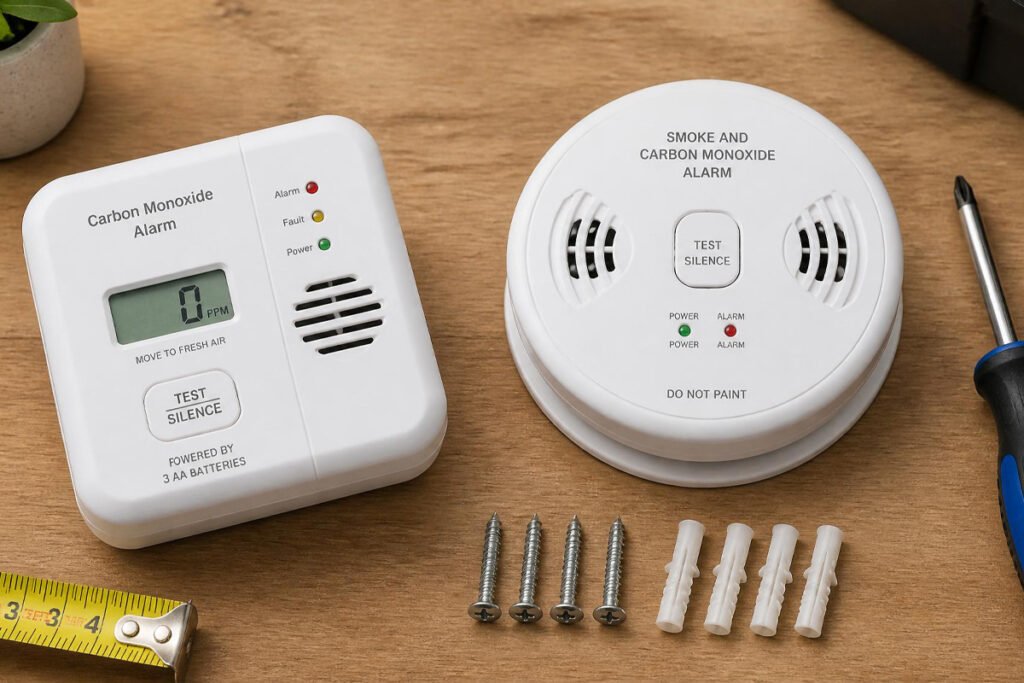
Understanding the sensor inside a CO detector explains why placement and detector type matter so much for a garage-adjacent setup. Most residential units use one of three sensor technologies:
Whichever sensor type you choose, the detector is only useful if it’s rated for the environment you install it in. A unit rated for 40°F to 100°F will not perform reliably in an unheated garage that swings from freezing in January to well over 100°F in a closed summer garage — another reason most detectors belong just inside the house rather than out in the garage itself.
How Carbon Monoxide Poisoning Actually Happens
CO is dangerous precisely because it gives no warning. It has no smell, no color, and no taste, and it binds to red blood cells far more readily than oxygen does, which starves the body of oxygen from the inside out. Early symptoms are easy to mistake for the flu or simple fatigue: headache, nausea, dizziness, weakness, and shortness of breath. At higher concentrations, confusion, loss of consciousness, and death can follow quickly, sometimes before a person realizes anything is wrong.
Do You Actually Need a CO Detector Inside the Garage?
This is where a lot of well-meaning homeowners get it backwards. The instinct is to mount a carbon monoxide detector directly in the garage, since that’s where the CO originates. In practice, most fire-safety professionals and detector manufacturers recommend against permanently mounting a standard CO detector inside the garage itself, for a few practical reasons:
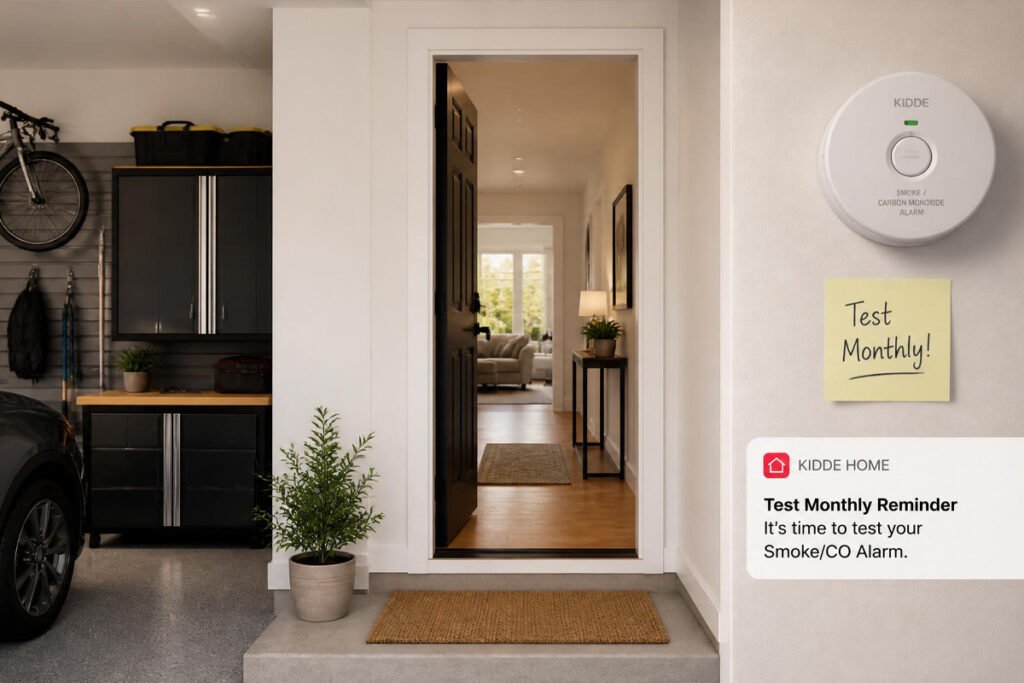
The safer, more reliable setup for most homes is to place CO detectors just inside the house, at the points where carbon monoxide would actually enter your living space — not out in the garage where conditions are harshest. The exception is a garage that houses a fuel-burning appliance like a furnace or water heater, or a garage-rated detector specifically designed for wider temperature ranges; in either case, follow the manufacturer’s specific installation guidance.
Where to Place CO Detectors for Garage Safety
Once you’ve decided against a permanent unit inside the garage itself, placement around it matters more than people expect:
Choosing the Right Detector for a Garage-Adjacent Setup
Not every CO detector is built the same way, and the right choice depends on how your garage and home are laid out.
| Detector Type | Best For | Typical Cost |
| Battery-powered standalone | Renters, quick DIY installs, homes without a nearby outlet | $20–$40 |
| Plug-in with battery backup | Hallways or rooms near an outlet; keeps working through power outages | $25–$45 |
| Combo smoke + CO | Consolidating two devices into one, especially in rooms above the garage | $40–$80 |
| Hardwired, interconnected | Whole-home coverage where one alarm triggers all units | $50–$100 + install |
| Smart / app-connected | Homes where you want mobile alerts when no one’s there | $80–$150 |
Look for a unit carrying a recognized testing-lab label, and if you’re combining CO and smoke detection near a garage entry point, confirm the smoke sensor type tolerates occasional dust and exhaust drift without constant false alarms.
A few extra features are worth the small price premium for a garage-adjacent detector specifically. A digital display showing the current CO reading in parts per million lets you see a slow creep upward before it hits alarm thresholds, rather than getting no information until the alarm sounds. A peak-level memory function records the highest reading since the last reset, which is useful if you come home to a false-seeming alarm and want to know whether it was a real spike or a momentary blip. And end-of-life warnings — a distinct chirp pattern separate from the low-battery chirp — tell you when the sensor itself has aged out, which matters because a CO sensor can stop reliably detecting gas well before the unit stops powering on.
Step-by-Step: Installing and Testing Your Garage-Adjacent CO Detector
Reducing CO Risk Beyond Detectors
A detector is your last line of defense, not your first. These habits and upgrades cut down how much CO ever builds up in the first place.
Never idle a vehicle in the garage
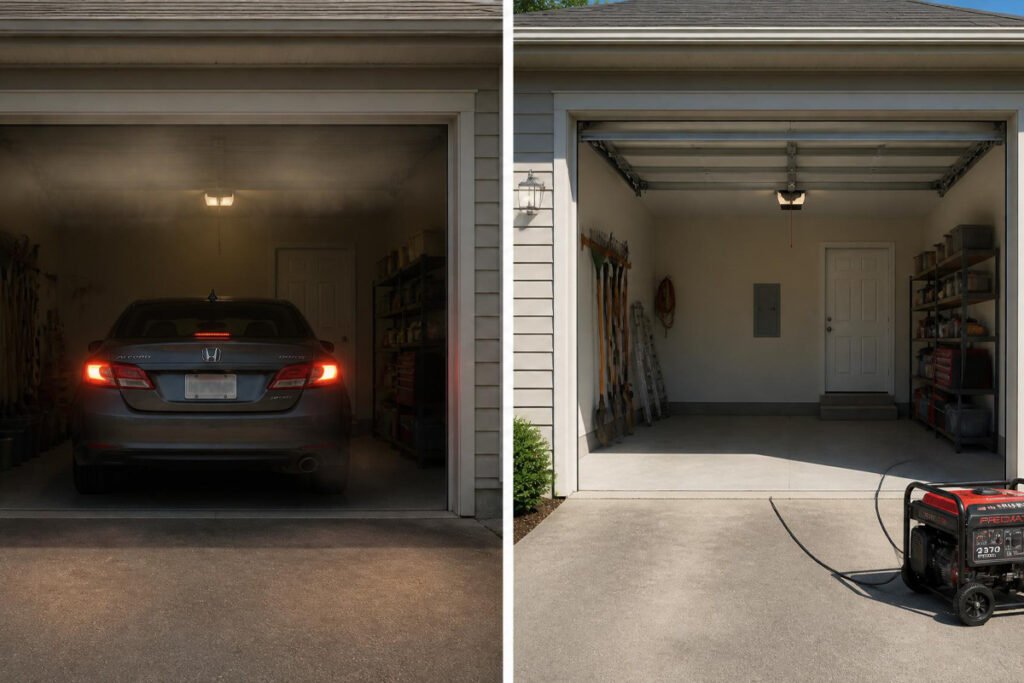
Keep generators outside, every time
Portable generators should run outdoors, well away from windows, doors, and vents — never in the garage, even with the door up, and never in a carport or under an overhang. As a rule of thumb, fire-safety guidance generally calls for at least 20 feet of clearance from the home in every direction, since research has shown that even 15 feet isn’t always enough to keep exhaust from drifting back indoors. Point the exhaust away from the house, and if you own a newer model, look for one with a built-in CO shutoff sensor that automatically stops the engine if levels rise dangerously nearby — a meaningful backup layer during storm season when generators see the heaviest use. Store the generator itself in a dry, ventilated spot such as overhead racks or heavy-duty shelving rather than a closed cabinet, so fuel residue and fumes have somewhere to go between uses.
Watch for seasonal spikes in risk
CO incidents cluster heavily in the colder months and immediately after severe weather, when generators come out of storage, engines idle longer to warm up, and garage doors stay shut to keep heat in. If a storm knocks out power, resist the urge to run a generator in a garage or breezeway “just until the rain stops” — that’s exactly the scenario behind a large share of accidental CO deaths every year. Building a quick pre-storm checklist — detector batteries fresh, generator placement planned, garage door hardware working — before severe weather season starts is far easier than improvising during an outage.
Store and run gas-powered tools with airflow in mind
Improve overall garage ventilation
Rethink CO risk if you’re converting the garage into occupied space
Signs You May Already Have a Low-Level CO Problem
Detectors are the reliable way to catch CO, but it helps to recognize the pattern of low-level, chronic exposure too, since it’s often mistaken for something else entirely. A few signs worth paying attention to:
None of these signs confirm CO exposure on their own, but if more than one shows up at the same time, it’s worth leaving the house, getting fresh air, and having a professional check for a CO source before assuming it’s a coincidence.
Common Myths About CO in the Garage
Myth: Leaving the garage door open makes it safe to idle a car
An open door speeds up air exchange but doesn’t prevent CO from accumulating while an engine runs, especially in an attached garage where fumes can still drift toward the connecting door faster than open airflow clears them. The only fully safe option is not idling vehicles in the garage at all.
Myth: Newer cars don’t produce enough CO to worry about
Modern emissions systems have dramatically cut tailpipe CO output compared to older vehicles, but “dramatically less” isn’t “zero.” A malfunctioning exhaust system, a catalytic converter problem, or simply enough time idling in an enclosed space can still build dangerous concentrations, and it only takes one mechanical issue to change the math.
Myth: Electric vehicles remove all CO risk from the garage
Myth: A working smoke detector in the garage covers CO too
Smoke and CO are detected by entirely different sensors, and a standard smoke detector will not alert you to a CO buildup. If you want combined coverage, you need a unit specifically listed as a combination smoke and CO alarm — and per the placement guidance above, it generally belongs just inside the house rather than mounted out in the garage.
Multi-Car Households and High-Use Garages
Garages with two or more vehicles, or households where cars get started and moved frequently — delivery drivers, contractors, anyone running a home business out of the garage — face compounding CO risk simply from volume of exposure. If your garage sees this kind of daily traffic, a few adjustments are worth the extra effort:
What to Do If Your CO Alarm Sounds
Treat every CO alarm as real until proven otherwise. Nuisance alarms happen, but the symptoms of low-level CO exposure (headache, fatigue, nausea) are easy to write off as something else — which is exactly how people get hurt.
Cost & Time Breakdown
Protecting a garage-attached home against CO doesn’t require a big budget. For a typical three-bedroom house needing coverage at the garage entry, the room above the garage, and one additional floor:
Battery and plug-in units are genuinely a same-afternoon DIY project — no tools beyond a screwdriver and stud anchors in most cases. Hardwired, interconnected systems are worth calling an electrician for, especially if you’re tying new units into existing household wiring, since a mistake there risks the whole interconnected system failing silently. If you’re already having an electrician out for something else — adding an EV charger circuit, for example — it’s worth asking them to quote CO detector wiring at the same time to save a separate service call.
Check Your Local Requirements
Many states and municipalities require CO detectors in homes with an attached garage or a fuel-burning appliance, and requirements vary by jurisdiction and by whether you’re building new or retrofitting an existing home. Your local fire marshal’s office or building department can confirm what applies to your specific address before you finalize placement.
Frequently Asked Questions
Can I put a carbon monoxide detector directly in my garage?
You can, but most manufacturers and fire-safety authorities recommend against it for everyday use. Temperature swings, dust, and exhaust exposure shorten sensor life and cause false alarms. Placing detectors just inside the house — near the entry door and in the room above the garage — is the more reliable approach for most homes.
How many CO detectors does a garage-attached home need at minimum?
At least one on every level of the home, plus one near the door connecting the garage to the house and one in any room directly above the garage. A typical three-bedroom house often ends up with three to four units total.
Will leaving the garage door open prevent CO buildup from a running car?
Not reliably. An open door speeds up clearing but doesn’t prevent CO from building up while the engine runs, especially in an attached garage. The safest habit is simply not idling vehicles in the garage at all.
How is a heat detector different from a CO detector in a garage?
A heat detector responds to a rapid temperature rise from fire and is a better fit for the garage itself than a standard smoke detector, which false-alarms easily from dust and exhaust. A CO detector responds to gas concentration, not heat or smoke, and serves a completely different purpose — most garages benefit from having both addressed, just via different devices in different locations.
How often should I test and replace my garage-area CO detector?
Test monthly using the built-in test button, replace batteries on the schedule printed on the unit (commonly once a year for backup batteries), and replace the entire detector every 5–7 years regardless of how it appears to be functioning.
Is it safe to run a generator in the garage with the door open during a storm?
No. This is one of the most common causes of accidental CO poisoning during power outages. Run generators outdoors, well clear of doors, windows, and vents, regardless of weather — a tarp or temporary canopy to keep rain off is safer than moving the unit indoors or into the garage.
Does an electric vehicle in the garage change any of this advice?
An EV itself doesn’t produce CO while parked or charging, which removes one source of risk. But if the garage still stores a gas vehicle, generator, or gas-powered tools, all of the placement and prevention advice above still applies to those items.
Can carbon monoxide from the garage set off alarms in rooms far from it?
Yes, given enough time and concentration. CO doesn’t stay confined to the room it originated in — it spreads through a house via air currents, HVAC ductwork, and gaps around doors and framing, which is exactly why whole-home coverage on every level matters more than a single detector positioned only near the garage.
How to Convert Your Garage into a Living Space: Complete Step-by-Step Guide (2026)
The Bottom Line
Carbon monoxide risk in the garage isn’t about one dramatic scenario — it’s about a handful of everyday habits (idling a car, running a generator, storing gas equipment) intersecting with a space that’s more connected to your living area than most people realize. A few properly placed detectors, a maintained garage door that opens and seals the way it should, decent ventilation, and the habit of never running fuel-powered equipment in an enclosed garage cover the vast majority of the risk. None of it is expensive or complicated — it just has to actually get done, ideally before the next storm or cold snap makes it urgent.
Last Updated: July 2026