
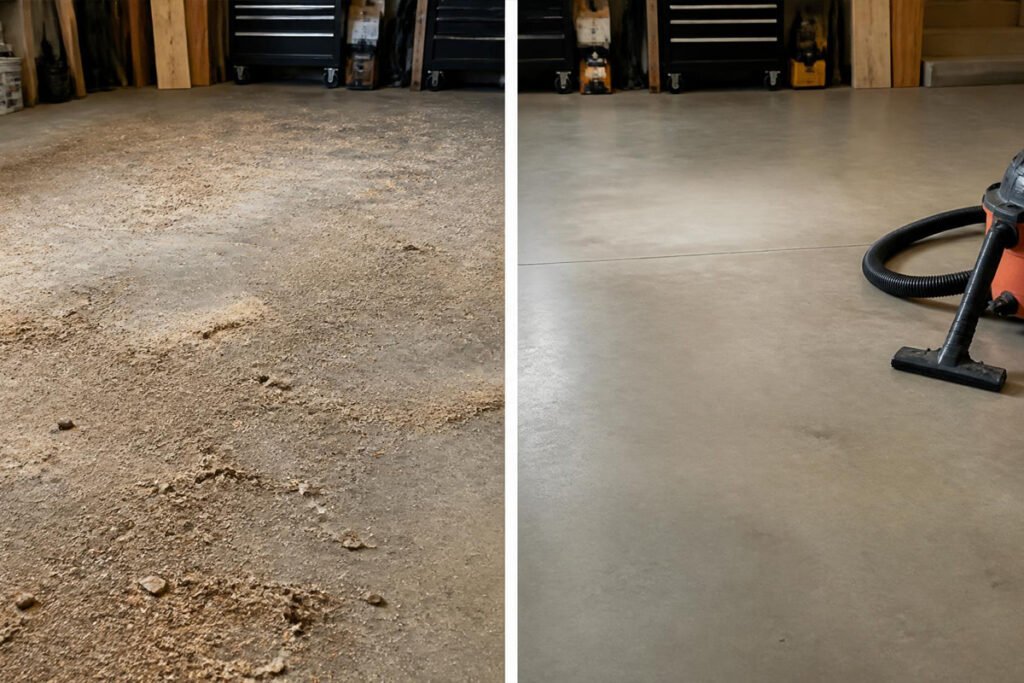
Sawdust under the miter saw, a puddle by the water heater, gravel tracked in from the driveway, drywall dust after a wall patch — a regular household vacuum gives up on all of it within a few minutes. A shop vacuum is the tool that actually keeps up with a working garage, handling wet and dry messes a standard vacuum was never built for.
The problem is that “shop vac” covers everything from a $40 five-gallon canister to a $300 wall-mounted system with a 30-foot hose, and the wrong choice means either constant emptying or a bulky tank you can barely maneuver around a parked car. Before buying anything, it’s worth pairing this with your broader garage cleaning tools and supplies setup so the vacuum actually fits how you already clean.
This guide compares five shop vacuums that hold up to real garage use — sawdust, standing water, gravel, and everything in between — and breaks down which one fits which situation.
Quick Answer
The best shop vacuum for a garage depends on the size of the space and the kind of mess you deal with most. For most one- or two-car garages, a 12-gallon RIDGID NXT hits the sweet spot of capacity and maneuverability without being awkward to store. If dust collection during power tool work matters more than sheer capacity, the Craftsman 16-Gallon Heavy-Duty with its wide 2.5-inch hose handles large debris and fine dust better than most competitors. Anyone working cordless already should look at the Milwaukee M18 FUEL 6-Gallon, which trades some capacity for the freedom of no cord. Tight storage spaces do better with a compact option like the RIDGID 4.5-Gallon Pro Pack, and a garage that regularly floods or handles a lot of standing water benefits from a wall-mounted system like the DEWALT 6-Gallon Wall-Mounted Vac, which stays out of the way entirely.
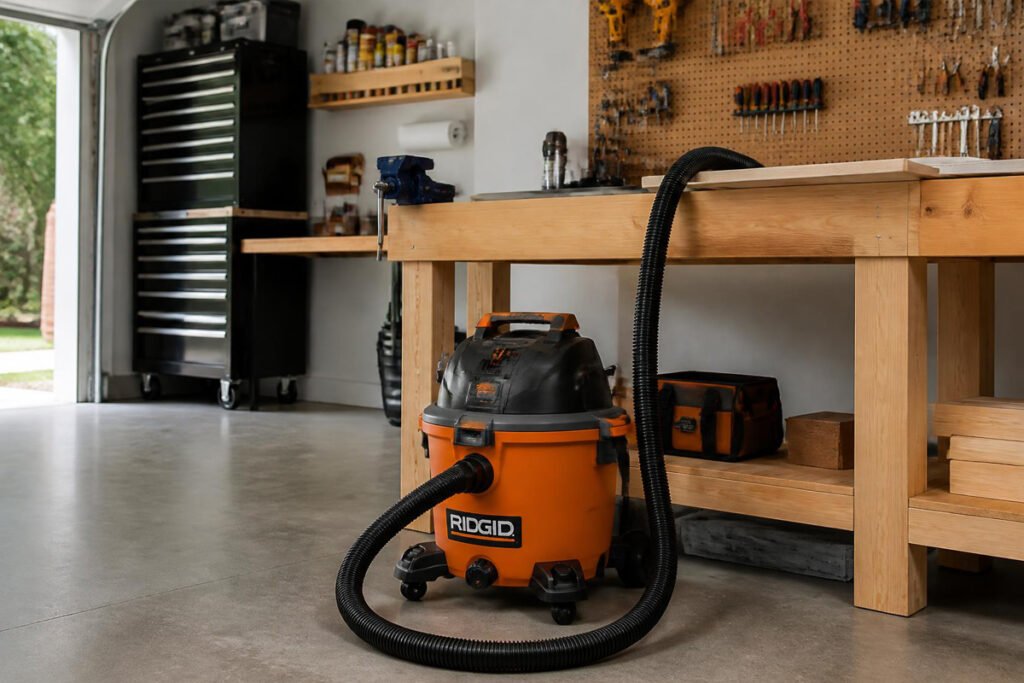
Table of Contents
- How Shop Vacuums Work
- How to Choose the Right Shop Vacuum
- Best Shop Vacuums Available
- Comparison Table
- Best Shop Vacuums for Different Garage Setups
- How to Use a Shop Vacuum Correctly
- Common Mistakes
- Expert Tips
- Final Thoughts
- Frequently Asked Questions
How Shop Vacuums Work
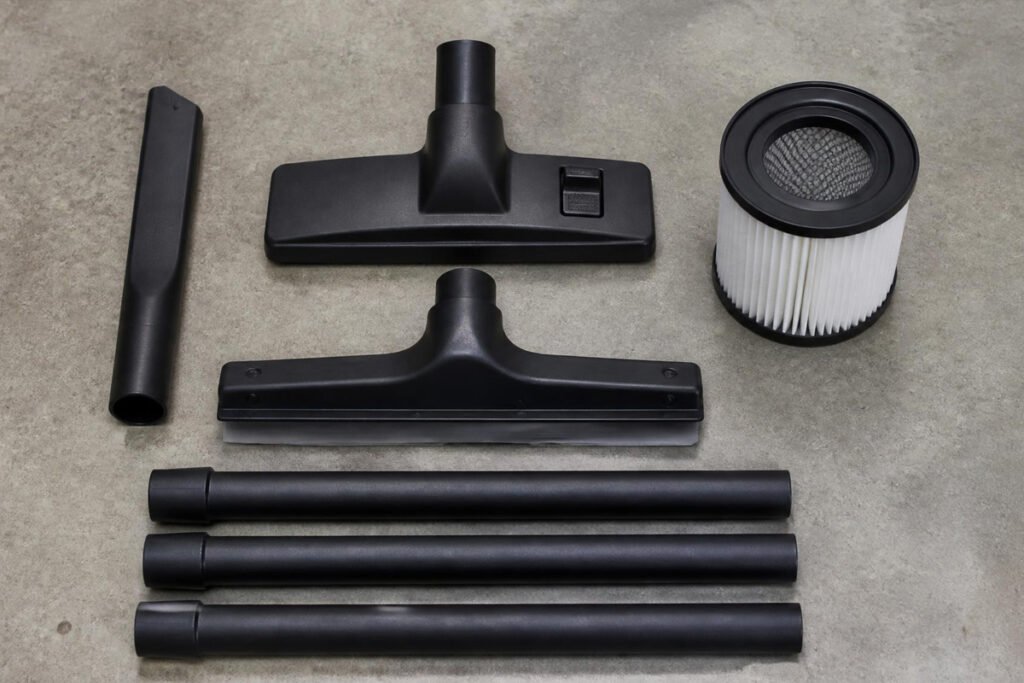
A shop vacuum, sometimes called a wet/dry vac, uses a motor-driven fan to pull air (and whatever’s in it) through a hose and into a sealed drum, where a filter separates debris from the airflow before it exhausts back out. Unlike a household vacuum, the motor sits above the tank rather than behind a bag, which is what lets these machines pull in liquid without damaging the motor — as long as the wet-rated filter or no filter at all is used for water pickup, per the manufacturer’s instructions.
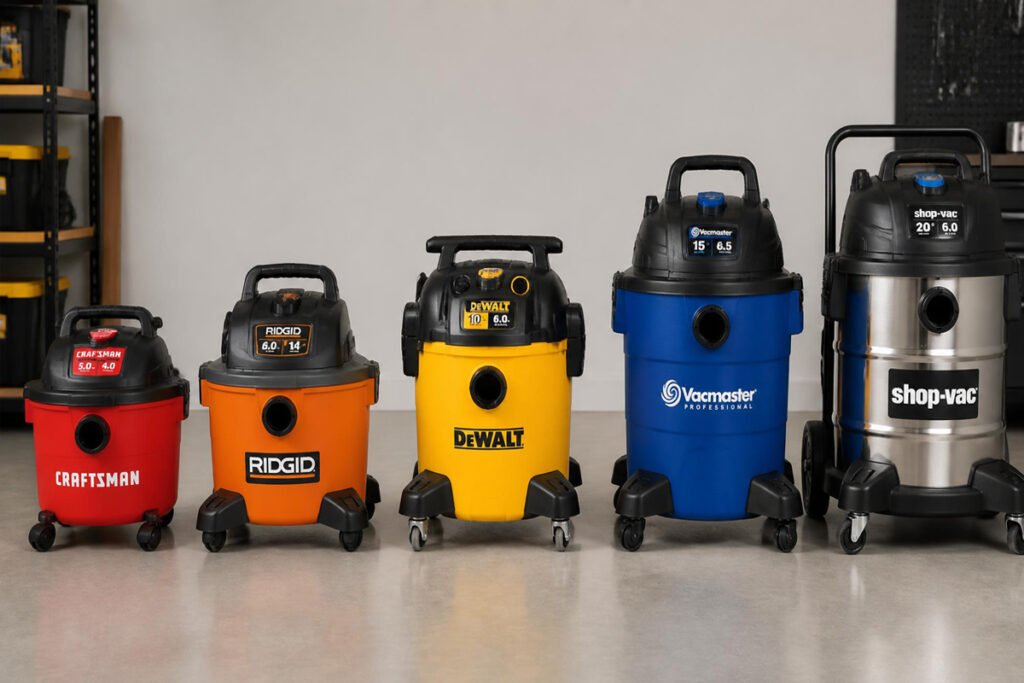
Two specs matter more than anything else for garage use: tank capacity and peak horsepower. Capacity determines how often you’ll stop to empty the tank, while horsepower affects how well the machine holds suction as the tank fills and the filter loads up with dust. Hose diameter matters too — a 1-7/8 inch hose is standard and fine for most jobs, while a wider 2.5-inch hose moves large debris and high volumes of water faster but is heavier to maneuver.
If your garage doubles as a workshop, it’s also worth checking whether a vacuum has a tool-triggered auto-start port, which turns the vacuum on automatically when a connected power tool starts — a genuinely useful feature if you’re already following a garage workshop setup guide.
How to Choose the Right Shop Vacuum
Before comparing specific models, work through three questions:
How much floor space do you actually have to store it? A 16-gallon drum clears debris fast but eats up real floor space in a single-car garage. Measure the spot it’ll live in before buying based on capacity alone.
Wet mess, dry mess, or both? If standing water is a regular problem — a leaking water heater, spring flooding, or a garage that floods during storms — prioritize wet pickup performance and consider a wall-mounted unit that’s always ready. If it’s mostly sawdust and debris, dry filtration and hose width matter more.
Corded or cordless? A corded shop vac has effectively unlimited run time but ties you to an outlet and cord length. A cordless model gives full mobility around a car or driveway but runs on battery time and usually holds less capacity.
For general guidance on separating dust collection from silica-generating materials like concrete or drywall, the Occupational Safety and Health Administration’s guidance on respirable crystalline silica is a useful, non-commercial reference — standard shop vacs are not rated for that kind of fine dust, and a dedicated dust extractor is the safer choice for regular concrete or masonry work.
Best Shop Vacuums Available
1. RIDGID 12-Gallon NXT Wet/Dry Vacuum — Best Overall
Overview: RIDGID’s 12-gallon NXT line is the size most reviewers and long-time garage owners point to first — big enough to clean an entire garage without constant dumping, but not so bulky that it’s awkward to move around a parked car. It backs that up with a lifetime motor warranty, which is unusual in this category and reflects how long these units tend to last in daily use.
Key Features:
- 12-gallon poly tank, 5.0 peak HP motor
- Expandable, locking 1-7/8 inch hose
- Lifetime motor warranty
- Includes fine dust filter, wet filter, and standard accessory kit
Best For: One- or two-car garages that need reliable capacity without the bulk of a 16-gallon drum.
Pros: ✅ Strong capacity-to-footprint ratio ✅ Lifetime motor warranty is the best in the category ✅ Wide accessory ecosystem and readily available replacement parts
Cons: ❌ Louder than some newer “quiet” models ❌ Standard hose diameter struggles with very large debris
Our Verdict: For most garages, this is the default recommendation — it holds enough to get through a real cleaning session and the warranty means it’s a one-time purchase for most homeowners.
2. Craftsman 16-Gallon Heavy-Duty Wet/Dry Vacuum — Best for Large Messes
Overview: The Craftsman 16-gallon steps up in both tank size and hose diameter, using a wide 2.5-inch hose that moves large debris and high volumes of water noticeably faster than the standard 1-7/8 inch hose most competitors use. Independent lab testing has repeatedly found it handles bark, mulch, and metal chunks that clog narrower-hosed vacuums.
Key Features:
- 16-gallon tank with wide 2.5-inch hose
- Strong wet pickup speed
- Large-debris handling without clogging
- Included casters for easier movement despite the larger tank
Best For: Big garages, workshops with heavy sawdust or debris output, or anyone who deals with major spills or flooding.
Pros: ✅ Wide hose rarely clogs, even on bulky debris ✅ Fast wet pickup for flooding or major spills ✅ Large capacity means fewer trips to empty the tank
Cons: ❌ Bulky — needs real floor space to store ❌ Heavier and less maneuverable than 12-gallon models
Our Verdict: If your garage regularly produces genuinely large messes — a workshop generating heavy debris, or a space prone to flooding — the extra size and hose width pay off. For lighter, more occasional cleanup, it’s more vacuum than most people need.
3. Milwaukee M18 FUEL 6-Gallon Wet/Dry Vacuum — Best Battery-Powered
Overview: Milwaukee’s M18 FUEL shop vac cuts the cord entirely, running on the same battery platform as the company’s other M18 tools — a real advantage if you’re already invested in that ecosystem. It trades tank capacity for full mobility, making it easy to carry out to a driveway or up a ladder without dragging a cord behind it.
Key Features:
- 6-gallon capacity, cordless M18 battery platform
- Shares batteries with other Milwaukee M18 tools
- Compact enough to carry one-handed
- No cord to manage or trip over
Best For: Homeowners already using Milwaukee M18 tools, or anyone who needs to vacuum spots far from an outlet.
Pros: ✅ Full mobility with no cord ✅ Battery-sharing with other M18 tools saves money over time ✅ Compact and easy to carry
Cons: ❌ Smaller tank than corded alternatives ❌ Runtime is limited by battery charge, not ideal for long sessions
Our Verdict: This isn’t the vacuum for a full garage deep-clean, but for quick jobs, car interiors, or spots away from an outlet, the cordless freedom is worth the smaller tank.
4. RIDGID 4.5-Gallon Pro Pack Shop Vacuum — Best for Tight Spaces
Overview: The Pro Pack trims RIDGID’s NXT line down to a compact 4.5-gallon size that tucks into a corner or shelf without eating up real floor space, while still carrying the same 5.0 peak HP motor and expandable hose found on the larger models. It’s an easy first shop vac for anyone in a small garage or apartment-style setup.
Key Features:
- 4.5-gallon tank, 5.0 peak HP motor
- Expandable locking hose
- Compact footprint, easy to store on a shelf
- Same accessory kit as larger RIDGID models
Best For: Small garages, apartments with limited storage, or anyone who wants a light, easy-to-carry second vacuum for the car.
Pros: ✅ Small enough to store almost anywhere ✅ Same motor power as larger RIDGID models ✅ Affordable entry point into the RIDGID ecosystem
Cons: ❌ Small tank means frequent emptying on bigger jobs ❌ Not suited to major cleanup projects
Our Verdict: For a garage where floor space is the real constraint, this gives up very little suction power for a much smaller footprint — a smart trade for most small-space owners.
5. DEWALT 6-Gallon Wall-Mounted Wet/Dry Vacuum — Best for Frequent Wet Cleanup
Overview: Instead of sitting on the floor, this DEWALT mounts directly to the wall with a long hose that reaches most of a standard garage bay, so it’s always plugged in and ready rather than something you have to drag out of a corner. That makes it especially useful for a garage that deals with water regularly — melting snow off a car, a leak, or routine hose-down cleaning.
Key Features:
- Wall-mounted design, always ready to use
- Long hose reach covers most of a single garage bay
- 6-gallon capacity
- Frees up floor space entirely
Best For: Garages that deal with frequent water or wet messes, or anyone who wants a vacuum that never has to be moved or stored.
Pros: ✅ Zero floor space used ✅ Always plugged in and ready — no setup time ✅ Long hose covers most of a garage bay from one mounting spot
Cons: ❌ Installation is more involved than a plug-and-go canister vac ❌ Fixed mounting location limits use outside the garage
Our Verdict: If quick, frequent wet cleanup is a regular part of your routine, having a vacuum that’s always mounted and ready removes the biggest reason people put off using one — the it’s-in-the-way factor.
Comparison Table
| Product | Best For | Capacity | Power Source | Approx. Price |
|---|---|---|---|---|
| RIDGID 12-Gallon NXT | Best Overall | 12 gallons | Corded | $130–$160 |
| Craftsman 16-Gallon Heavy-Duty | Best for Large Messes | 16 gallons | Corded | $140–$170 |
| Milwaukee M18 FUEL 6-Gallon | Best Battery-Powered | 6 gallons | Cordless (M18) | $200–$280* |
| RIDGID 4.5-Gallon Pro Pack | Best for Tight Spaces | 4.5 gallons | Corded | $65–$90 |
| DEWALT 6-Gallon Wall-Mounted | Best for Wet Cleanup | 6 gallons | Corded | $150–$190 |
Milwaukee price is bare-tool; battery and charger sold separately if not already owned. Prices are approximate and vary by retailer.
Best Shop Vacuums for Different Garage Setups
One- or Two-Car Garage With Limited Storage
A 12-gallon model like the RIDGID NXT balances capacity against footprint well, or step down to the 4.5-gallon Pro Pack if floor space is especially tight. Either pairs naturally with a broader tool chest or storage cabinet setup so the vacuum has a defined home rather than sitting in the walkway.
Active Workshop With Heavy Sawdust or Debris
The wider hose and larger capacity of the Craftsman 16-gallon holds up better to continuous sawdust and larger scrap than a standard-hose vacuum. If you’re setting up dust collection more broadly, review it alongside your full garage workshop guide before finalizing tool placement.
Garage Prone to Water, Flooding, or Snow Melt
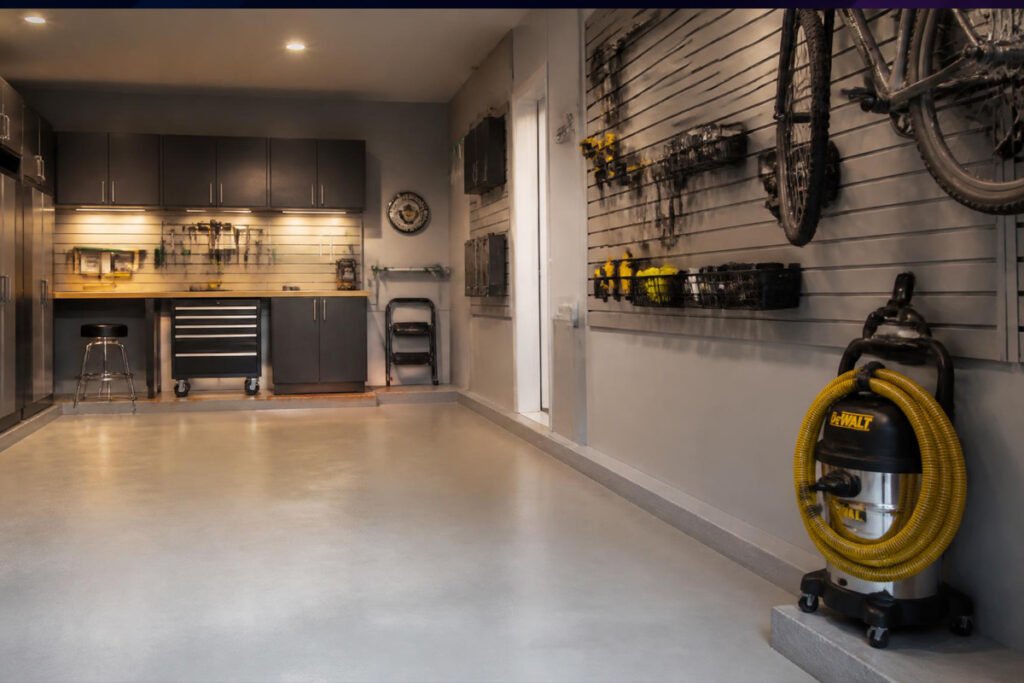
The DEWALT wall-mounted vac stays ready without taking up floor space, which matters if wet cleanup happens often enough that “dragging out the vacuum” becomes a reason it doesn’t get used. This is also a good moment to double-check your garage ventilation, since standing water and poor airflow together are a common path to mold.
How to Use a Shop Vacuum Correctly
Step 1: Match the Filter to the Job
Use a dry filter for dust and debris, and switch to a wet-rated filter (or remove the filter per the manufacturer’s instructions) before vacuuming any liquid — running the wrong filter on water pickup can damage the motor.
Step 2: Empty the Tank Before It’s Full
Most shop vacs lose suction well before the tank is physically full, especially on dry debris. Emptying at roughly two-thirds full keeps performance consistent.
Step 3: Clean or Tap the Filter Regularly
A clogged filter is the single most common cause of “my shop vac lost suction” complaints. Tap or rinse (dry filters only, per manufacturer instructions) between sessions.
Step 4: Use the Right Attachment
A wide floor nozzle covers ground fast on an open floor; a crevice tool handles corners and along baseboards; a brush attachment protects delicate surfaces like a car’s interior trim.
Step 5: Store With the Hose Detached and Drained
Coiling a wet hose and leaving it attached traps moisture and encourages mildew inside the hose. Detach, drain, and let it dry before storing.
Common Mistakes
Vacuuming standing water with a dry-only filter. This is the fastest way to damage a shop vac’s motor. Always confirm the filter (or lack of one) is rated for wet pickup first.
Buying based on tank size alone. A bigger tank sounds better on paper, but if it doesn’t fit your storage space or is too heavy to move comfortably, it ends up unused. Match capacity to how you’ll actually store and use it, not just the spec sheet — the same logic applies when picking garage storage solutions generally.
Skipping filter maintenance until suction is already gone. By the time suction noticeably drops, the filter is usually well past due for cleaning. Build filter checks into a regular garage maintenance routine rather than waiting for a problem.
Expert Tips
Keep a dedicated wet filter on hand, not just the one that came in the box. Swapping filters based on the job, rather than using one filter for everything, extends the life of both the filter and the motor.
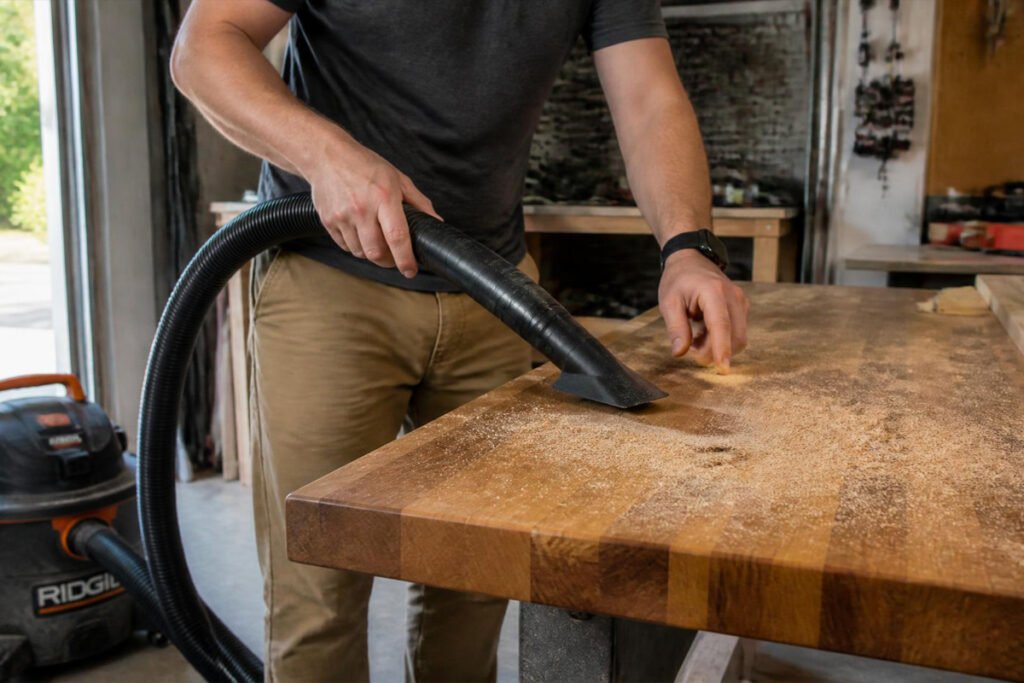
Use the blower port for quick dry cleanup. Many shop vacs can reverse airflow through a blower port, which clears sawdust off a workbench or leaves out of a corner faster than vacuuming them up directly.
Don’t use a standard shop vac for fine construction dust like drywall sanding or concrete cutting. Standard filters pass fine silica dust through the exhaust. For regular work with concrete, tile, or drywall dust, a dedicated HEPA-rated dust extractor is the safer tool, not a general-purpose shop vac.
Final Thoughts
Best Overall: The RIDGID 12-Gallon NXT hits the right balance of capacity, price, and durability for most garages — the lifetime motor warranty alone makes it worth the default pick.
Best for Big Messes: The Craftsman 16-Gallon’s wide hose earns its size for anyone dealing with heavy sawdust, debris, or regular flooding.
Best for Small Spaces: The RIDGID 4.5-Gallon Pro Pack proves a compact vacuum doesn’t have to mean weak suction.
Whichever model you choose, pair it with good filter habits and proper storage, and it’ll outlast most other tools in the garage. For the rest of your cleaning setup, see our full guide to garage cleaning tools and supplies.
Frequently Asked Questions
What size shop vacuum do I need for a garage? For most one- or two-car garages, 10–12 gallons is the sweet spot — enough capacity to avoid constant emptying without becoming too bulky to store or maneuver. Larger 16-gallon models make sense for bigger workshops or frequent heavy debris.
Can a shop vacuum pick up water? Yes, most shop vacuums are rated for wet pickup, but only with the correct wet filter installed (or no filter, per the manufacturer’s instructions). Using a dry-only filter on standing water can damage the motor.
How often should I clean or replace the filter? Tap or rinse a dry filter after every few uses, and replace it once it no longer restores suction after cleaning — typically every few months with regular use, sooner with heavy dust exposure.
Corded vs. cordless shop vac — which is better for a garage? Corded models offer unlimited run time and are generally more powerful for the price, making them the better default for garage-based cleanup. Cordless models trade some capacity and runtime for full mobility, which matters more for outdoor or far-from-outlet jobs.
Can I use a regular household vacuum instead of a shop vac in the garage? Not for wet messes or heavy debris — household vacuums aren’t built to handle water and can be damaged or clog quickly on sawdust, gravel, or construction debris. A shop vac is purpose-built for exactly those conditions.
Is a wall-mounted shop vac worth the installation effort? If wet or routine cleanup happens often enough that dragging out a canister vac becomes a hassle you avoid, yes — having it always mounted and ready removes the main reason people skip using one.
What’s the difference between a shop vac and a dust extractor? A shop vac is a general-purpose wet/dry vacuum for everyday debris and spills. A dust extractor is a specialized tool with HEPA-rated filtration built to safely capture fine, hazardous dust like silica from concrete or tile work — the two aren’t interchangeable for regular construction dust.
Why did my shop vac lose suction? The most common cause is a clogged or overloaded filter. Check and clean the filter first; if suction is still weak, check the hose for blockages and confirm the tank isn’t past the point where dry debris chokes airflow.
How loud are shop vacuums, and does it matter? Most shop vacs run louder than a household vacuum, often in the 80–90 decibel range, loud enough that hearing protection is reasonable for extended use. Some newer “quiet” models reduce this somewhat, at a price premium.
Do I need a tool-triggered auto-start feature? Only if you’re regularly running power tools like a table saw or sander connected to the vacuum for dust collection. For general garage cleanup, it’s a nice-to-have rather than a necessity.
Author: Danial Marquez Last Updated: September 2026



1 thought on “Best Shop Vacuums for Garage Cleanup: Top 5 Picks & Buying Guide”
Pingback: Best Rust Remover for Tools: Proven Top Picks | GarageDaily.com – Master Your Garage with Expert Tips