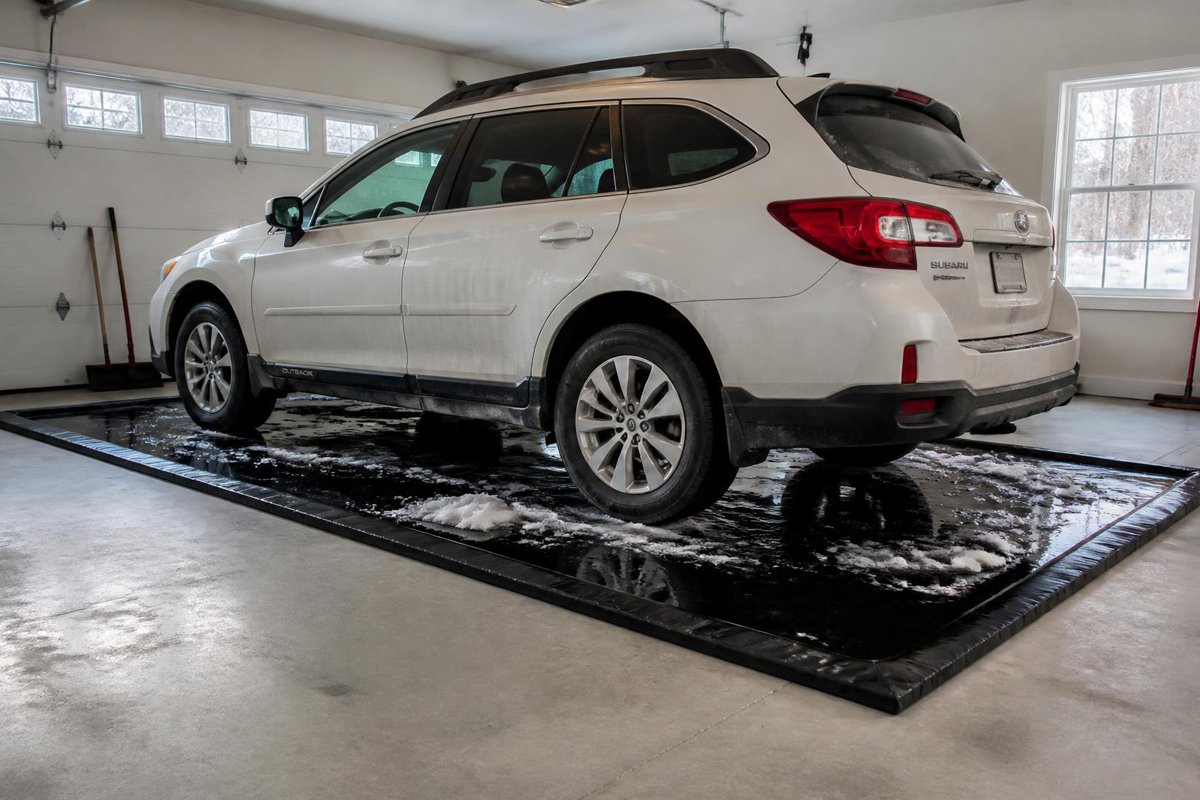
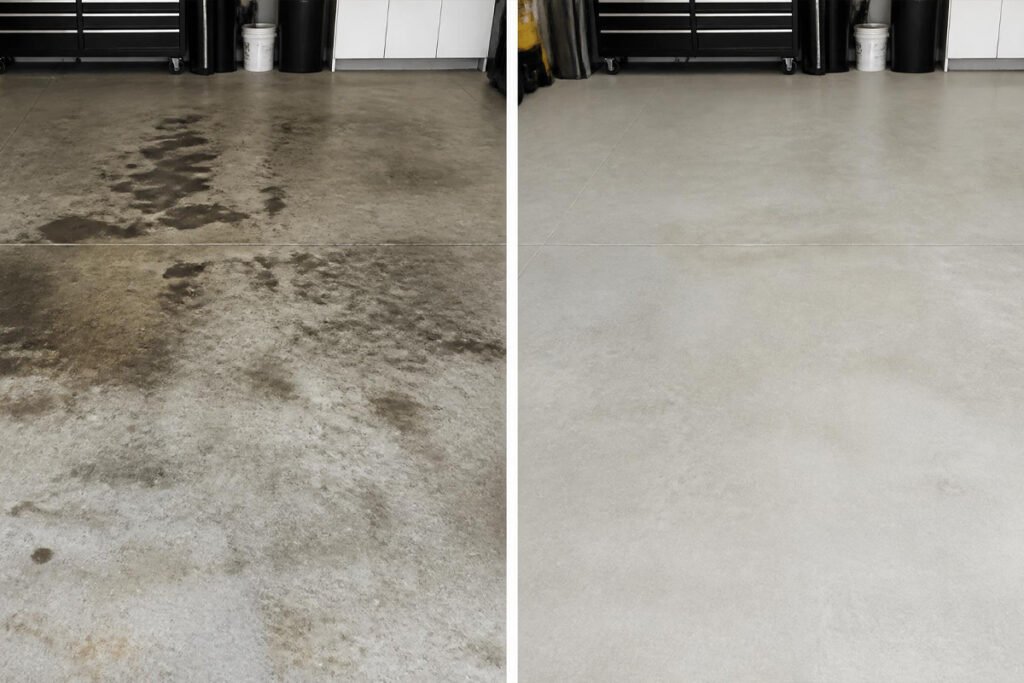
Oil stains, tire grime, and years of dried mud don’t come off a garage floor with just a broom and a bucket. A degreaser can break down grease, but for driveways, garage doors, and concrete floors caked in years of buildup, nothing beats the raw rinsing power of a pressure washer.
The problem is that most homeowners either buy something too weak to make a dent in old oil stains, or something so powerful it’s overkill for a home garage — and can actually damage concrete sealant or epoxy coatings if used incorrectly.
This guide breaks down five of the best pressure washers for garage use in 2026, how to size one correctly for your space, and how to use it without damaging your floor or garage door.
Quick Answer
The best pressure washer for your garage depends on how you plan to use it. For most homeowners tackling oil stains and seasonal driveway cleanup, a mid-range electric model in the 2,000–2,800 PSI range hits the sweet spot of power and control. If you need to move around a large driveway or don’t have an outlet nearby, a battery-powered cordless washer trades a bit of runtime for total freedom of movement. And if you’re dealing with heavy-duty jobs like removing years of oil buildup from unsealed concrete, a higher-PSI unit will cut cleaning time significantly — just be careful with sealed or epoxy-coated floors, which can be damaged by excessive pressure at close range.
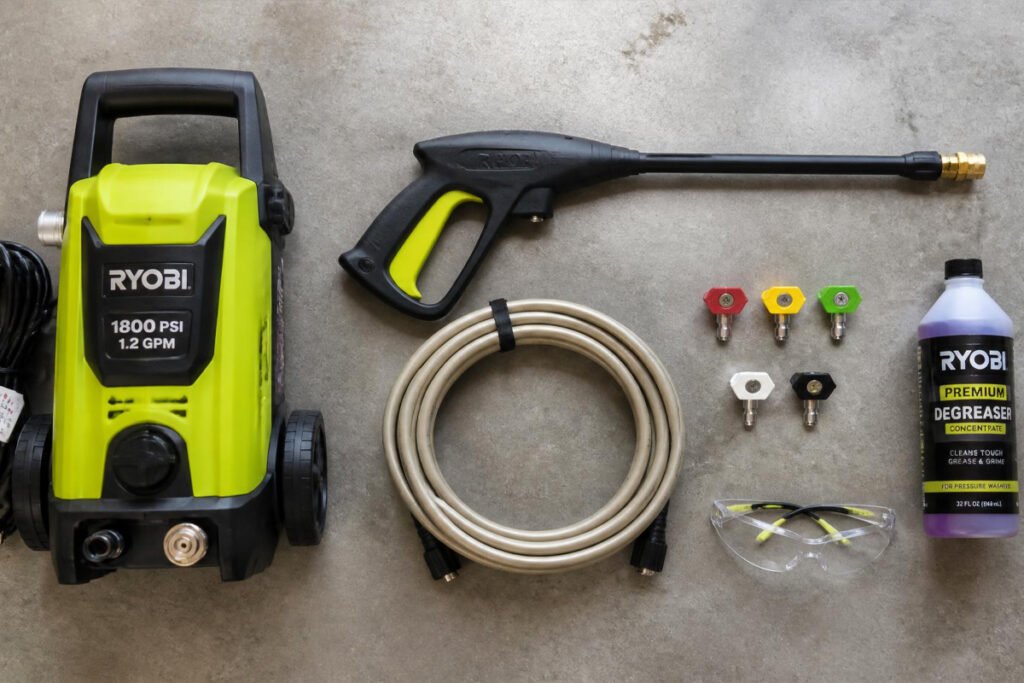
Table of Contents
- How Pressure Washers Work (And What PSI/GPM Actually Mean)
- How to Choose the Right Pressure Washer for Your Garage
- Best Pressure Washers for Garage Use
- Comparison Table
- Best Pressure Washers for Different Garage Jobs
- How to Pressure Wash a Garage Floor Correctly
- Common Mistakes
- Expert Tips
- Final Verdict
- Frequently Asked Questions
How Pressure Washers Work (And What PSI/GPM Actually Mean) {#how-pressure-washers-work}
A pressure washer takes ordinary tap water and forces it through a narrow nozzle using an electric or gas-powered pump, multiplying the water’s force by 20–40 times what comes out of a garden hose. Two numbers determine how effective a machine will be for garage cleaning:
- PSI (pounds per square inch) measures the force of the water stream — this is what breaks up caked-on dirt and stains.
- GPM (gallons per minute) measures the volume of water flowing through the nozzle — this is what rinses debris away once it’s loosened.
Multiply the two together and you get “cleaning units” (CU), a rough measure of overall cleaning power. For a typical residential garage floor, most models between 1,900–3,000 PSI and 1.2–2 GPM will comfortably handle oil residue, dirt, and mildew without being so aggressive that they etch bare concrete or strip paint. If you also need to remove mold from garage walls, look for a unit with an adjustable nozzle so you can dial back pressure on softer surfaces like drywall or wood.
How to Choose the Right Pressure Washer for Your Garage {#how-to-choose}
Before comparing specific models, ask yourself these three questions:
- Is my garage floor sealed, epoxy-coated, or bare concrete? Bare concrete tolerates higher PSI; epoxy-coated floors do better with a wide-fan nozzle and lower pressure to avoid peeling the coating.
- Do I need portability, or do I have power and water access nearby? Corded electric units need an outdoor-rated outlet within extension-cord range; battery models trade some runtime for the freedom to clean a driveway, garage door exterior, and vehicle in one trip.
- What else will I use it for? If you’ll also wash your car, siding, or deck, a model with interchangeable nozzles and a detergent tank gives you more versatility than a garage-only unit.
According to the Consumer Product Safety Commission, pressure washers rated above 2,000 PSI carry a significantly higher risk of skin and eye injury if mishandled, so factor your own comfort level and experience into the decision as well as raw power.
Best Pressure Washers for Garage Use {#best-pressure-washers}
Sun Joe SPX3000
Overview: The SPX3000 has become the default recommendation for homeowners buying their first pressure washer, and for good reason — it’s affordable, widely available, and powerful enough for the vast majority of garage and driveway jobs. It runs on a standard 14.5-amp motor, so any outdoor-rated outlet will power it. Key Features:
- Up to 2,030 PSI / 1.76 GPM output
- Five quick-connect spray tips (0°, 15°, 25°, 40°, and soap)
- Dual removable detergent tanks for switching cleaners mid-job
- 20-foot high-pressure hose plus a 35-foot power cord
- Total Stop System (TSS) that shuts the pump off automatically when the trigger is released
Best For: First-time buyers cleaning a garage floor, driveway, and vehicles on a budget. Pros: ✅ Very affordable relative to its output ✅ Lightweight and easy to store on a garage shelf ✅ Widely available parts and accessories
Cons: ❌ Corded — limited by outlet and extension-cord placement ❌ Plastic components feel less durable than premium models over years of heavy use
Our Verdict: For the majority of homeowners whose garage cleaning needs are oil stains, seasonal dirt, and the occasional car wash, the SPX3000 delivers more than enough cleaning power without the higher price tag of a premium unit. Pair it with a stiff-bristle attachment for tackling grease buildup on garage door tracks.
Kärcher K5 Premium
Overview: Kärcher is one of the most established names in pressure washing, and the K5 Premium is its step-up residential model — built for homeowners who want more durability and a quieter motor than entry-level electric units typically offer. Key Features:
- Higher-output motor built for frequent, heavy use
- Induction motor designed to run quieter and last longer than universal motors
- Multiple quick-connect nozzles included
- Integrated detergent tank
Best For: Homeowners who pressure wash regularly and want a longer-lasting motor. Pros: ✅ More durable build quality than budget electric models ✅ Quieter operation, which matters in an attached garage ✅ Strong reputation for longevity
Cons: ❌ Higher upfront cost than the SPX3000 ❌ Still corded, so outlet placement matters
Our Verdict: If you plan to use your pressure washer several times a month rather than a few times a year, the K5 Premium’s more robust motor is worth the extra cost — it’s a machine built to be used, not just owned.
EGO Power+ 3200
Overview: For homeowners who don’t want to deal with cords at all, the EGO Power+ 3200 is a battery-powered pressure washer that reaches some of the highest pressure output available in a cordless unit, running on EGO’s ARC Lithium battery platform. Key Features:
- Battery-powered — no cord, no gas fumes
- High PSI output for a cordless unit
- Compatible with EGO’s broader battery ecosystem if you already own their outdoor tools
- Multiple nozzle tips included
Best For: Homeowners without a convenient outdoor outlet, or anyone who wants to clean a driveway, garage door exterior, and yard equipment without dragging a cord around. Pros: ✅ Complete freedom of movement — no cord to manage ✅ No gas fumes or engine maintenance ✅ Battery shared across other EGO outdoor tools
Cons: ❌ Runtime is limited by battery capacity — long jobs may need a spare battery ❌ Higher upfront cost, especially if batteries aren’t already owned
Our Verdict: This is the pick for garages where the nearest outlet is inconveniently far from the driveway, or for anyone who’s tired of fighting with extension cords mid-job.
Craftsman 2100 Electric Pressure Washer
Overview: The Craftsman 2100 is built around ease of use — simple assembly, compact storage, and a quieter motor than many electric competitors, making it a solid choice for light-to-moderate garage cleaning and car detailing. Key Features:
- Roughly 2,100 PSI output
- Compact frame designed for easy garage storage
- Quieter motor relative to comparable electric models
- Simple, tool-free assembly
Best For: Homeowners prioritizing ease of use and quiet operation over maximum power. Pros: ✅ Easy to assemble and start using immediately ✅ Compact footprint for garage storage ✅ Comparatively quiet for an electric unit
Cons: ❌ Less powerful than premium picks for heavy-duty jobs ❌ Best suited to lighter cleaning rather than years of embedded oil stains
Our Verdict: If auto detailing and light garage floor touch-ups are your main use case, the 2100’s simplicity and quiet operation make it a low-hassle choice.
DeWalt 20V MAX Cordless Pressure Washer
Overview: Built on DeWalt’s 20V MAX battery platform, this cordless washer is aimed at homeowners who already own DeWalt tools and want a pressure washer that shares the same battery system. Key Features:
- Runs on DeWalt’s 20V MAX battery platform
- Cordless operation for full mobility around the garage and driveway
- Compact and lightweight compared to gas alternatives
- No gas, oil changes, or engine maintenance
Best For: Homeowners already invested in the DeWalt battery ecosystem who want a grab-and-go garage cleaning tool. Pros: ✅ Battery interchangeable with other DeWalt 20V MAX tools ✅ No cord or gas engine to manage ✅ Compact enough for a garage shelf
Cons: ❌ Lower PSI output than corded or gas alternatives — best for lighter jobs ❌ Runtime tied to battery charge
Our Verdict: This won’t out-clean a dedicated 2,000+ PSI electric unit on tough oil stains, but for quick rinse-downs and touch-up cleaning, the convenience of shared batteries is hard to beat if you already own DeWalt tools.
Comparison Table {#comparison-table}
| Product | Best For | Power Source | Approx. PSI | Portability |
|---|---|---|---|---|
| Sun Joe SPX3000 | Budget all-rounder | Corded electric | ~2,030 | Moderate (cord length) |
| Kärcher K5 Premium | Frequent/heavy use | Corded electric | Higher-output | Moderate (cord length) |
| EGO Power+ 3200 | No outlet access | Battery | High (cordless class) | Excellent |
| Craftsman 2100 | Light cleaning, quiet use | Corded electric | ~2,100 | Moderate (cord length) |
| DeWalt 20V MAX | DeWalt tool owners | Battery | Lower (light-duty) | Excellent |
Best Pressure Washers for Different Garage Jobs {#different-jobs}
For Removing Old Oil Stains
Deep, set-in oil stains respond best to higher PSI combined with a degreaser applied first to break down the oil before rinsing. The Kärcher K5 Premium or Sun Joe SPX3000, paired with a 15° nozzle, work well here — just avoid holding the nozzle too close to bare or painted concrete.
For Epoxy-Coated or Sealed Floors
If you’ve already invested in an epoxy floor coating, stick to a wide 40° fan nozzle and moderate pressure. A lower-PSI unit like the Craftsman 2100 or DeWalt 20V MAX reduces the risk of chipping or lifting the coating at the edges.
For Cleaning Garage Doors and Exteriors
Cleaning the exterior of a garage door calls for lower pressure and a soft, wide spray to avoid denting aluminum panels or stripping paint. A cordless option like the EGO Power+ 3200 also makes it easy to work around the driveway without a cord getting in the way.
How to Pressure Wash a Garage Floor Correctly {#how-to-pressure-wash}
Step 1: Clear and Prepare the Space
Remove parked vehicles, stored totes, and anything that can’t get wet. Sweep loose debris first so it doesn’t interfere with the spray.
Step 2: Pre-Treat Stubborn Stains
Apply a garage floor degreaser to oil stains and let it sit per the product’s instructions before rinsing.
Step 3: Test Pressure in a Small Area
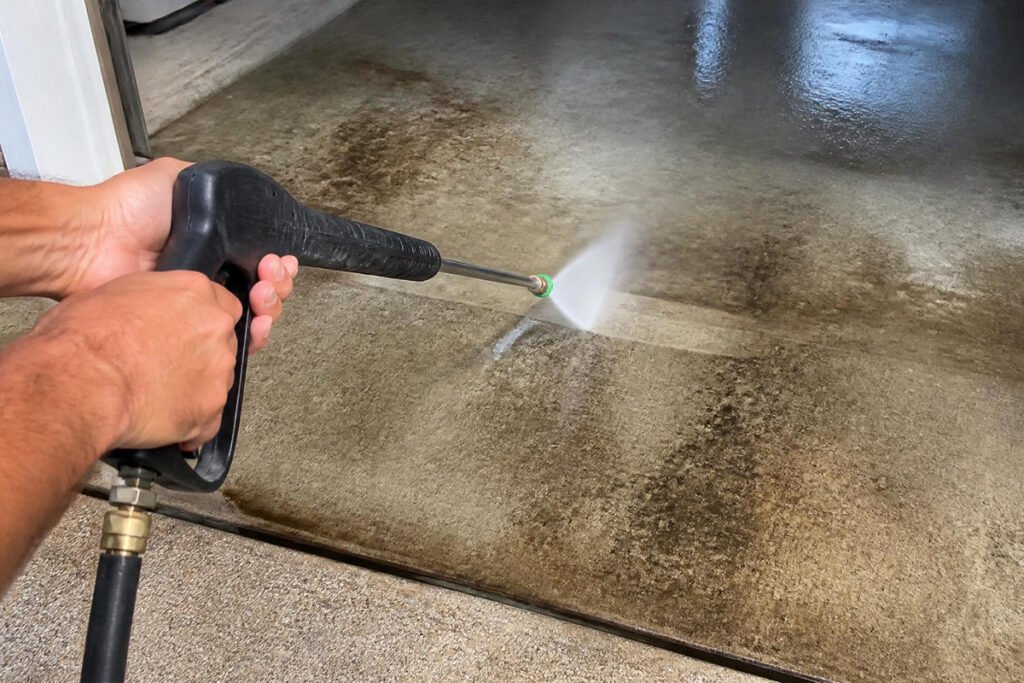
Start with the widest nozzle and lowest pressure setting on an inconspicuous corner to confirm it won’t damage your specific floor finish.
Step 4: Wash in Overlapping Passes
Work in straight, overlapping strokes at a consistent distance from the floor, moving from the back of the garage toward the door so dirty water flows out rather than pooling inside.
Step 5: Let the Floor Dry Fully
Prop the garage door open and allow the floor to air-dry completely before parking a vehicle back inside — a damp floor combined with poor ventilation can encourage mildew.
Common Mistakes {#common-mistakes}
Holding the nozzle too close to the surface. This is the single most common cause of etched concrete or peeled epoxy — keep the nozzle at least 12 inches from the floor on the first pass.
Skipping the pre-treatment step. Pressure alone often can’t fully lift set-in oil; combining a degreaser with the pressure washer cuts cleaning time significantly.
Closing the garage door before the floor dries. Trapping moisture in an unventilated space is a common contributor to garage mold and mildew — always let the floor dry with airflow first.
Expert Tips {#expert-tips}
Match the nozzle to the job, not just the machine. Even a high-PSI unit can be gentle with the right wide-fan tip — the nozzle angle matters as much as the PSI rating.
Don’t skip eye and ear protection. Pressure washers can kick back debris at high speed; safety glasses are worth the extra thirty seconds.
Store your washer properly between uses. Draining the pump and coiling hoses loosely (never kinked) prevents cracking, especially if your garage sees freezing temperatures in winter.
Final Verdict {#final-verdict}
Best Overall: Sun Joe SPX3000 — the best balance of price and cleaning power for most garages. Best for Heavy, Frequent Use: Kärcher K5 Premium — a sturdier motor built to handle regular use. Best Cordless: EGO Power+ 3200 — for garages without convenient outlet access.
Whichever model you choose, pair it with the right degreaser and follow the step-by-step cleaning process above to get years of buildup off your garage floor without damaging the surface underneath.
Frequently Asked Questions {#faq}
Do I need a gas or electric pressure washer for my garage? For most homeowners, an electric model provides plenty of power for garage floors, driveways, and vehicles without the noise, fumes, and maintenance of a gas engine. Gas units are typically reserved for large commercial jobs.
How much PSI do I need to clean a garage floor? Somewhere between 1,900 and 3,000 PSI handles the vast majority of garage cleaning jobs. Bare, unsealed concrete can tolerate the higher end of that range; sealed or epoxy-coated floors do better closer to the lower end with a wide nozzle.
Corded vs. cordless: which is better for a garage? Corded electric units generally offer more sustained power for the price, while cordless models trade some runtime for the freedom to move around the driveway without managing a cord or finding an outlet.
Can a pressure washer damage my garage floor? Yes, if used incorrectly. Holding the nozzle too close, using too narrow a nozzle angle, or applying too much pressure to a coated floor can etch concrete or peel epoxy. Always test on a small area first.
How long does it take to pressure wash a garage floor? A single-car garage typically takes 20–40 minutes including pre-treatment with a degreaser, depending on how much buildup you’re removing.
Do I need to use detergent, or is water enough? Plain water handles light dirt, but set-in oil and grease respond much better to a dedicated degreaser applied before rinsing.
What safety gear should I wear? Safety glasses and closed-toe shoes are the minimum. Gloves are also recommended if you’re handling detergents or degreasers alongside the washer.
Will a pressure washer remove mold from garage walls? It can help rinse away surface mold, but for a thorough fix you’ll want to follow a dedicated mold removal process, since pressure alone can spread spores rather than eliminate them.
How do I stop my garage floor from smelling musty after washing? Make sure the floor dries completely with the garage door open and consider improving garage ventilation if musty odors persist — trapped moisture is the main cause of lingering smells, as covered in our garage odor removal guide.
Can I use a pressure washer on my garage door? Yes, but use a wide, low-pressure nozzle, especially on painted or aluminum doors, to avoid stripping paint or denting panels — see our full garage door cleaning guide for material-specific tips.
Author: Danial Marquez Last Updated: July 2026