Most garages don’t get dirty all at once — they get dirty one skipped weekend at a time. A little sawdust here, an oil drip there, a box that never made it back to the shelf, and eventually the space stops feeling usable at all. The common mistake is treating garage cleanup as one big vague chore instead of a specific, repeatable process with a clear starting point and a clear order of operations.
That’s exactly what a real garage deep cleaning checklist solves. Instead of wandering in with a broom and no plan, you work through the space in a logical sequence — declutter, then surfaces, then floor, then finishing touches — so nothing gets cleaned twice and nothing gets missed. If you’ve already tackled a specific problem area, like mold in the corners or a lingering musty smell, this guide shows you where that step fits into the bigger picture.
This article walks through a complete, seasonal deep-cleaning checklist for the entire garage — ceiling to floor, walls to cabinets — with the right tools and order for each step.
Quick Answer
A proper garage deep clean follows five phases in order: declutter and sort, clear cobwebs and dust from ceiling to floor, wipe down walls and cabinets, deep-clean the floor last, then finish with odor and organization touches. Doing the floor first is the most common mistake — dust and debris from higher surfaces will just resettle on a clean floor. Plan for a half-day for a single-car garage, a full day for a two-car garage or workshop, and aim to do a full deep clean twice a year, in spring and fall, with lighter monthly touch-ups in between.
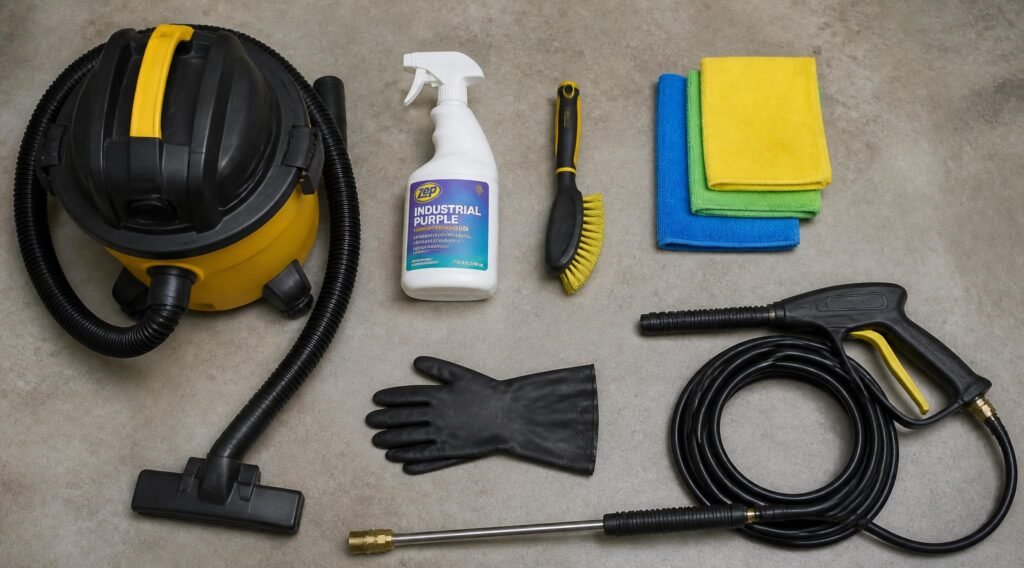
Table of Contents
- Why a Deep Clean Is Different From a Quick Tidy-Up
- How to Choose Your Starting Point
- The Complete Garage Deep Cleaning Checklist
- Seasonal Cleaning Schedule at a Glance
- Deep Cleaning Different Areas of the Garage
- How to Deep Clean a Garage Step-by-Step
- Common Mistakes
- Expert Tips
- Final Thoughts
- Frequently Asked Questions
Why a Deep Clean Is Different From a Quick Tidy-Up
A quick tidy-up is putting things back where they belong. A deep clean is different: it means clearing every surface completely, including ceiling corners, shelving undersides, and behind stored items, then cleaning each surface on its own merits rather than around whatever’s sitting on it.
This matters because a garage collects more than dust. Vehicles track in road salt and grime, power tools leave behind fine particulate dust, and stored chemicals or cardboard can trap moisture against walls and floors. Left alone, that combination is exactly what leads to problems covered elsewhere on this site, like garage wall stains and mold or a floor that won’t come clean with a quick sweep. A real deep clean, done a couple of times a year, is what keeps those problems from starting in the first place.
The keyword to keep in mind throughout this garage deep cleaning checklist is order — cleaning the garage in the wrong sequence means redoing work, while cleaning it top-to-bottom and back-to-front means every step only has to happen once.
How to Choose Your Starting Point
Before grabbing a mop, ask three quick questions:
How long has it been since the last deep clean? More than a year usually means budgeting extra time for cobwebs, dust buildup, and forgotten clutter.
Is the floor bare concrete, sealed, or coated? This changes which cleaning products are safe to use later in the process — a degreaser that’s fine on bare concrete can dull an epoxy coating if it’s the wrong formula.
Is the garage also a workshop, gym, or storage overflow space? A multi-purpose garage needs the decluttering phase to be more deliberate, since items get sorted into “keep here,” “relocate,” and “donate/discard” rather than just “put away.”
According to general home-maintenance guidance from the U.S. Environmental Protection Agency, good ventilation is also worth checking before using strong cleaning chemicals in an enclosed garage space — propping the door open or running a fan for the duration of the clean is a simple, often-skipped safety step. If the garage tends to run stuffy even with the door open, it may be worth a broader look at a garage ventilation guide separately from the cleaning day itself.
It also helps to know roughly how much time to block off. A single-car garage used mainly for a vehicle and light storage is usually a half-day project. A two-car garage, a garage that doubles as a workshop, or one that hasn’t been fully cleared out in over a year should get a full day on the calendar — trying to compress either into a couple of rushed hours is the most common reason a “deep clean” ends up being just a surface wipe-down instead.
The Complete Garage Deep Cleaning Checklist
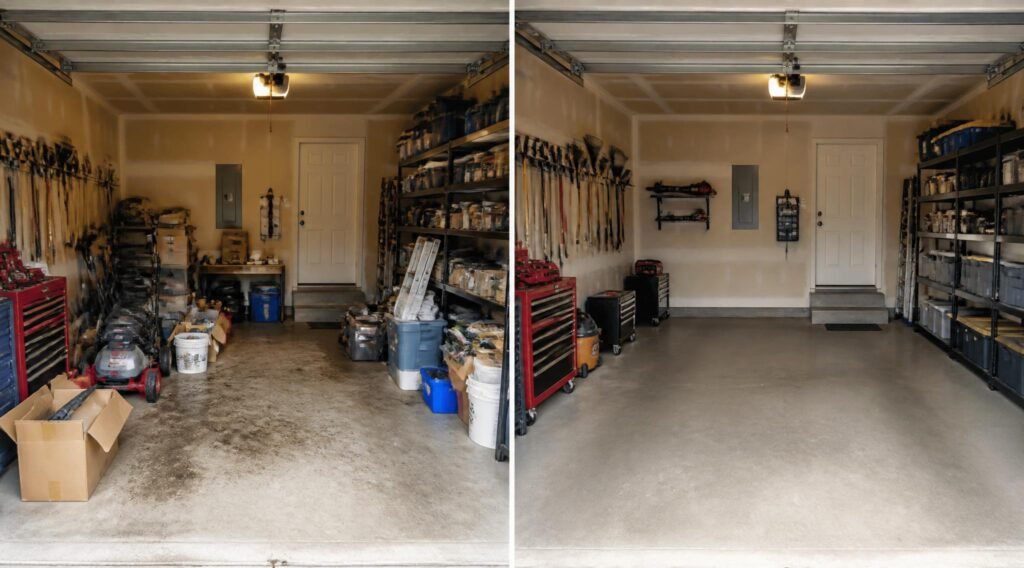
Work through these phases in order. Skipping ahead to the floor before finishing the steps above it is the single most common reason a “deep clean” doesn’t actually look clean once everything’s put back.
Phase 1: Declutter and Sort
- Pull everything off shelves, out of cabinets, and off the floor
- Sort into keep, relocate, donate, and discard piles
- Check expiration dates on chemicals, paint, and automotive fluids
- Bag or box anything going to donation immediately, so it doesn’t drift back in
Phase 2: Ceiling to Cabinet-Top
- Knock down cobwebs and dust from the ceiling, light fixtures, and rafters
- Wipe down the tops of cabinets and shelving units, where dust settles thickest
- Clean windows and any garage door glass panels
Phase 3: Walls and Cabinets
- Wipe down garage walls with an appropriate cleaner for the wall material — drywall, block, or painted concrete each call for slightly different approaches
- Clean cabinet interiors and exteriors, including door handles and hinges where grease accumulates
- Spot-treat any mold or mildew patches before they spread further
Phase 4: The Garage Door
- Clean both sides of the garage door panels appropriate to the material (steel, wood, or composite)
- Wipe down weatherstripping and check it for cracking while you’re there
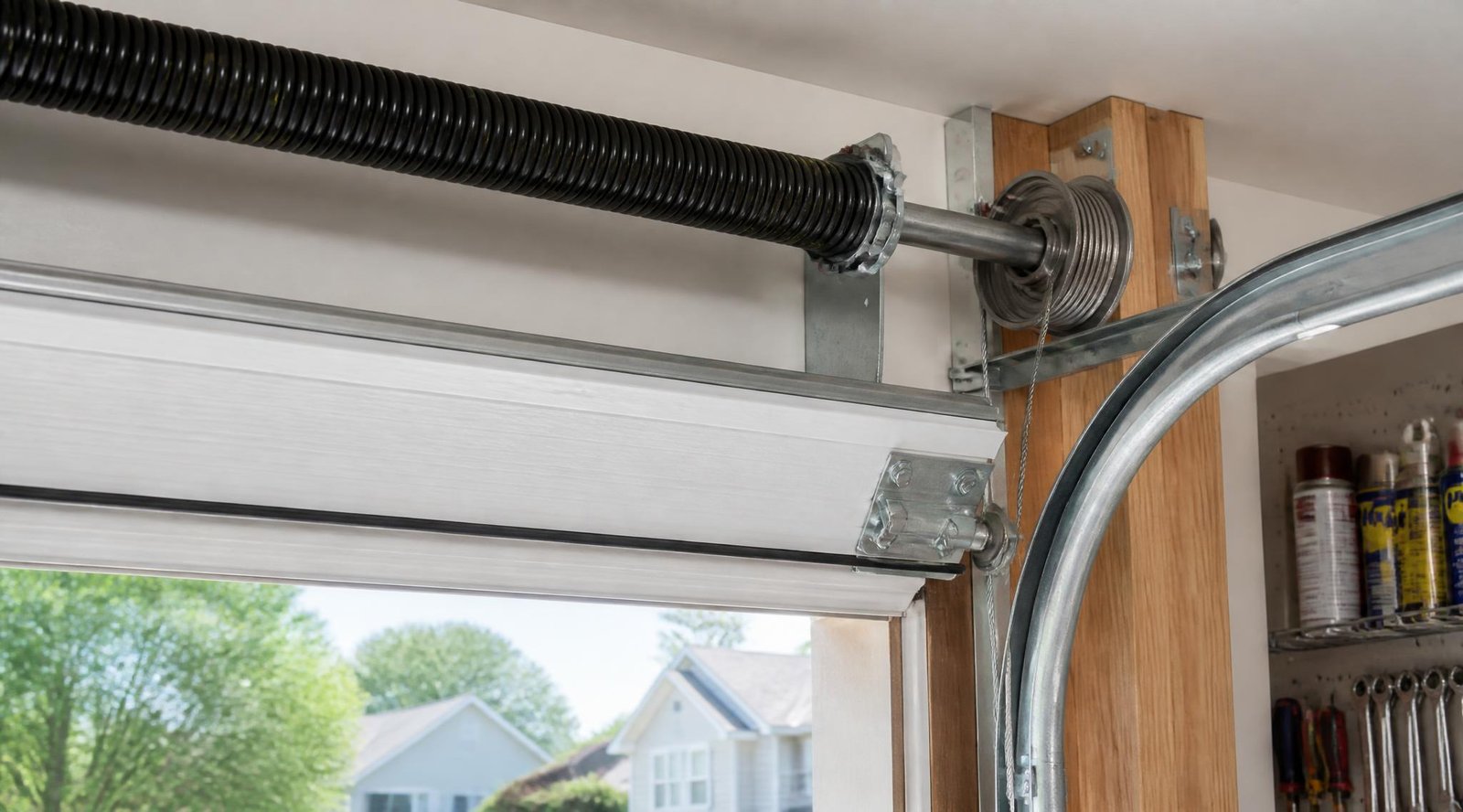
- Note any tracks that look dry or gritty — that’s a maintenance flag, not a cleaning one, and is worth a look at a garage door maintenance checklist
Phase 5: Floor — Last, Always Last
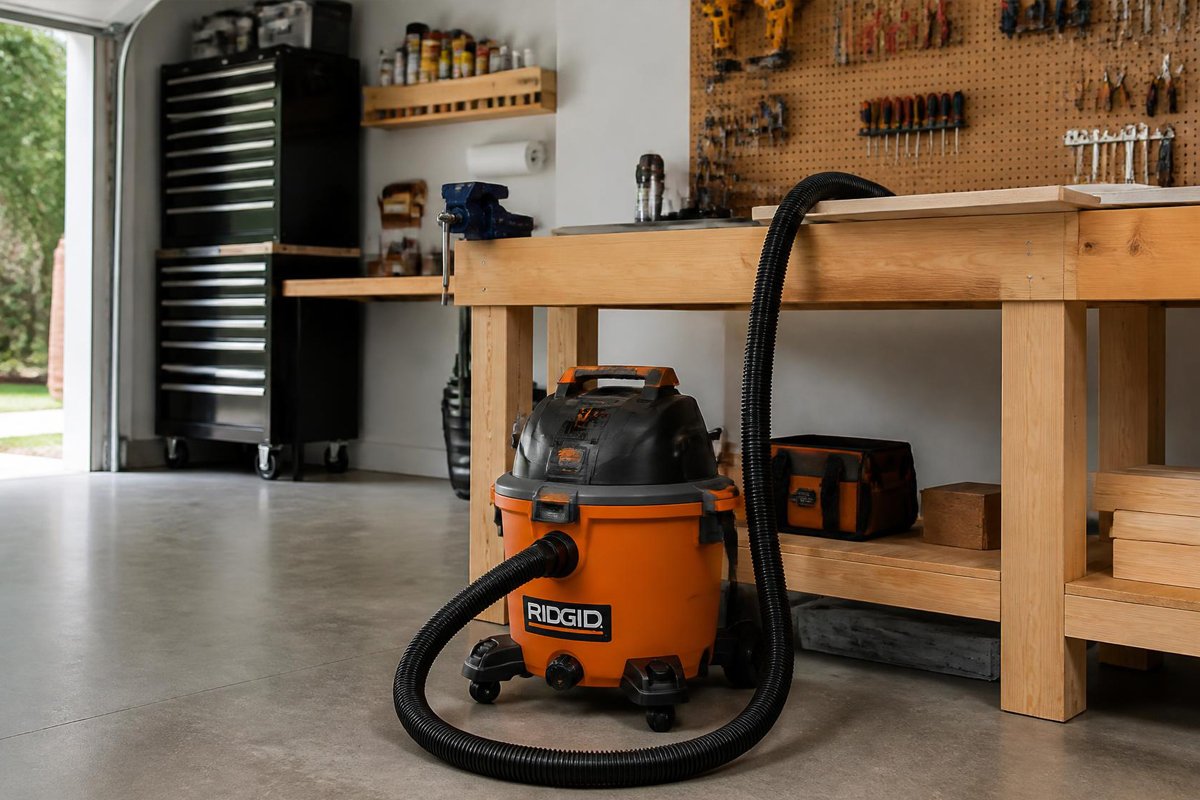
- Sweep or use a shop vacuum to clear all loose debris first
- Spot-treat oil and grease stains with a garage floor degreaser
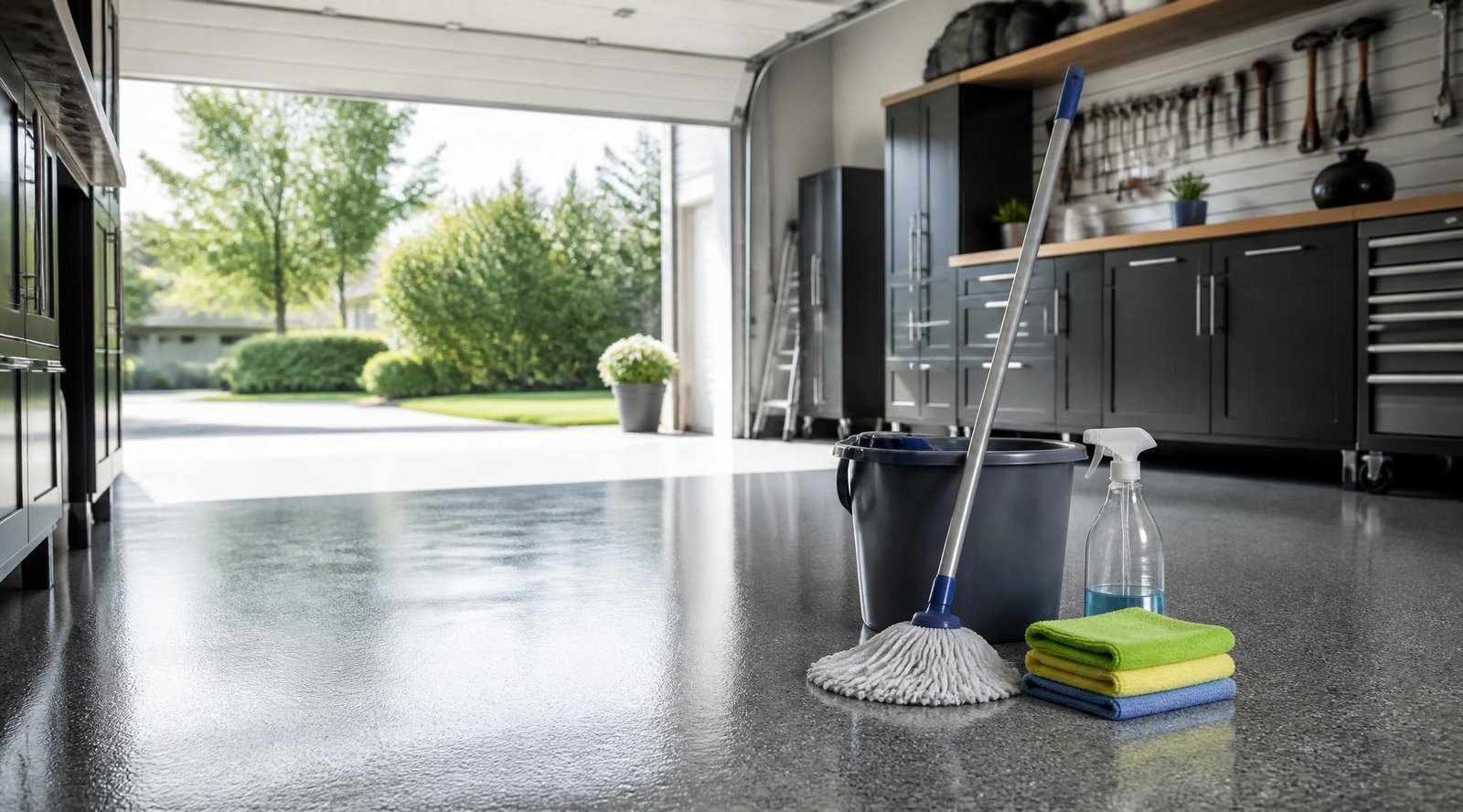
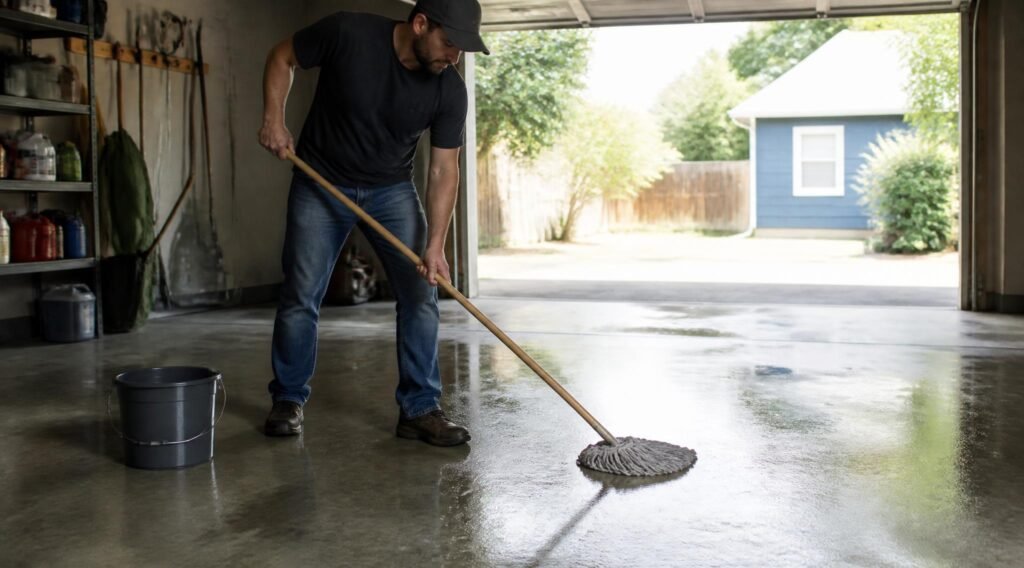
- Wash the full floor with a pressure washer or a stiff broom and cleaning solution if pressure washing isn’t practical indoors
- Let the floor dry completely before returning items to the space
Phase 6: Finishing Touches
- Run an odor-elimination pass if any musty smell lingers after cleaning
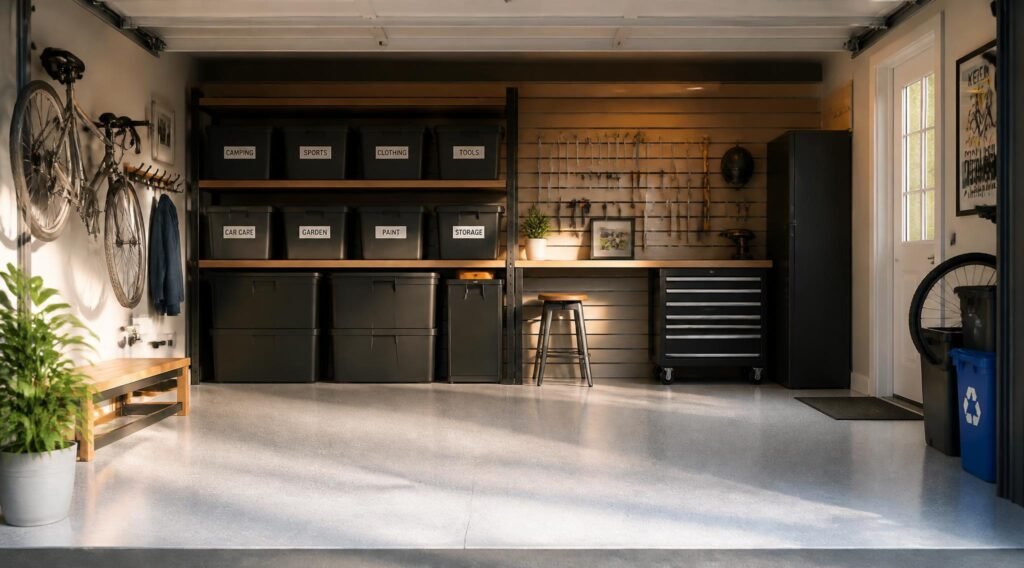
- Return items to labeled zones rather than wherever they fit
- Do a final walkthrough with fresh eyes — most missed spots show up in this last look
Seasonal Cleaning Schedule at a Glance
| Task | Spring | Fall | Monthly |
|---|---|---|---|
| Full declutter and sort | ✅ | ✅ | — |
| Ceiling, rafters, cobwebs | ✅ | ✅ | — |
| Walls and cabinets wipe-down | ✅ | ✅ | Spot-check |
| Garage door clean | ✅ | ✅ | Quick wipe |
| Full floor wash | ✅ | ✅ | Sweep only |
| Odor and mold check | ✅ | ✅ | Quick sniff test |
A spring deep clean clears out winter grime — road salt, slush stains, and condensation buildup. A fall deep clean prepares the space before it’s sealed up for cold weather, when moisture and stored items sit undisturbed for months. Monthly maintenance in between is mostly about not letting small messes compound into the next full deep clean.
Deep Cleaning Different Areas of the Garage
Workshop or tool zone: Sawdust and metal shavings need to be vacuumed rather than swept, since sweeping just redistributes fine particulate into the air and back onto surfaces. If you’re setting up or reorganizing this area, it’s worth reviewing a full garage workshop setup guide at the same time.
Storage zone: Cardboard boxes sitting directly on concrete are a common source of trapped moisture and musty odor. Elevate storage on shelving or pallets during the deep clean, not just for cleaning access but as an ongoing habit.
Vehicle bay: This area sees the heaviest grime — oil drips, tire residue, and road salt in winter climates. It also benefits most from the degreaser-then-wash sequence described in Phase 5 above.
Entry zone (house-to-garage door): This gets tracked dirt from both directions and is easy to overlook since it’s not “storage” or “workspace.” A quick wall and floor wipe here prevents dirt from migrating into the house.
Overhead and rafter storage: If the garage has ceiling-mounted racks or exposed rafters used for seasonal storage, these collect a surprising amount of dust because they’re rarely disturbed. Pull stored items down during Phase 1 rather than cleaning around them, and check for any signs of pest activity while everything is out in the open — a garage’s overhead storage is one of the more common places for nests to go unnoticed for months.
How to Deep Clean a Garage Step-by-Step
Step 1: Prepare the Space
Open the garage door and any windows for ventilation, gather all cleaning supplies in one spot, and set aside dedicated time — rushing a deep clean is how steps get skipped.
Step 2: Clear and Sort
Remove everything from the garage or move it to the center, away from walls and shelving, so every surface is fully accessible.
Step 3: Clean Top to Bottom
Work from the ceiling down through walls and cabinets, following Phases 2–4 above, before touching the floor at all.
Step 4: Wash the Floor
Complete Phase 5 in full, allowing adequate drying time before moving items back in.
Step 5: Reorganize and Review
Return sorted items to clearly defined zones, do the finishing-touches pass, and take a photo for reference — it makes the next deep clean faster to plan.
Common Mistakes
Cleaning the floor first. Dust and debris from ceiling, walls, and shelving will resettle on a freshly cleaned floor, undoing the work. Always finish the floor last, as outlined in the step-by-step floor cleaning guide.
Using the wrong cleaner on a coated floor. A degreaser or cleaner formulated for bare concrete can dull or damage an epoxy or polyaspartic coating — always check what the floor’s finish actually is before applying anything.
Skipping ventilation. Many garage cleaning products are stronger than typical household cleaners, and an enclosed garage with the door shut concentrates fumes quickly.
Expert Tips
Label storage zones after the declutter phase, not before — you’ll have a much clearer sense of what actually needs a permanent spot once everything’s sorted rather than guessing in advance.
Keep a small “quick-clean kit” — a handheld vacuum, a microfiber cloth, and a spray bottle — near the garage entrance so small spills and dust get handled weekly instead of piling up until the next full deep clean.
If cleaning a two-car garage or workshop-sized space, split the deep clean across a weekend rather than one long day; drying time for the floor alone can eat several hours you can use productively elsewhere.
Take a “before” photo of each zone before decluttering starts. It sounds unnecessary in the moment, but it becomes the fastest way to judge progress halfway through, and it’s genuinely useful for planning the next seasonal clean — you’ll immediately see which areas accumulated clutter fastest and can budget extra time for them next time.
Final Thoughts
A garage deep clean isn’t complicated, but it does depend on sequence — declutter, then ceiling-to-cabinet, then walls, then door, then floor last, then finishing touches. Best overall approach: follow the full checklist twice a year. Best for a quick refresh: focus on Phases 1, 5, and 6 only. Best for a workshop-heavy garage: pay extra attention to the vacuuming step in Phase 5, since fine dust is the biggest recurring issue in that zone.
Whichever pace you take, the full checklist above, the floor cleaning steps, and the odor removal guide cover the vast majority of what makes a garage deep clean actually stick between seasons.
Frequently Asked Questions
How long does a full garage deep clean take? A single-car garage typically takes 3–4 hours for a full deep clean. A two-car garage or one that doubles as a workshop can take a full day, especially with floor-drying time factored in.
How often should I deep clean my garage? Twice a year — spring and fall — is the standard recommendation, with lighter monthly maintenance in between to prevent buildup.
Do I need special products, or will household cleaners work? Household cleaners work fine for walls and cabinets, but floors — especially oil-stained or coated ones — usually need a dedicated degreaser or floor cleaner formulated for garage use.
Pressure washer vs. mop — which is better for the floor? A pressure washer is faster and more thorough for bare concrete, but isn’t always practical for enclosed or finished garages. A manual method without a pressure washer works well for coated or smaller floors.
My garage still smells musty after cleaning — what’s wrong? Lingering odor after a full clean usually points to a moisture source that hasn’t been addressed, such as a leak, poor ventilation, or hidden mold. See the garage odor removal guide for a full troubleshooting process.
Should I clean before or after decluttering? Always declutter first. Cleaning around stored items just means cleaning the same surface twice once those items are eventually moved.
Is it safe to use a shop vacuum on drywall dust and sawdust? Yes, and it’s the recommended method — a shop vacuum rated for fine particulate handles this far better than a broom, which tends to redistribute dust into the air.
What should I do with expired chemicals found during the declutter phase? Don’t pour them down a drain or into regular trash. Most municipalities have a household hazardous waste collection program — check local guidelines before disposal.
Can I deep clean a garage that’s also a home gym or living space conversion? Yes, but plan extra time for protecting equipment or flooring not designed for standard garage cleaning products, and consider reviewing a garage-to-living-space conversion guide if the space serves a dual purpose.
Does a clean garage actually help prevent pests? Yes — clutter and food residue (including pet food storage) are the two biggest attractants. A full declutter and cabinet wipe-down phase removes most of what draws pests in.
Author: Danial Marquez Last Updated: September 2026