Most garages run on one sad ceiling bulb and whatever daylight sneaks in around the door — which is fine until you’re trying to tell a 10mm socket from a 12mm one, or find the paint can you swear you just set down. Upgrading to modern LED shop lights is one of the highest-impact, lowest-effort improvements you can make to a garage, and it doesn’t require rewiring anything in most cases.
Garage lighting is also one of the areas where the market has genuinely improved fast. A decade ago, upgrading meant swapping in brighter incandescent or fluorescent tubes that ran hot, flickered, and needed replacing every year or two. Modern LED shop lights run cool, last tens of thousands of hours, and cost a fraction of what equivalent brightness used to cost in electricity — which is why this has become one of the most recommended first upgrades for anyone turning a garage into an actual workspace rather than just a parking spot.
We compared products on lumen output, color temperature, CRI (color accuracy), installation type, coverage area, and price-to-brightness value — specifically for garage use rather than general household lighting, where the priorities and typical fixture types differ.
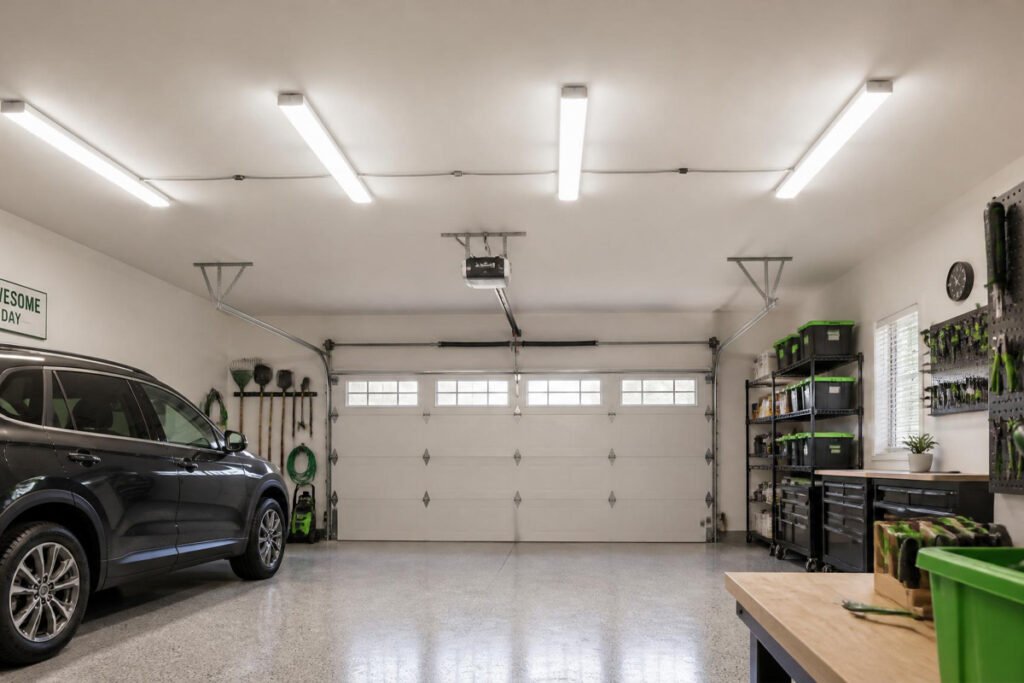
Quick answer: for most two-car garages, a set of linkable 4-foot LED shop lights delivering 4,000+ lumens each is the best balance of brightness, coverage, and price. Car enthusiasts who care about accurate color under the hood should look at a higher-CRI hexagon or panel system instead. Full picks and a buying guide follow below. If you’re setting up the rest of the space at the same time, our garage workshop setup guide and workbench organization guide cover the other half of building a genuinely usable space.
Quick Comparison
| Product | Best For | Output / Color | Approx. Price |
| Hykolity 4-Pack Linkable Shop Light | Best Overall for a Two-Car Garage | 4,400 lm each, 5000K | ~$55–$65 |
| TANBABY 2-Pack Deformable Panel | Best Raw Brightness for the Price | 30,000 lm combined, 6500K | ~$30–$40 |
| LZHOME Hexagon Modular System | Best for Auto Detailing & Color Accuracy | Modular, 5000K, CRI 85+ | ~$60–$120 |
| Sunco 4ft Hardwired Shop Light | Best Permanent/Professional Install | 8,200 lm, 5000K | ~$35–$45 each |
| AUDLES 2-Pack Deformable Panel | Best Ultra-Budget Pick | 20,000 lm each, 6500K | ~$20–$25 |
Note: prices and lumen figures are approximate and based on typical current listings — confirm exact specs and pricing before you buy.
1. Hykolity 4-Pack Linkable LED Shop Light — Best Overall
⭐ Best Overall
4,400 lumens per fixture (~17,600 total) | 5000K daylight | Linkable, plug-in | ETL listed | ~$55–$65 for 4-pack
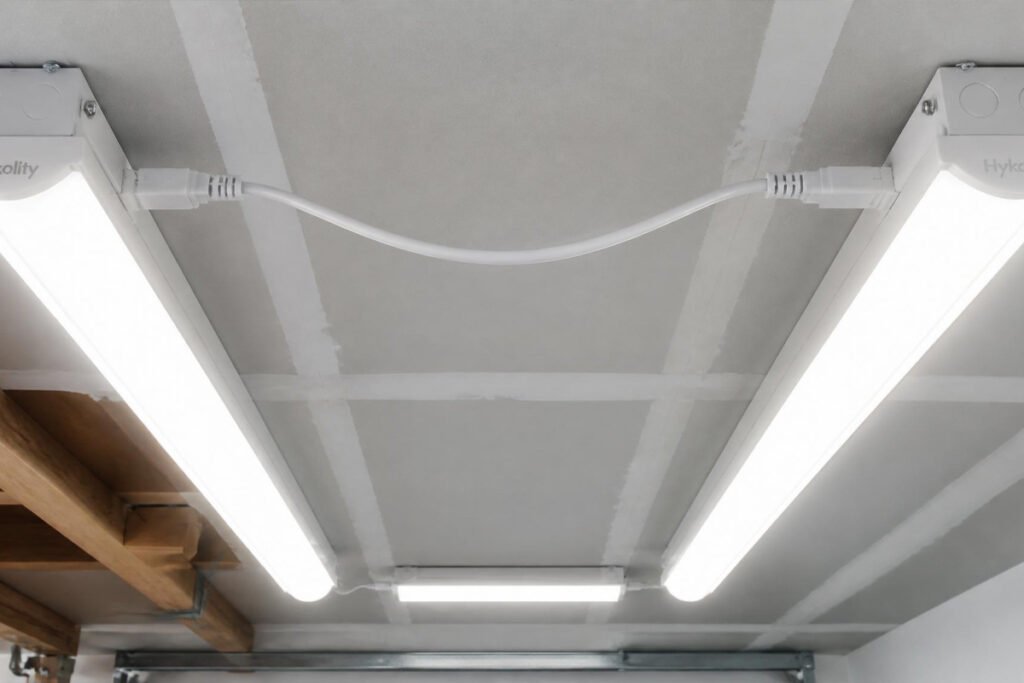
This is the setup most people should actually buy: four linkable fixtures that plug into a single outlet and daisy-chain together, giving a typical two-car garage genuinely even, shadow-free coverage instead of one bright spot under a single bulb. At 5000K, the color sits in the crisp “daylight” range that makes it easy to read labels and spot stains without feeling clinical.
Why buy it
- Linkable design covers a full two-car garage from a single outlet, no extra wiring needed
- 4,400 lumens per fixture is enough for genuine task lighting, not just ambient glow
- Straightforward ceiling or surface mount installs in well under an hour for the full set
Worth knowing
- No dimming — these are on-or-off fixtures, which is fine for a workspace but not adjustable for mood lighting
- Plastic housing keeps cost down but feels less substantial than metal fixtures
Verdict: the default recommendation for most garages — genuinely bright, easy to install, and priced for a full-room upgrade rather than a single fixture.
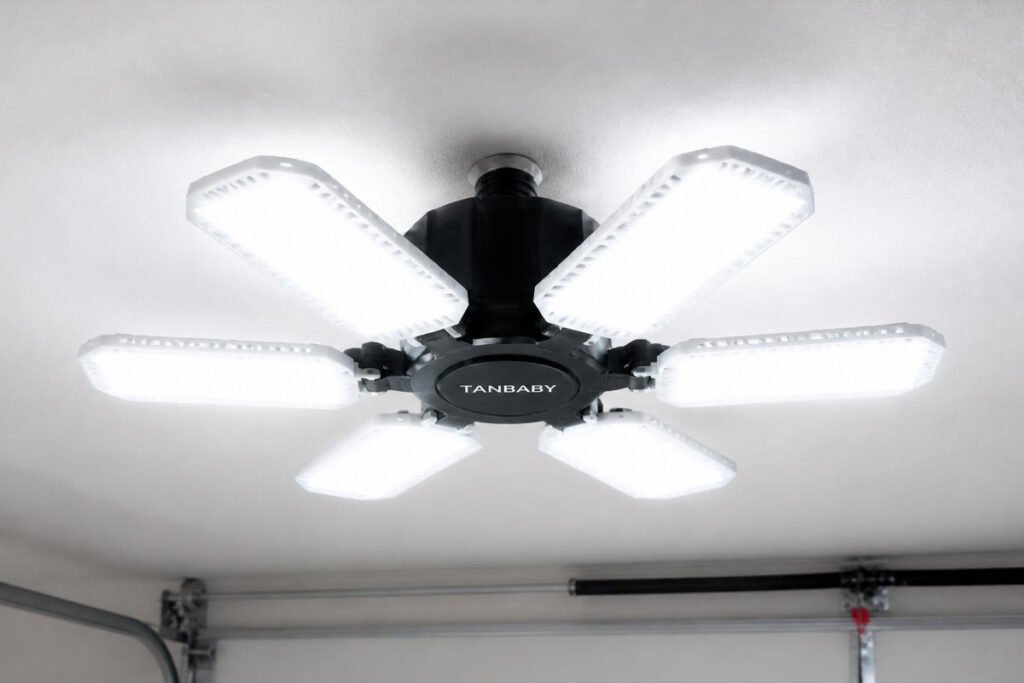
2. TANBABY 2-Pack Deformable LED Panel — Best Raw Brightness for the Price
💡 Best Brightness
30,000 lumens combined | 6500K daylight | Adjustable multi-panel, screw-in base | ~$30–$40
These screw into a standard E26/E27 socket and unfold into six or more adjustable panels, which means you can aim the light exactly where you need it rather than accepting a fixed beam. At 30,000 combined lumens across a 2-pack, this is genuinely bright — among the highest lumen-per-dollar options on the market — and the adjustable panels help spread that output evenly instead of creating one blinding hotspot.
Why buy it
- Among the highest lumen output per dollar of any option on this list
- Adjustable panels let you aim light at a specific workbench or corner
- Screws into an existing fixture or socket — no new wiring or bracket needed
Worth knowing
- Very wide, diffuse light pattern rather than a focused beam — great for general illumination, less ideal for concentrated task lighting
- No dimming, and full brightness can feel intense in a smaller single-car garage
Verdict: the pick if raw brightness-per-dollar is your main priority and you already have a fixture or socket to screw it into.
3. LZHOME Hexagon Modular System — Best for Auto Detailing & Color Accuracy
🎯 Best for Detailing
Modular hexagon panels | 5000K, CRI 85+ | DIY grid layout | ~$60–$120 depending on panel count
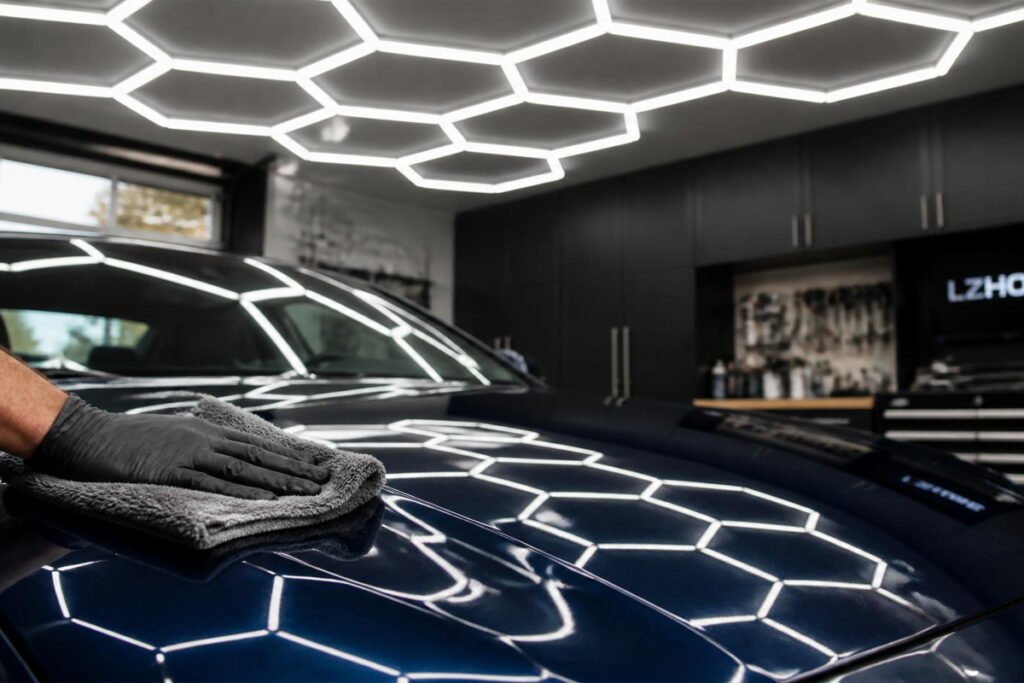
The hexagon panels click together into a custom honeycomb layout sized to your ceiling and use case, and the higher CRI (color rendering index) rating is the real reason to pick this over a cheaper deformable panel: at CRI 85+, paint colors, primer mismatches, and touch-up work look accurate instead of washed out or color-shifted. That distinction matters a lot if you’re detailing, painting, or doing any color-critical work under these lights, and much less if you’re just trying to see your tools.
Why buy it
- CRI 85+ shows true color — genuinely useful for detailing, painting, and touch-up work
- Modular hexagon layout adapts to odd ceiling shapes and can expand over time
- Wide, even light spread across the whole panel grid reduces harsh shadows
Worth knowing
- Costs more than a standard shop light per lumen, since you’re paying for color accuracy and the modular design
- Installation takes longer than a simple linkable 4-pack, since you’re planning a custom layout
Verdict: worth the premium specifically if color accuracy matters to what you do in the garage — skip it if you just need to see clearly.
4. Sunco 4ft Hardwired LED Shop Light — Best Permanent Install
🔧 Best Permanent Install
8,200 lumens | 5000K | Hardwired, surface mount | 7-year warranty | ~$35–$45 each
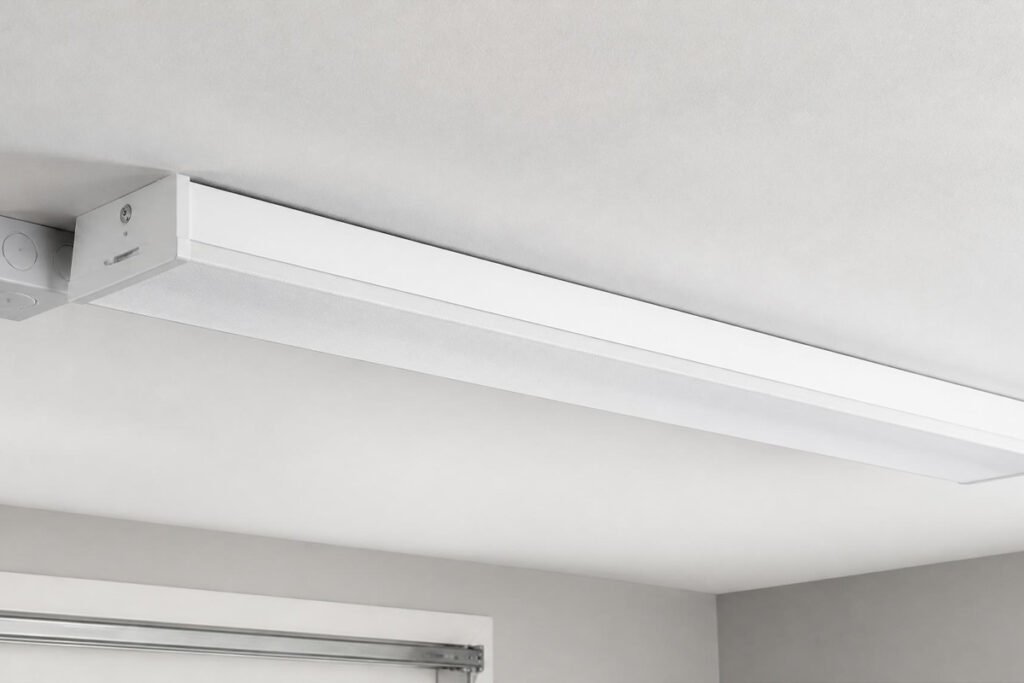
If you’re already doing electrical work — during a workshop build-out or alongside an EV charger installation — a hardwired fixture is worth the extra step. Skipping the plug and cord means no dangling cables, no outlet dependency, and a genuinely finished, professional look. The 7-year warranty is also among the longest offered on this list, reflecting a fixture built for a true permanent install rather than a plug-in upgrade.
Why buy it
- Clean, cordless, professional-grade permanent installation
- 7-year warranty is longer than most plug-in alternatives
- No outlet dependency — wired directly into a switched circuit
Worth knowing
- Requires actual electrical work — a licensed electrician or genuine comfort with house wiring
- Lower per-fixture lumen output than the brightest deformable panels, so you may need more fixtures for full coverage
Verdict: the right choice if you’re already opening up the ceiling or walls for other electrical work and want a permanent, no-cord finish.
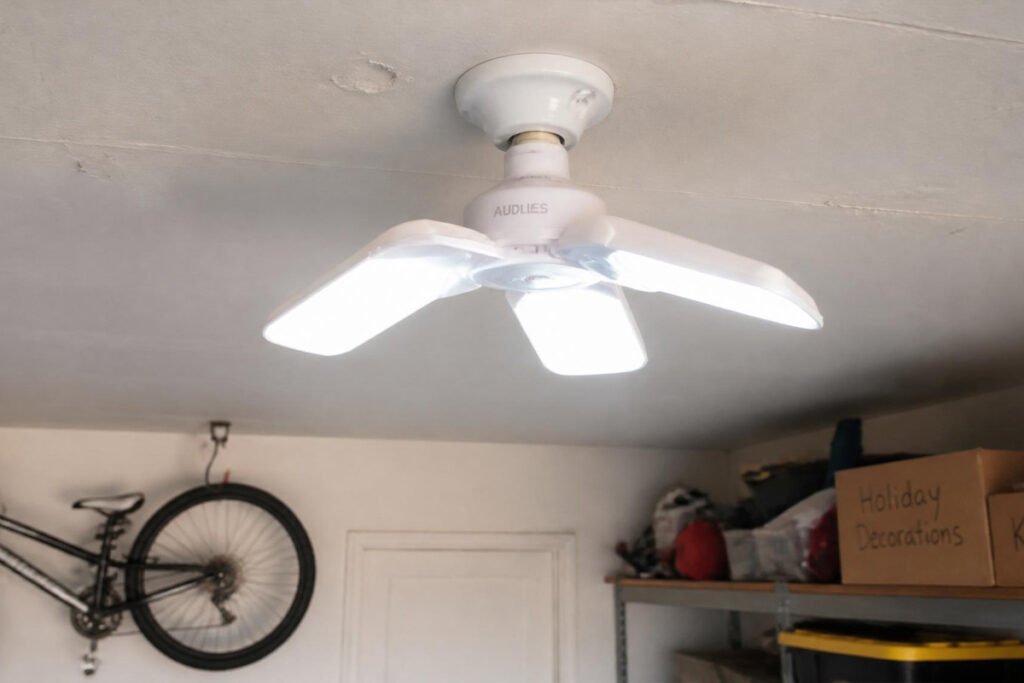
5. AUDLES 2-Pack Deformable Panel — Best Ultra-Budget Pick
💰 Best Budget
20,000 lumens per light | 6500K | Adjustable panels, screw-in base | ~$20–$25
At roughly the price of a fast-food meal per light, this delivers a genuinely usable 20,000 lumens per fixture — more than enough for a single-car garage or as a quick fix for one dark corner. It won’t match the build quality or coverage evenness of the pricier options above, but for the cost, it’s a dramatic upgrade over a single incandescent bulb.
Why buy it
- Lowest price on this list by a wide margin, while still delivering genuinely usable brightness
- Simple screw-in installation — works with an existing fixture in minutes
- Good option for a single problem corner rather than a whole-garage overhaul
Worth knowing
- Build quality and long-term durability trail the pricier picks on this list
- Less even light spread across a larger two-car garage — better suited to a smaller space or single fixture location
Verdict: the right call if budget is the primary constraint and you just need meaningfully more light than what’s currently there.
Common Mistakes When Buying Garage Lights
Judging by wattage instead of lumens
Wattage measures power draw, not brightness. A 60W “equivalent” LED bulb might produce anywhere from 500 to 900 lumens depending on the manufacturer — always check the actual lumen number on the packaging rather than assuming wattage tells you how bright something is.
Buying one fixture when you need several
A single bright fixture creates a hotspot directly beneath it and leaves the corners dim. Two or more linked fixtures spread evenly across the ceiling almost always outperform one very bright single unit for actual usability, even at a similar total lumen count.
Ignoring the mounting height
Lumen output on the package assumes a specific mounting height, typically 8–10 feet. A garage with a higher or lower ceiling than that will see noticeably different real-world brightness than the number on the box suggests — err toward more lumens if your ceiling is unusually tall.
Skipping the linkable feature
If a fixture supports daisy-chaining to additional units, using that feature from one outlet is almost always cleaner and easier than running separate cords to multiple outlets — check that a product explicitly supports linking before assuming you can chain several together.
Fast Buying Guide
Lumens: how much light do you actually need
As a starting benchmark, aim for roughly 50 lumens per square foot of garage floor for general work lighting. A typical two-car garage (400–450 sq ft) lands comfortably in the 18,000–22,000 total lumen range — which is why the linkable 4-packs and higher-output panels on this list are sized the way they are. For comparison, the average American two-car garage reportedly still runs on well under 4,000 total lumens — roughly a fifth of what’s actually recommended for detail-oriented tasks like automotive repair or woodworking, which is exactly the gap these fixtures are designed to close.
Color temperature: 5000K vs. 6500K
5000K reads as neutral daylight white and is the most common recommendation for general garage use — bright and clear without feeling clinical. 6500K skews slightly bluer and cooler, which some people prefer for detail work but can feel a bit harsh for long sessions. Either works well; it’s mostly personal preference once you’re above 4000K.
CRI: does color accuracy matter to you
CRI (Color Rendering Index) measures how accurately a light source reveals true color compared to natural daylight. Standard shop lights often sit in the CRI 70–80 range, which is fine for general visibility but can make paint colors and finishes look slightly off. If you’re doing detailing, painting, or any color-critical work, look for CRI 85+ like the hexagon system above.
Plug-in vs. hardwired
Plug-in linkable fixtures are the faster, lower-commitment choice and the right default for most homeowners. Hardwired fixtures look cleaner and skip outlet dependency entirely, but require actual electrical work — a natural add-on if you’re already opening up wiring for another project.
Where extra lighting matters most
General ceiling coverage handles most of a garage, but a few spots benefit from dedicated task lighting on top of it: directly over a workbench, inside any garage that’s been converted into a home gym or living space where lighting quality affects daily comfort rather than just visibility, and near an entry door for safety and visibility at night. If you’ve recently insulated and finished the ceiling, that’s also a natural moment to plan permanent fixture locations before drywall goes up.
One more note on efficiency: LED lighting is already the most energy-efficient widely available lighting technology, with the U.S. Department of Energy citing efficacies up to 150 lumens per watt or more in some products — which is part of why even the brightest options on this list sip power compared to old fluorescent tubes.
Frequently Asked Questions
What’s the single best LED light for a garage?
For most two-car garages, the Hykolity 4-Pack Linkable Shop Light is the strongest all-around pick — it covers the full space evenly from one outlet without requiring any electrical work.
How many lumens do I need for a garage?
Aim for roughly 50 lumens per square foot for general work lighting. A typical two-car garage needs somewhere around 18,000–22,000 total lumens; a single-car garage can often get by with 8,000–12,000.
Is 5000K or 6500K better for a garage?
Both work well. 5000K is the more common recommendation for a balance of brightness and comfort over long periods; 6500K is slightly cooler and some people prefer it for detail-oriented tasks. The difference is mostly personal preference above 4000K.
Do I need an electrician to install garage LED lights?
Not for plug-in linkable fixtures — those install in under an hour with basic tools. Hardwired fixtures do require an electrician or genuine comfort working with house wiring, since you’re tying into a circuit rather than plugging into an outlet.
What’s the difference between CRI 80 and CRI 85+?
CRI measures how accurately a light reveals true color compared to natural daylight. CRI 80 is perfectly fine for general visibility and everyday tasks. CRI 85+ shows noticeably truer color, which matters for detailing, painting, and any work where color accuracy affects the outcome.
Can I mix different brands or lumen outputs in the same garage?
You can, but it’s not ideal — mismatched color temperatures (say, 5000K next to 6500K) create a visibly inconsistent look, and mismatched brightness levels can create uneven hotspots. If possible, stick to one product line for the main ceiling coverage and reserve mixing for distinctly separate purposes, like a cooler task light over a workbench versus warmer general coverage elsewhere.
How long do LED garage lights actually last?
Most quality LED shop lights are rated for 25,000–50,000 hours of use, which at a few hours a day translates to well over a decade of typical garage use — a dramatic improvement over fluorescent tubes that often needed replacing every year or two.
The Bottom Line
If you buy just one thing from this list, make it a linkable 4-pack like the Hykolity set — it solves the actual problem (a dim, shadowy garage) for most households without any electrical work. Step up to a higher-CRI hexagon system only if color accuracy genuinely matters to what you do in the space, and consider hardwiring only if you’re already opening up wiring for another project.
Last Updated: July 2026