By Danial Marquez | Maintenance | Updated June 2026
The average gym membership costs $500–$800 per year. The average commute to and from the gym eats 30–60 minutes per workout. And the average gym visit means waiting for equipment, dealing with crowds, and working out on someone else’s schedule.
A garage home gym solves all of that.
Converting your garage into a dedicated workout space is one of the best home improvement investments you can make in 2026. Done right, a garage gym gives you access to professional-quality training equipment, 24/7 availability, total privacy, and a space that can be customised exactly to how you train — all without leaving your home.
The good news is that a garage gym conversion does not have to be expensive or complicated. Whether you are working with a single-car garage on a tight budget or turning a two-car garage into a full commercial-quality training facility, this complete guide walks you through every step of the process — from preparing the space and choosing the right flooring, to selecting equipment, improving lighting and ventilation, and making your garage gym a space you actually want to spend time in.
Why a Garage Gym Is the Best Investment You Can Make in 2026
Before diving into the how-to, it is worth understanding exactly why garage gyms have exploded in popularity and why the investment makes sense.
Cost savings over time. A well-equipped garage gym can be set up for $500–$3,000 depending on what equipment you choose, and it pays for itself within 2–4 years compared to ongoing gym membership fees. After that, every workout is essentially free.
Zero commute, zero waiting. Your gym is 30 feet from your living room. You can train at 5 AM, during lunch, or at 11 PM without driving anywhere or waiting for a squat rack to open up.
Complete customisation. You choose the equipment. You choose the music. You choose the temperature. You set the layout to match exactly how you train — something no commercial gym will ever offer.
Adds value to your home. A well-finished garage gym is an attractive feature for future home buyers. Unlike some garage modifications, a clean, professional gym conversion is generally viewed as a positive by real estate appraisers.
Better consistency. Research consistently shows that people who exercise at home maintain more consistent workout habits than those who commute to gyms. When friction is reduced, excuses disappear.
Privacy. No one watching you. No unsolicited advice. No waiting. Just you, your equipment, and your goals.
Step 1: Assess and Plan Your Garage Gym Space
Every successful garage gym conversion starts with an honest assessment of the space you are working with and a clear plan for how you intend to use it.
Measure Your Garage
Before buying a single piece of equipment, measure your garage precisely:
- Total floor area (length × width)
- Ceiling height — critical for overhead movements like pull-ups, Olympic lifting, and kettlebell swings (you need at least 8 feet; 9–10 feet is ideal for overhead pressing)
- Door clearance — the garage door and its tracks take up space; measure how much room you have once the door is fully open
- Obstructions — columns, water heaters, electrical panels, storage areas you intend to keep
A single-car garage (approximately 10 × 20 feet = 200 sq ft) is sufficient for a very functional home gym. A double-car garage (approximately 20 × 20 feet = 400 sq ft or larger) gives you room for a comprehensive setup.
Define Your Training Goals
The equipment you need depends entirely on how you train. Be honest about this before spending any money:
- Strength training (powerlifting/weightlifting): Barbell, rack, weight plates, bench — these are the priorities. Everything else is secondary.
- Functional fitness / CrossFit-style: Barbell, pull-up rig, rings, kettlebells, jump rope, rower or assault bike.
- Cardio and general fitness: Treadmill or bike, adjustable dumbbells, resistance bands, pull-up bar, some open floor space.
- Bodybuilding / hypertrophy: Cable machine or functional trainer, adjustable dumbbells, bench, multiple barbells and bars.
- Mixed martial arts / boxing: Heavy bag, mats, open floor space — equipment needs are relatively minimal but space requirements are higher.
Defining your goals prevents the most common garage gym mistake: buying equipment you do not actually use and running out of space.
Create a Layout Plan
Sketch a simple floor plan (or use a free app like MagicPlan or RoomSketcher) showing where each piece of equipment will go. Consider:
- Heavy, fixed items (rack, cable machine) in the centre or along walls
- Cardio equipment where you want to watch TV or look outside
- Open floor space for stretching, mobility work, or mat-based movements
- Clear pathways between all equipment for safety
- Wall space for pegboards, mirrors, or storage
Plan your layout before buying equipment — not after.
Step 2: Prepare the Garage Structure
Converting a garage into a gym requires addressing several structural and comfort issues that most people underestimate. Skipping these steps results in a space that is uncomfortable, potentially damaging to equipment, and unpleasant to train in.
Inspect and Clean the Space
Start by completely emptying the garage and doing a thorough inspection:
- Check for cracks, moisture stains, or water damage on the floor (water infiltration under flooring will ruin rubber mats and create mould)
- Inspect walls for dampness, pest damage, or structural issues
- Check the ceiling for any leaks around the garage door tracks or roof line
- Assess the electrical situation — how many outlets do you have, and where are they?
Once inspected, clean the garage thoroughly. Our complete garage floor cleaning guide covers how to properly deep-clean concrete before any flooring goes down. Do not skip this step — dirt and oil under flooring create uneven surfaces and reduce the lifespan of your mats.
Address Any Moisture Issues
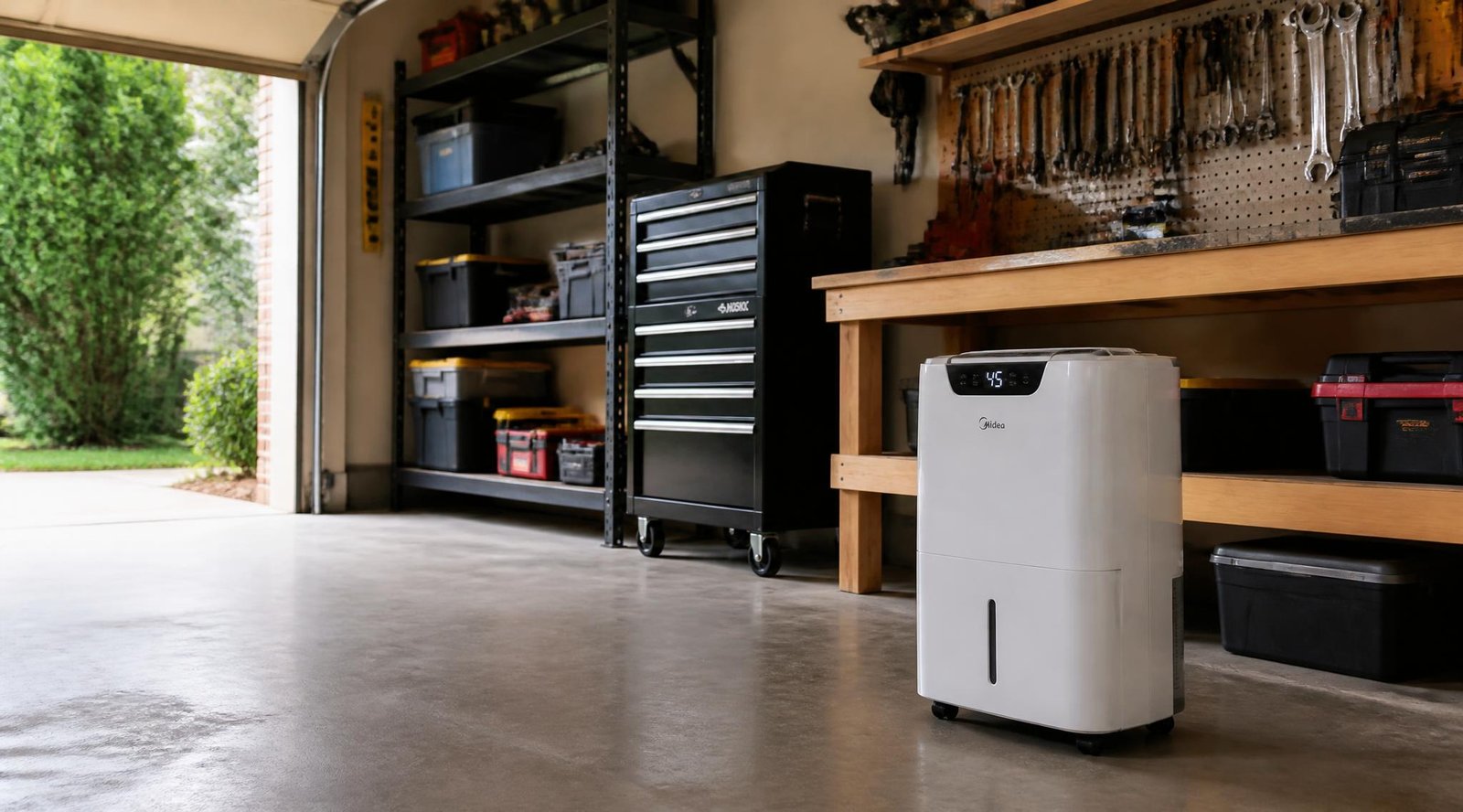
Moisture is the enemy of a garage gym. It damages rubber flooring, promotes mould growth, rusts iron weights, and makes the space uncomfortable to train in.
Before laying any flooring:
- Perform a moisture test. Tape a 12 × 12 inch piece of plastic sheeting to the bare concrete floor and seal all four edges with tape. Leave it for 24–48 hours. If moisture condenses on the underside of the plastic, your floor has a moisture infiltration problem that needs addressing before you install flooring.
- Apply a concrete sealer if moisture is present. A penetrating concrete sealer (not just a surface coating) reduces moisture transmission significantly and is inexpensive to apply.
- Seal gaps and cracks in the floor and walls using an appropriate filler or hydraulic cement for wet cracks.
Moisture management is also closely related to ventilation, which we cover in detail in Step 4.
Step 3: Insulate Your Garage Gym
An uninsulated garage is unusable as a gym for large parts of the year in most climates. In summer, temperatures can reach 110°F+ in an uninsulated metal garage in full sun. In winter, an uninsulated garage in a cold climate is so uncomfortable it stops most people training.
Insulation is one of the single best investments you can make in a garage gym.
What to Insulate
Garage door — The garage door is the largest single source of heat loss and heat gain in most garages. Even if you insulate the walls and ceiling perfectly, an uninsulated door undermines everything. Either install a new insulated door or purchase a garage door insulation kit (rigid foam panels that attach to the interior of an existing door). Our guide on how to insulate a garage covers every component in full detail, including R-value recommendations by climate zone.
Walls — Standard 2×4 stud walls should be insulated with R-13 to R-15 fibreglass batts or spray foam. If your garage walls are unfinished (exposed studs), this is the perfect time to insulate before drywalling.
Ceiling — Heat rises; a poorly insulated ceiling allows enormous amounts of heat transfer. R-30 or higher is recommended for garage ceilings in most climates.
Floor — While floor insulation is less practical in an existing garage (it would require raising the floor level), a quality rubber floor provides modest thermal insulation compared to bare concrete, and it dramatically reduces the cold-feet sensation that makes barefoot training in winter unpleasant.
Heating and Cooling Your Garage Gym
Even with good insulation, you will likely want some form of climate control:
Heating options:
- Electric fan heaters (cheap to purchase, expensive to run long-term)
- Propane or natural gas heaters (efficient for larger spaces, requires ventilation)
- Mini-split heat pump (most efficient long-term option, both heats and cools, requires professional installation)
- Infrared heaters (excellent for garages — they heat objects and people rather than air, making them efficient in leaky spaces)
Cooling options:
- Portable air conditioner (easy to install, less efficient)
- Mini-split system (recommended for serious long-term use)
- High-velocity fans + open garage door (effective in mild climates)
For most garage gym owners in moderate climates, an infrared heater for winter and large fans or a portable AC for summer is a cost-effective starting point.
Step 4: Ventilation — The Most Overlooked Element
Ventilation is the most overlooked element of garage gym design — and one of the most important.
When you exercise intensely in an enclosed space, you produce heat, CO2, and moisture. Without adequate air exchange, the space becomes hot, humid, and stuffy within minutes. Beyond comfort, poor ventilation in a garage that also stores vehicles creates carbon monoxide risk.
Ventilation Strategies
Exhaust fan — A wall-mounted exhaust fan that vents to the outside is the most effective single ventilation upgrade for a garage gym. A fan rated at 200–400 CFM (cubic feet per minute) for a standard single-car garage provides strong air turnover.
Intake vent — Pair your exhaust fan with an intake vent on the opposite wall or side of the garage to create true cross-ventilation. Air needs somewhere to enter as well as exit.
Garage door — Training with the garage door partially or fully open is one of the simplest ventilation strategies in mild weather. Many garage gym owners train with the door open by default in spring and autumn.
Mini-split with fresh air intake — Premium mini-split systems can be paired with fresh air intake kits that bring a controlled amount of outside air into the system, providing both climate control and ventilation simultaneously.
For more on garage ventilation design, our garage safety guide covers the CO risk from engines in garages and the ventilation requirements to manage it safely — important reading if you ever run your car in the same space as your gym.
Step 5: Garage Gym Flooring
Flooring is the foundation of your garage gym — literally and figuratively. The right flooring protects your concrete, absorbs impact, reduces noise, improves safety, and makes the space feel like a proper gym rather than a bare garage.
Rubber Flooring: The Standard Choice
Rubber flooring is the gold standard for garage gyms. It is durable, impact-absorbing, easy to clean, resistant to moisture, and available in configurations that work for any budget and training style.
Rubber horse stall mats (4×6 feet, 3/4 inch thick) — The most popular and cost-effective garage gym flooring option. Available at farm supply stores for approximately $40–$60 per mat, they are extremely durable, have good impact absorption, and are easy to lay without adhesive (they stay in place from their own weight). The downside is they are heavy (approximately 100 lbs each) and can have a strong rubber odour when new that takes several weeks to dissipate.
Interlocking rubber tiles — Easier to install and configure around equipment than stall mats, rubber interlocking tiles come in various thicknesses (3/8 inch for general use, 3/4 inch for weightlifting areas). They allow you to mix thicknesses in different zones (thicker under the rack, thinner in cardio areas) and can be rearranged as your gym evolves.
Rolled rubber flooring — Offers a seamless surface without joints that can catch weights or trip you. More expensive than mats or tiles and typically requires professional installation for large areas, but the result is a cleaner, more gym-like appearance.
Flooring Thickness by Use Case
| Activity | Recommended Thickness |
|---|---|
| General fitness, cardio | 3/8 inch (10mm) |
| Dumbbell and machine work | 1/2 inch (12mm) |
| Barbell training, powerlifting | 3/4 inch (19mm) |
| Olympic lifting, dropping weights | 3/4 inch minimum + lifting platform |
Lifting Platforms
If you plan to do Olympic lifts (clean and jerk, snatch) or drop heavy barbells from overhead, a dedicated lifting platform is strongly recommended. A platform consists of a central section of hardwood (for foot placement) flanked by rubber sections where the barbell lands. You can build one yourself for approximately $150–$250 in materials, or purchase a commercial platform for $400–$1,000+.
Our garage floor epoxy coating guide is also worth reading if you prefer a finished concrete floor for your non-lifting areas — some gym owners epoxy the perimeter areas (where cardio equipment sits) and lay rubber only under the lifting section.
Step 6: Garage Gym Lighting
Training in a dimly lit garage is demotivating, unsafe, and hard on your eyes. Good lighting transforms a dark, gloomy garage into an energising, professional-feeling training environment.
How Much Light Do You Need?
For a workout space, aim for 50–100 foot-candles of illumination at floor level. For a standard garage (200–400 sq ft), this typically means:
- Single-car garage: 2–4 LED shop lights (4,000–6,000 lumens each)
- Double-car garage: 4–6 LED shop lights
Best Lighting for Garage Gyms
LED shop lights (4-foot or 8-foot strip lights) are the most popular choice for garage gyms. They are inexpensive (typically $30–$60 per fixture), energy-efficient, long-lasting, bright, and mount easily to the ceiling. Look for a colour temperature of 4,000K (neutral white) to 5,000K (daylight) for maximum energy and alertness during training.
LED high bay lights provide broad, even illumination from a single fixture. A single 100W LED high bay light can illuminate a large area effectively and is a good option if you prefer fewer fixtures.
Motion-activated lighting can be useful for secondary areas of the gym (storage sections, changing areas) where you want light on demand without it being always on.
Avoid older fluorescent tube lights — they are less energy-efficient, flicker under cold temperatures (making them unreliable in winter), and produce harsher, less motivating light than LEDs.
For a complete lighting upgrade guide covering fixture types, placement, colour temperature, and installation, see our complete garage lighting guide.
Step 7: Electrical Upgrades
A home gym puts significant demand on your garage’s electrical system. Before setting up equipment, assess your electrical situation.
What Equipment Draws Significant Power?
- Treadmills: 10–15 amps (require a dedicated 20-amp circuit)
- Ellipticals: 5–10 amps
- Air conditioners and mini-splits: 15–30 amps (often require a dedicated circuit)
- Infrared heaters: 10–15 amps per unit
- Electric fans: 1–2 amps each
- Televisions and sound systems: minimal draw
Most garages have only one or two outlets on a single circuit. Adding a treadmill, a heater, and an air conditioner to the same circuit will trip the breaker repeatedly.
What Upgrades Should You Make?
At minimum for a functional garage gym:
- Dedicated 20-amp circuit for your treadmill or main cardio machine (required by most manufacturers to maintain warranty)
- At least 4–6 properly spaced outlets around the perimeter of the gym so cords reach equipment without crossing the floor as trip hazards
- GFCI-protected outlets at all locations (required by code in garages)
- Separate circuit for HVAC if you install a mini-split or large heater
Have a licensed electrician assess your panel and run any new circuits. The cost is typically $200–$600 for adding circuits and outlets — a worthwhile investment for safety and convenience.
Step 8: Choose Your Equipment
Equipment selection is where most people either over-invest in things they do not need or under-invest in the foundation pieces they use constantly. Be strategic.
The Core Foundation: What Every Garage Gym Should Have
Flooring — Already covered. This is the true foundation.
A power rack or squat stand — If you lift barbells, a rack is the single most important piece of equipment in your gym. It enables squats, bench press, overhead press, pull-ups (most racks have a pull-up bar), and safely catches the bar if you fail a lift. Budget option: a basic squat stand or fold-flat wall-mounted rack ($200–$500). Mid-range: a freestanding power cage with J-hooks and safety arms ($500–$1,200). Premium: a full commercial-style cage with attachments ($1,500–$4,000+).
A barbell and weight plates — A standard 7-foot Olympic barbell (20kg/45 lb) is compatible with all standard Olympic plates. Start with enough plates to cover your current working weights plus room to progress. Bumper plates (rubber-coated) are quieter and safer for dropping than standard iron plates — recommended for any Olympic lifting.
An adjustable bench — A quality adjustable bench (flat/incline/decline) enables chest press, incline press, rows, step-ups, and dozens of other exercises. Look for a bench rated to at least 1,000 lbs. Budget: $150–$300. Quality: $300–$600+.
Adjustable dumbbells or a dumbbell set — Dumbbells are among the most versatile pieces of equipment you can own. A set of adjustable dumbbells (such as Bowflex SelectTech or PowerBlock) saves enormous amounts of space compared to a traditional dumbbell rack. For a full rack, buy hex dumbbells in pairs: at minimum 15, 25, 35, and 50 lb to start.
Cardio Equipment Options
Treadmill — The most popular home cardio machine. Takes significant floor space (approximately 3 × 6 feet when in use). Look for commercial-grade motors (3.0 HP or higher), a cushioned belt, and a weight capacity appropriate for your household.
Assault bike / air bike — One of the most effective conditioning tools available. Takes up minimal space, has no impact on joints, and provides an incredibly intense cardiovascular workout. Highly recommended for garage gyms with limited space.
Rowing machine — Full-body conditioning, low impact, folds upright for storage. Concept2 is the gold standard. Takes approximately 9 × 2 feet of floor space when in use.
Jump rope — Inexpensive, stores in a pocket, elite conditioning tool. Requires ceiling height of at least 10 feet for comfortable use.
Secondary Equipment Worth Considering
- Pull-up bar (standalone or mounted to wall/ceiling)
- Kettlebell set (16kg, 20kg, 24kg as a solid starting trio)
- Resistance bands
- Gymnastics rings
- Foam roller and mobility tools
- Wall-mounted cable attachment (DIY landmine or commercial unit)
Equipment to Skip (At First)
- Cable crossover machines (enormous, expensive, rarely used by beginners)
- Smith machines (limit natural movement patterns; free weights are more versatile)
- Multiple cardio machines (pick one type and use it)
- Leg press machines (leg pressing on a barbell squat is more effective and takes no extra space)
Step 9: Walls, Storage, and Organisation
A well-organised garage gym is safer, more motivating, and more functional than a cluttered one. Treat your walls as usable space.
Wall Storage for Garage Gyms
Pegboard — One of the best garage gym additions. Mount 4×8 foot pegboard panels on the wall for hanging resistance bands, jump ropes, kettlebells (with appropriate hooks), smaller accessories, and tools. Our guide on 25 best garage wall storage ideas has specific recommendations for heavy-duty wall storage systems that can handle gym equipment weight.
Weight plate storage — Vertical plate storage (upright posts or A-frame trees) keeps plates organised and off the floor. Many power racks include plate storage posts on the sides.
Dumbbell racks — A horizontal or vertical dumbbell rack keeps weights organised and eliminates the floor hazard of dumbbells scattered across the room.
Cable management — Keep power cords off the floor and routed along walls. Cord clips, cable raceways, and velcro ties keep the space tidy and eliminate trip hazards.
Mirrors
Mirrors serve a functional purpose in a gym — they allow you to monitor form during lifts. One large mirror (4×4 feet or larger) on the main wall facing the rack is highly recommended. Use shatter-resistant gym mirrors rather than standard glass mirrors for safety.
Motivational Elements
A garage gym should be a space you genuinely want to enter. Consider:
- Motivational wall art or decals
- A quality Bluetooth speaker (music makes a measurable difference in workout performance — this is not just preference, it is supported by exercise science research)
- A whiteboard or chalkboard for tracking workouts, goals, or PRs
- A clock or timer visible from your main training position
Step 10: Safety in Your Garage Gym
A home gym without proper safety measures is a genuine injury risk. These precautions are non-negotiable.
Rack Safety
- Always use the safety arms or spotter arms on your power rack when lifting heavy without a spotter — these catch the bar if you fail a lift
- Never attempt a max-effort lift alone without a rack with properly positioned safeties
- Ensure your rack is properly levelled and, if required by the manufacturer, bolted to the floor
Weight Storage Safety
- Store heavy plates low, never high — a plate falling from height can cause serious injury
- Return weights to their storage location immediately after each set — weights left on the floor are trip hazards
- Keep the floor path between all equipment clear at all times
Our complete garage safety guide covers fire safety, CO safety, electrical safety, and floor safety in detail — all of which apply directly to garage gym environments. Read it before you set up your equipment.
Ceiling Height and Overhead Safety
Before doing any overhead movement — pull-ups, kettlebell swings, overhead press, Olympic lifts — stand in your gym, extend something (a broomstick) fully overhead, and verify you have clearance from the ceiling, lighting fixtures, and any overhead obstacles.
Securing Equipment
Heavy equipment like treadmills and racks can move on rubber flooring during use. Rack feet should be bolted to a lifting platform or concrete anchors for heavy lifting. Treadmill placement should be away from walls to prevent contact if someone slips.
Budget Guide: How Much Does a Garage Gym Cost?
One of the most common questions about garage gym conversions is how much it costs. Here is a realistic breakdown across three budget levels.
Budget Build ($500–$1,500)
| Item | Estimated Cost |
|---|---|
| Rubber horse stall mats (6 mats) | $300–$400 |
| Basic squat stand | $200–$350 |
| Olympic barbell + 200 lb plate set (used) | $200–$400 |
| Adjustable bench (basic) | $100–$200 |
| LED shop lights (2–3 fixtures) | $80–$150 |
| Total | $880–$1,500 |
Mid-Range Build ($1,500–$4,000)
| Item | Estimated Cost |
|---|---|
| Rubber flooring (interlocking tiles) | $400–$700 |
| Power cage with pull-up bar | $600–$1,200 |
| Olympic barbell + 300 lb plate set (new) | $400–$700 |
| Adjustable bench (quality) | $300–$500 |
| Adjustable dumbbells (pair) | $300–$500 |
| LED lighting (4–6 fixtures) | $150–$300 |
| Assault bike or rowing machine | $350–$900 |
| Pegboard wall storage | $80–$150 |
| Total | $2,580–$5,050 |
Premium Build ($5,000–$15,000+)
| Item | Estimated Cost |
|---|---|
| Professional rubber flooring + lifting platform | $1,000–$2,500 |
| Commercial-grade power rack with attachments | $1,500–$4,000 |
| Full dumbbell set with rack | $800–$2,000 |
| Commercial treadmill | $2,000–$5,000 |
| Functional trainer / cable system | $1,500–$4,000 |
| Mini-split HVAC system | $1,500–$3,000 |
| Professional LED lighting | $500–$1,000 |
| Mirror wall | $300–$800 |
| Sound system | $300–$800 |
| Total | $9,400–$23,100 |
Pro tip: Buy used equipment. Facebook Marketplace, Craigslist, and OfferUp are consistently filled with high-quality gym equipment being sold at 30–70% below retail price by people who bought gym equipment during lockdowns and never used it consistently. You can often furnish a mid-range gym for a budget price buying secondhand.
Garage Gym Conversion: A Room-by-Room Comparison
| Factor | Commercial Gym | Home Garage Gym |
|---|---|---|
| Monthly cost | $40–$80/month | $0 after setup |
| Commute | 15–30 min each way | 0 minutes |
| Wait times | Common | Never |
| Hours available | Fixed | 24/7 |
| Equipment variety | Extensive | Curated to your needs |
| Privacy | None | Complete |
| Customisation | None | Total |
| Break-even point | — | 2–4 years vs. membership |
Common Garage Gym Conversion Mistakes to Avoid
Buying equipment before planning the layout. Always plan the space first. A squat rack that seemed reasonable online can become an immovable obstacle that blocks your garage door when it arrives.
Skipping insulation. An uninsulated garage gym is unusable in extreme weather. Insulation is not optional — it is what separates a garage gym you use consistently from one you abandon in January.
Under-lighting the space. Dark gyms are unsafe and demotivating. Invest in proper lighting from the start.
Ignoring electrical capacity. Tripping breakers mid-treadmill-run because you overloaded a circuit is not just frustrating — it can damage equipment over time.
Neglecting ventilation. A garage gym that gets unbearably hot and stuffy after 10 minutes of training will not get used. Plan ventilation before you need it.
Over-buying equipment. More equipment does not mean better training. A rack, barbell, bench, and adjustable dumbbells will take most people further than a room full of rarely-used machines.
Not addressing the garage door. Many garage gym owners overlook the fact that the garage door is often the most used feature of the space. Make sure your door is properly maintained so it operates quietly and reliably. See our guides on garage door spring replacement and garage door track alignment for keeping your door in top condition alongside your new gym.
Seasonal Maintenance for Your Garage Gym
A garage gym requires some basic ongoing maintenance to stay in top condition year-round.
Monthly:
- Wipe down equipment with a mild disinfectant (especially bars, handles, and benches)
- Clean rubber flooring with a mop and mild detergent
- Check that safety catches and rack hardware remain tight and secure
- Inspect power cords for fraying or damage
Seasonally:
- Lubricate cardio equipment (treadmill belts, bike chains) per manufacturer guidelines
- Test your HVAC system before each season (heating before winter, cooling before summer)
- Check and re-lubricate your garage door — a door that is used daily for gym access should be lubricated every 6 months. See our garage door lubricant guide for the correct technique and products.
- Check the garage door’s auto-reverse safety feature (monthly if the door is in heavy daily use)
- Inspect flooring for lifting edges or moisture underneath
Final Thoughts: Your Garage Gym Is One of the Best Decisions You Will Make
Converting a garage into a home gym is one of the most satisfying home improvement projects available. You are transforming a space that is often underutilised into something that actively improves your health, saves you money every month, and adds a tangible functional benefit to your home.
The process does not need to happen all at once. Many of the best garage gyms started as a rubber mat, a barbell, and a couple of weights — and grew over time as the owner’s needs and budget evolved.
Start with the fundamentals: address the structure (insulation, ventilation, moisture), lay quality flooring, install proper lighting, and acquire the equipment you will actually use. Build from there.
Your first workout in your own garage gym — your own space, your own equipment, your own rules, available whenever you want — will make the entire project feel worth it.
Need help with other garage upgrades? Browse our full library of expert garage guides at GarageDaily.com — from flooring and lighting to door repair and organisation.