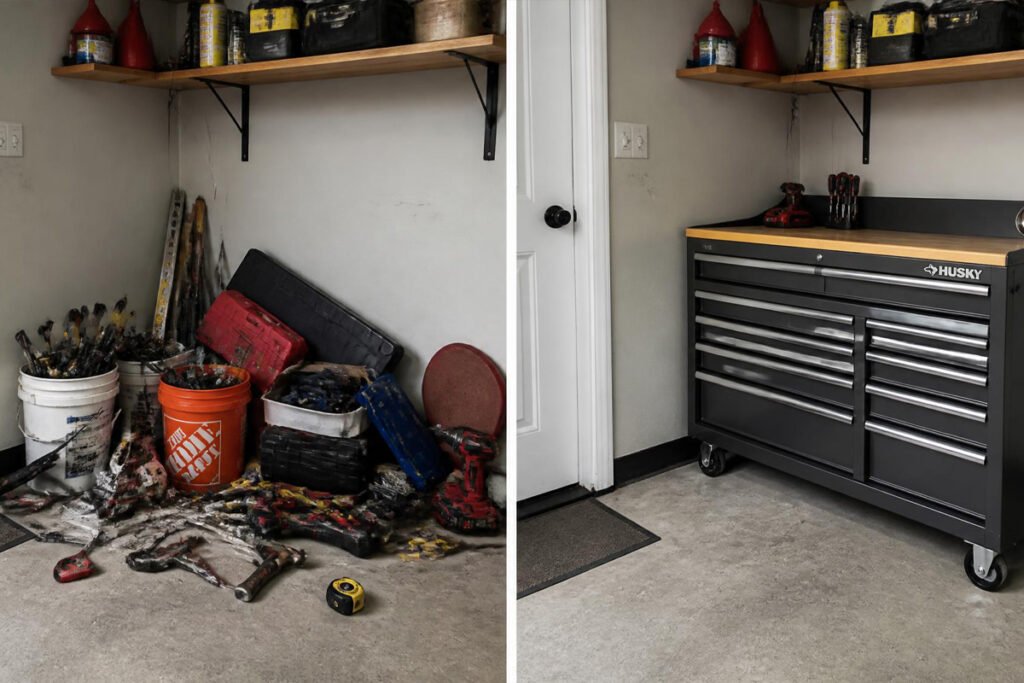
Walk into most garages and you’ll find the same scene: wrenches piled in a five-gallon bucket, sockets scattered across a shelf, and a cordless drill buried somewhere under a tarp. It’s not that homeowners don’t own enough tools — it’s that they never invested in a system to store them. A good tool chest fixes that problem in one purchase, giving every wrench, socket, and driver bit a dedicated spot so you’re not tearing the garage apart every time a project comes up.
The mistake most people make is buying based on size alone, without checking steel gauge, drawer slides, or how the unit fits their actual workflow. That’s how a $300 cabinet ends up with bent drawers within a year. This guide breaks down the best garage tool chests on the market right now, what actually separates a durable cabinet from a flimsy one, and how to pick the right size for your space. If you’re setting up a workshop from scratch, pair this with our guide on how to set up a garage workshop for the full layout plan.
Quick Answer
The best all-around garage tool chest for most homeowners is a mid-size rolling cabinet in the 26–52 inch range with at least 20-gauge steel and full-extension ball-bearing drawer slides — something like the Husky 52-inch 9-Drawer Rolling Cabinet. DIYers who move between the garage, the car, and the occasional job site are better served by a modular system like Milwaukee PACKOUT or DEWALT TSTAK, which trade one big footprint for portable, stackable boxes. Anyone furnishing an entire workshop at once — not just one cabinet — should look at a full wall-and-base system like NewAge Products’ Bold Series. The general rule: buy the storage capacity you’ll actually fill within two years, not the biggest box on the shelf.
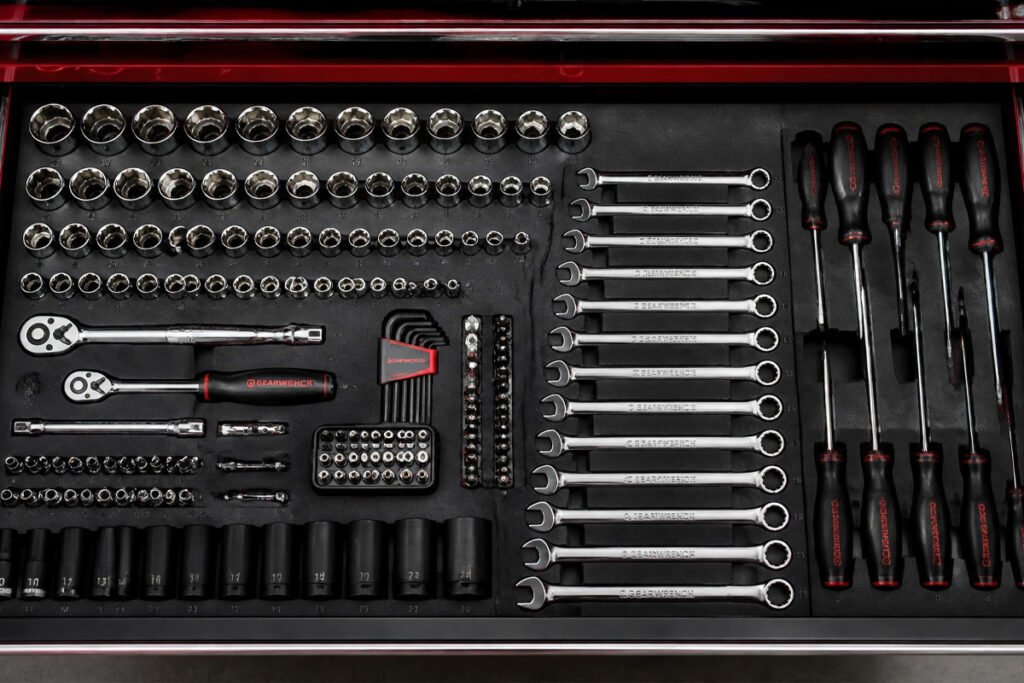
Table of Contents
- What Is a Garage Tool Chest and Why It Matters
- How to Choose the Right Tool Chest
- Best Garage Tool Chests Available
- Comparison Table
- Best Tool Storage for Different Garage Setups
- How to Set Up and Organize Your Tool Chest
- Common Mistakes
- Expert Tips
- Final Thoughts
- Frequently Asked Questions
What Is a Garage Tool Chest and How It Works {#what-is}
A tool chest is a purpose-built steel or heavy-duty polymer cabinet with a series of drawers, designed to organize hand tools, sockets, power tools, and accessories in one mobile or stationary unit. Most garage-grade chests fall into two configurations: a top chest (a smaller box that sits on a workbench or on top of a base cabinet) and a rolling cabinet (a larger, wheeled unit that serves as both storage and, often, a workbench surface itself).
The best garage tool chests are built from cold-rolled steel, measured in gauge — the lower the number, the thicker and more dent-resistant the steel. Drawers ride on ball-bearing slides rather than basic friction slides, which is the difference between a drawer that glides smoothly under 40 lbs of sockets and one that jams or sags within months. Most quality cabinets also include drawer liners, a lockable center rod or individual drawer locks, and locking caster wheels for mobility without drift.
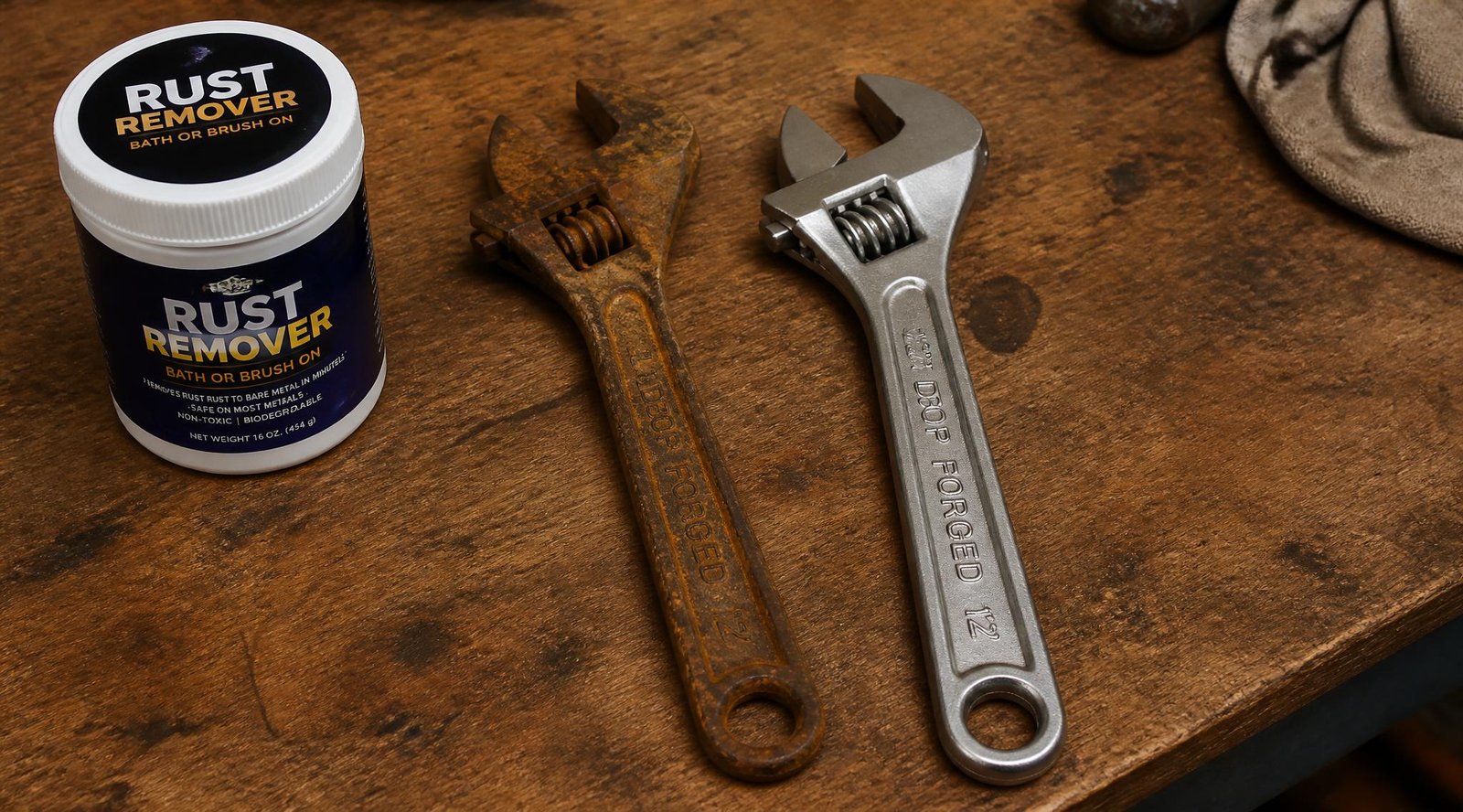
Why this matters for a home garage specifically: unlike a workshop toolbox that lives in a climate-controlled shop, a garage cabinet deals with temperature swings, humidity, dust, and — in a lot of homes — doubling as extra storage for anything from paint cans to holiday decorations. A cabinet built for garage use needs to hold up to that environment, not just look good in a showroom.
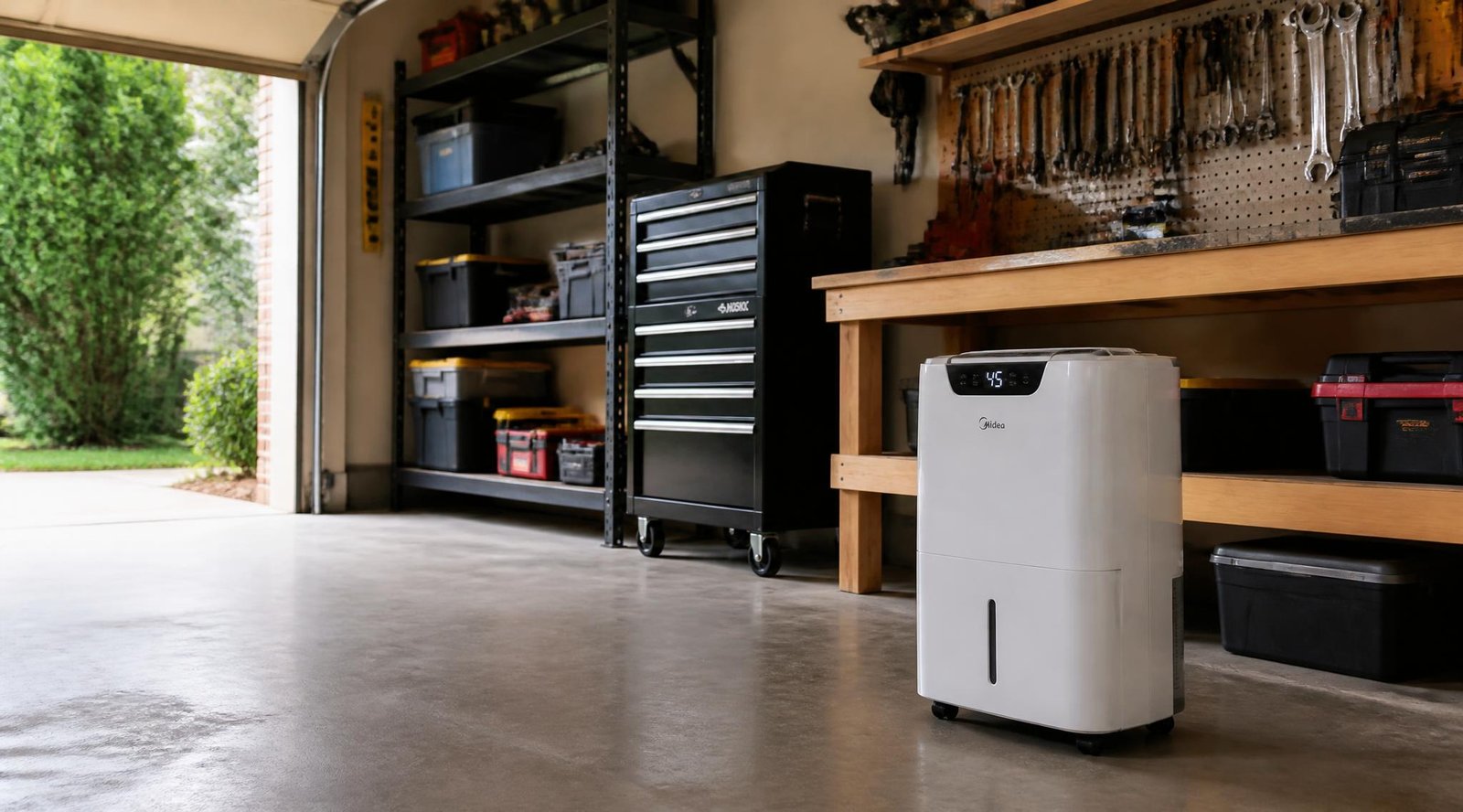
If your garage set-up also needs better airflow to protect tools from rust and humidity, our garage ventilation guide covers that side of the equation.
How to Choose the Right Tool Chest {#how-to-choose}
Before comparing specific models, ask yourself these three questions:
- How many tools do I actually own right now, and how fast is that collection growing? Buy for your collection in 18–24 months, not just today — but don’t pay for capacity you’ll never fill.
- Do I need mobility, or does this cabinet stay in one spot? A rolling cabinet with locking casters makes sense if you move between the garage, driveway, and car. A stationary base-and-wall combo makes more sense if the goal is maximizing wall space in a fixed workshop layout.
- What’s actually going in the drawers? Sockets and small hand tools need shallow, well-organized drawers. Power tools, chargers, and bulky accessories need deep drawers or an open cabinet section — a common gap in chests that are otherwise well-built.
According to the U.S. Consumer Product Safety Commission, unsecured heavy furniture and storage units are a documented tip-over hazard in homes, which is worth keeping in mind with any tall, top-heavy rolling cabinet — anchoring or using the built-in stabilizing feet matters as much as the drawer quality.
Best Garage Tool Chests Available {#best-options}
1. Husky 52-inch 9-Drawer Rolling Cabinet
Overview: The Husky 52-inch is the default recommendation for most home garages, and for good reason — it hits the balance point between steel gauge, drawer count, and price that a lot of pricier chests don’t improve on meaningfully for non-professional use. It ships mostly pre-assembled, needing only casters and a side handle attached.
Key Features:
- 9 drawers with full-extension ball-bearing slides
- Rigid + swivel casters rated for 600+ lb combined load
- Drawer liners included
- Central locking system across all drawers
- Side power strip on some configurations
Best For: Homeowners who want one large, do-everything cabinet without stepping up to professional pricing.
Pros: ✅ Excellent steel-to-price ratio for a home garage ✅ Smooth, fully-loaded drawer operation ✅ Easy single-person assembly
Cons: ❌ Large footprint — needs real floor space ❌ No modular expansion if your needs grow further
Our Verdict: For the majority of readers setting up or upgrading a home garage, this is the toolbox that solves the problem without overspending. If you’re also tackling floor protection at the same time, our garage floor degreaser guide is worth reading before you roll a 600 lb cabinet across old, oil-stained concrete.
2. Milwaukee PACKOUT Rolling Tool Box System
Overview: PACKOUT isn’t a single cabinet — it’s a modular, stackable system of interlocking boxes that can be configured as a rolling unit or broken apart into individual totes you carry to the job, the car, or the backyard. It’s the pick for anyone whose tools don’t stay in the garage full-time.
Key Features:
- Interlocking modular boxes (totes, organizers, rolling cart base)
- IP65-rated weather resistance on most modules
- Metal latches rated for repeated heavy use
- Expandable — add modules as your collection grows
Best For: DIYers and tradespeople who move tools between locations regularly.
Pros: ✅ Genuinely portable — detach exactly what you need ✅ Expands incrementally instead of one big upfront purchase ✅ Weather-sealed for outdoor and truck-bed use
Cons: ❌ Costs more per unit of storage than a fixed cabinet ❌ Less overall capacity than a large rolling chest at the same price
Our Verdict: The right choice if “garage tool chest” doesn’t fully describe your use case — this is for the person who’s just as often working in the driveway or a friend’s garage as their own.
3. DEWALT TSTAK Modular Storage System
Overview: TSTAK takes a similar modular philosophy to PACKOUT but leans more toward stackable drawer units that click together into a tower, plus a rolling cart base for mobility.
Key Features:
- Stackable, lockable modules that interconnect vertically
- Available as drawer units, deep totes, and a rolling cart
- Compatible with DEWALT’s broader storage ecosystem
- Compact footprint per module
Best For: Smaller garages where floor space is limited but vertical stacking is available.
Pros: ✅ Small footprint per module — good for compact garages ✅ Genuinely modular, buy only what you need ✅ Locks each module individually
Cons: ❌ Individual module capacity is smaller than a full-size drawer ❌ Cost adds up quickly once you’re several modules in
Our Verdict: Best suited to a smaller garage or a workbench-adjacent setup rather than as the single, central storage solution for a large tool collection.
4. Craftsman 2000 Series Rolling Cabinet
Overview: Craftsman’s 2000 Series sits a notch below premium professional chests in price while still using ball-bearing slides across the drawer range — a meaningful upgrade over entry-level cabinets that cut corners on slides first.
Key Features:
- Multiple drawer configurations (26″ to 52″ widths available)
- Ball-bearing slides throughout
- Integrated bumpers to protect walls and vehicles
- Optional matching top chest for stacked configurations
Best For: Buyers who want name-brand reliability without paying professional-tier prices.
Pros: ✅ Full-extension slides even on the base-tier models ✅ Wide range of sizes to match different garage footprints ✅ Stackable top-chest option for future expansion
Cons: ❌ Steel gauge is a step below premium professional units ❌ Fewer accessory options than the Milwaukee/DEWALT ecosystems
Our Verdict: A dependable middle-ground pick if PACKOUT-style modularity isn’t a priority and you just want a solid, traditional rolling cabinet.
5. NewAge Products Bold Series (Full Cabinet System)
Overview: This isn’t a single chest — it’s a coordinated system of wall cabinets, base cabinets, and a rolling tool chest designed to furnish an entire wall of a garage or workshop at once. It’s the pick for anyone doing a full garage overhaul rather than replacing one storage piece.
Key Features:
- Matching wall and base cabinets plus a rolling center chest
- Heavy-gauge steel construction throughout
- Soft-close drawer and door options on some configurations
- Designed as a coordinated visual system, not a single box
Best For: A full garage organization project, not an incremental upgrade.
Pros: ✅ Turns an entire wall into cohesive, matched storage ✅ Combines closed cabinet storage with open counter workspace ✅ Scales to fill a two-car garage wall comfortably
Cons: ❌ Highest upfront cost of any option on this list ❌ Requires real planning and wall space — not a drop-in solution
Our Verdict: Worth the investment only if you’re doing a full garage remodel — check out our guide on converting a garage into a home gym or living space if you’re weighing this kind of larger project against other uses for the same square footage.
Comparison Table {#comparison-table}
| Product | Best For | Steel Gauge | Mobility | Approx. Price |
|---|---|---|---|---|
| Husky 52″ 9-Drawer | Best Overall | 20-gauge | Rolling, locking casters | $$ |
| Milwaukee PACKOUT | Best for Portability | Impact-resistant polymer | Modular, detachable | $$$ |
| DEWALT TSTAK | Best for Small Garages | Reinforced polymer | Stackable, small footprint | $$ |
| Craftsman 2000 Series | Best Value Steel Cabinet | 21–22-gauge | Rolling | $$ |
| NewAge Bold Series | Best Full-Wall System | Heavy-gauge | Stationary + rolling center unit | $$$$ |
Prices vary by retailer and configuration — check current listings for exact specs before buying.
Best Tool Storage for Different Garage Setups {#different-setups}
The Weekend DIY Garage
If your garage handles the occasional shelf-building project or seasonal repair, a single mid-size rolling cabinet like the Husky 52-inch covers you without over-investing. Pair it with basic pegboard for oversized items like clamps and yard tools, and you’ve solved 90% of the organization problem in one purchase.
The Home Mechanic’s Garage
Anyone working on vehicles regularly needs deeper drawers for larger sockets, floor jacks, and fluids, plus a rolling unit that can move alongside the car. A Craftsman or Husky rolling cabinet with a locking top surface doubles as a mobile workbench during a job. If security is a concern with a garage full of expensive tools, our garage security camera guide and garage door security guide are worth reading alongside this one.
The Multi-Use / Small Garage
If the garage also stores bikes, a generator, seasonal decorations, and a workbench, vertical modular systems like DEWALT TSTAK or wall-mounted cabinets make more sense than one large floor cabinet eating up drive-in space. Combine with our garage bike storage guide to reclaim floor space for a cabinet in the first place.
How to Set Up and Organize Your Tool Chest {#how-to-set-up}
Step 1: Prepare the Space
Clear a level, dry section of floor with enough clearance for the drawers to fully extend. Concrete that’s stained or degreased first will make it easier to roll a loaded cabinet without dragging grit under the casters.
Step 2: Assemble and Anchor
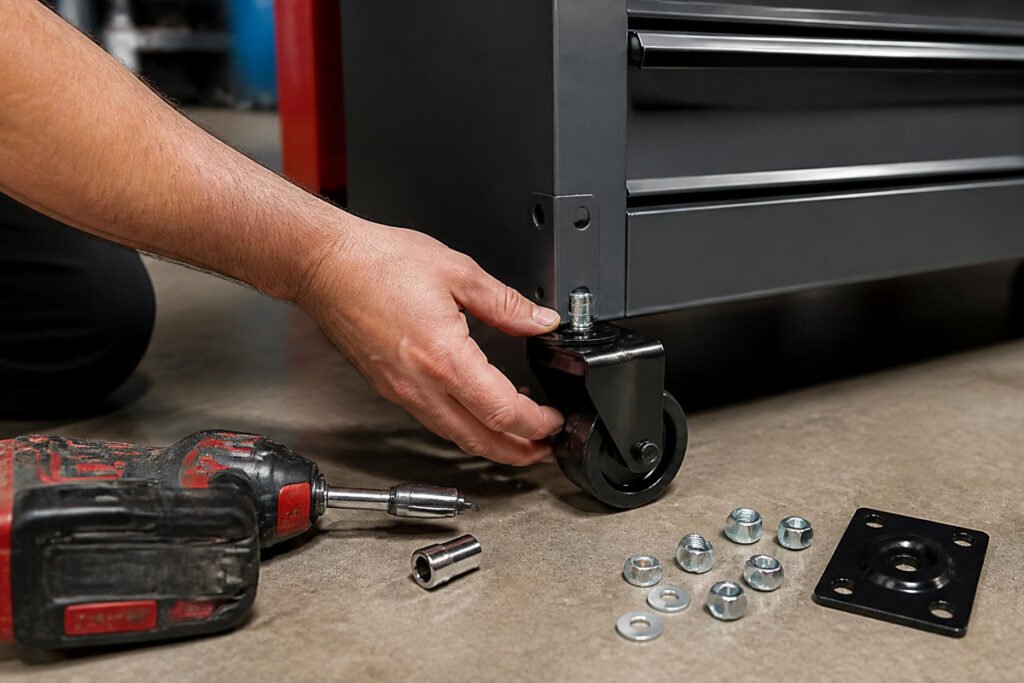
Attach casters, handles, and any accessory hardware per the included instructions. If the unit is tall relative to its base, use the manufacturer’s anti-tip bracket or strap — this matters more than people expect with a fully loaded, top-heavy cabinet.
Step 3: Sort Before You Load
Group tools by category (sockets, wrenches, screwdrivers, electrical, automotive) before putting anything in a drawer. Loading randomly is the single biggest reason a new tool chest becomes disorganized again within a month.
Step 4: Assign Drawers by Frequency of Use
Put daily-use tools in the top, easy-reach drawers. Reserve bottom, deep drawers for bulky or rarely used items like specialty automotive tools.
Step 5: Label and Review Quarterly
Simple drawer labels save time for anyone else using the garage, and a quarterly check keeps drawers from slowly filling with clutter that doesn’t belong there.
Common Mistakes {#common-mistakes}
Buying based on size instead of steel gauge and slide quality. A bigger cabinet with thin steel and basic slides will dent and sag faster than a smaller, better-built one. Check the specs, not just the drawer count.
Skipping the anti-tip anchor. A loaded rolling cabinet is heavier and more top-heavy than it looks, and tipping incidents are a real risk with kids or pets in the garage. If your garage doubles as a family space, this pairs directly with the tips in our garage safety guide.
Ignoring drawer weight limits. Overloading a single drawer — especially with dense items like sockets or a battery pack — is the fastest way to wear out slides prematurely, even on a quality unit.
Expert Tips {#expert-tips}
Match drawer depth to your heaviest items first. Plan power tool and battery storage around your deepest drawers before assigning smaller items — it’s much easier to fit small tools into leftover space than to force a drill into a shallow drawer.
Use foam drawer organizers for your most-used sockets and wrenches. A cut foam insert cuts the time spent hunting for the right size in half, and makes it immediately obvious when a tool hasn’t been put back.
Buy one size larger than you think you need if budget allows. Almost every reader who’s owned a tool chest for more than two years says the same thing: they wish they’d bought the next size up.
Final Thoughts {#final-thoughts}
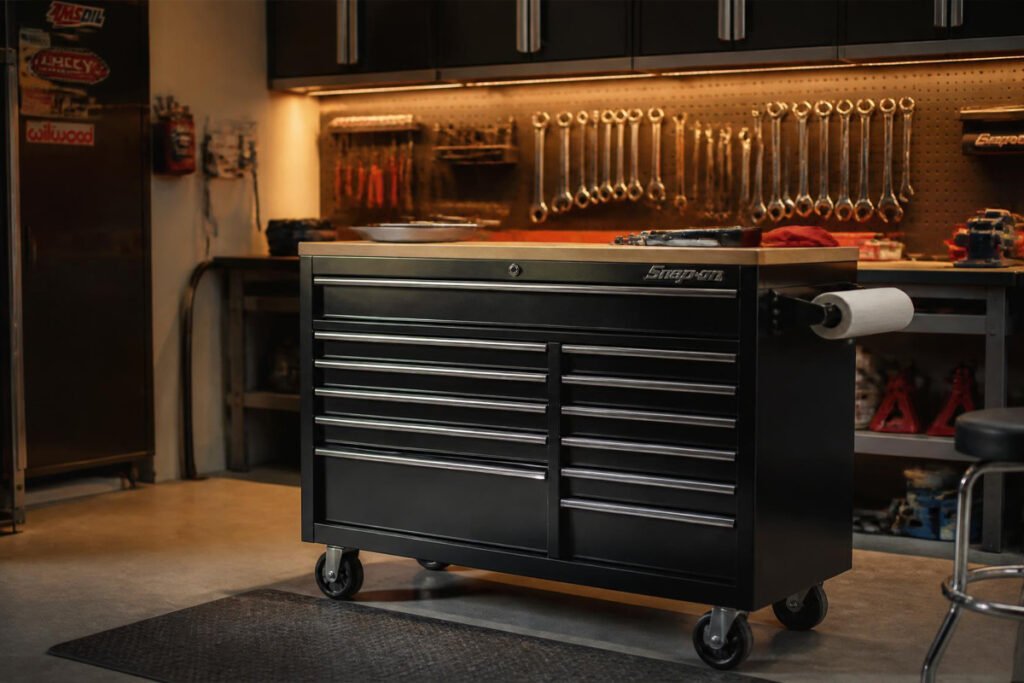
For most home garages, a mid-size rolling steel cabinet like the Husky 52-inch is the best overall balance of durability, capacity, and price. If your work regularly leaves the garage, Milwaukee PACKOUT or DEWALT TSTAK are the better long-term investment despite the higher per-unit cost. And if you’re furnishing an entire wall as part of a bigger garage overhaul, a coordinated system like NewAge’s Bold Series is worth the higher upfront spend.
Whichever you choose, the real payoff isn’t the cabinet itself — it’s never having to dig through a bucket for a 10mm socket again. For more on getting the rest of the garage to match, see our guides on garage workshop setup and garage ventilation.
Frequently Asked Questions {#faq}
Do I really need a steel tool chest, or will a plastic storage bin work? Plastic bins work for occasional-use items but don’t hold up to daily tool traffic, moisture, or the weight of a full socket set long-term. A steel cabinet with proper slides is worth the investment if you use your tools regularly.
How much should I expect to spend on a good garage tool chest? A solid mid-size rolling cabinet from a reputable brand typically falls in the $250–$600 range. Modular systems like PACKOUT cost more per unit of storage but add portability a fixed cabinet can’t match.
Rolling cabinet vs. wall-mounted system — which is better? Rolling cabinets are better if you need mobility or work on vehicles. Wall systems free up floor space and work well in smaller garages or alongside a rolling cabinet as a hybrid setup.
My drawers are sagging after a year — what went wrong? This is almost always a steel gauge or slide quality issue, often made worse by overloading a single drawer beyond its rated weight. Redistribute weight across more drawers and avoid stacking dense items like sockets in one spot.
Can a tool chest go in an unheated or humid garage without rusting? Steel cabinets with a powder-coat finish resist surface rust reasonably well, but a genuinely humid, unventilated garage will shorten the life of any steel unit. Improving airflow, as covered in our garage ventilation guide, helps protect both the cabinet and the tools inside it.
How many drawers do I actually need for a typical home garage? Six to nine drawers covers most home DIY and light-mechanic use. Serious home mechanics or anyone combining automotive and general household tools in one cabinet often benefit from a 9-to-13-drawer configuration.
Is a locking tool chest necessary for a home garage? If the garage is attached and rarely left open, a lock is a nice-to-have. If the garage is detached, shared, or accessible to visitors, a locking cabinet is a meaningful theft deterrent worth prioritizing.
What’s the biggest difference between a $300 chest and a $1,000+ professional chest? Mainly steel gauge and slide durability under constant heavy use. For home garage use, the gap in real-world performance is smaller than the price difference suggests — the extra budget is often better spent on the tools themselves.
Author: Danial Marquez Last Updated: August 2026