
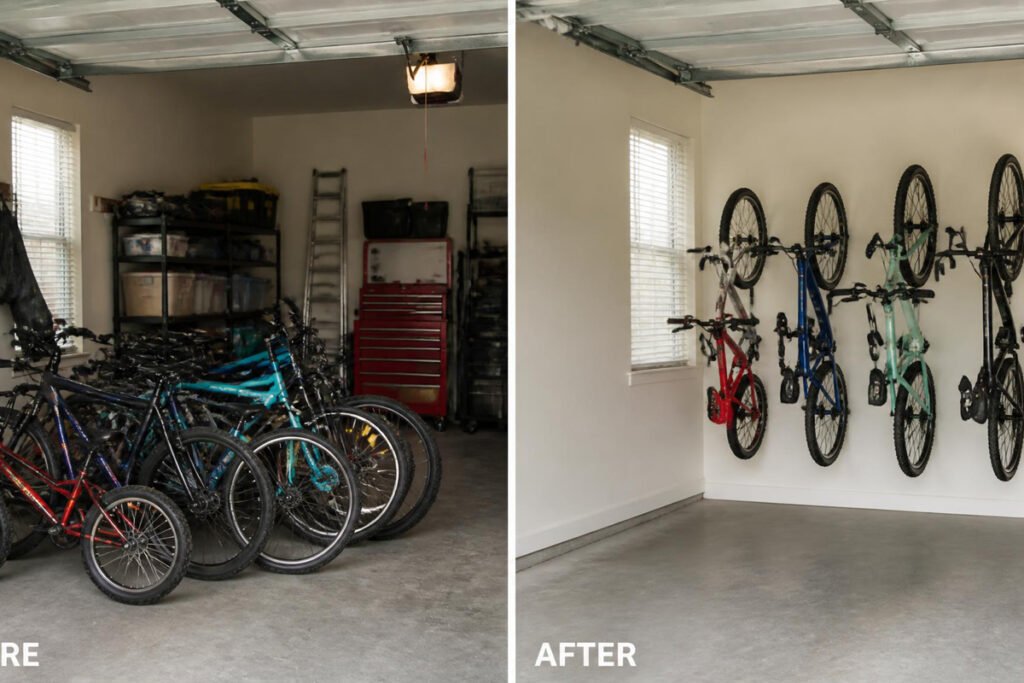
A bike leaning against the wall seems harmless enough — until there are three of them, tangled handlebars blocking the workbench, and someone trips over a pedal reaching for the trash cans. Bikes are one of the most awkward things to store in a garage: too big for a bin, too irregular for standard shelving, and usually needed often enough that “just put it somewhere” never actually sticks.
A dedicated bike storage rack solves this permanently, getting bikes off the floor and out of the way while keeping them genuinely easy to grab for the next ride. This guide breaks down the best garage bike storage racks available right now, organized by space, bike count, and how your garage is laid out. If you’re planning bike storage as part of a bigger organization project, our guide on garage storage bins and shelving covers the rest of the space around it.
Quick Answer
The best garage bike storage rack depends on your wall space and how many bikes you’re storing. For most garages, a wall-mounted swivel or vertical hook rack is the simplest, most affordable solution, holding one or two bikes flat against the wall. For households with several bikes and limited wall space, a ceiling-mounted hoist reclaims completely unused overhead space instead. For garages that can’t have anything drilled into the wall or ceiling, a freestanding floor rack offers a no-installation alternative, at the cost of a small permanent footprint.
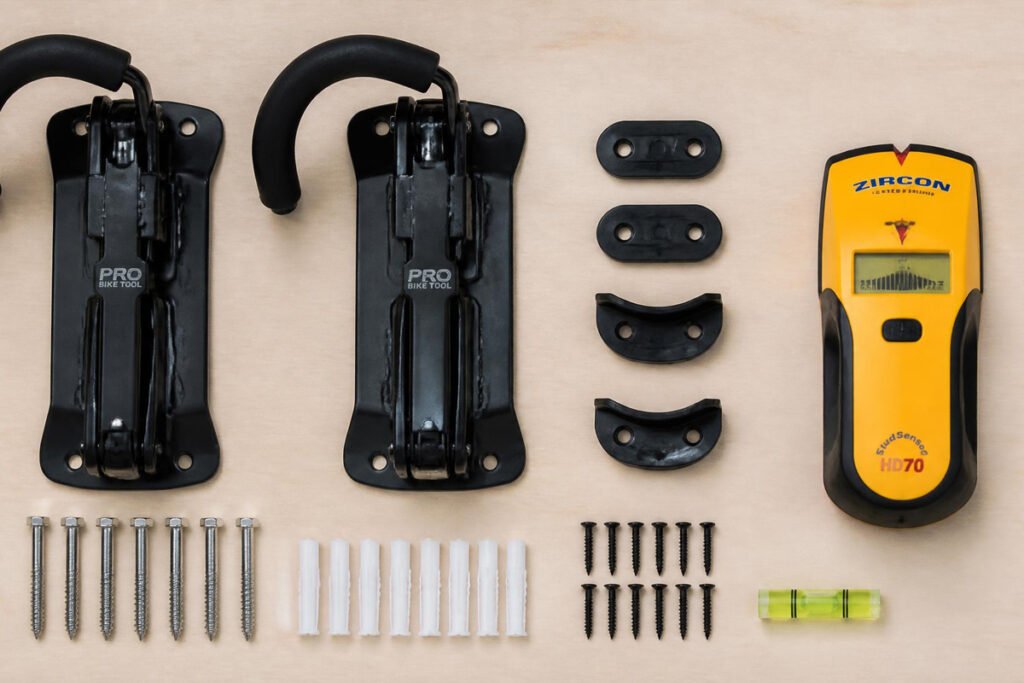
Table of Contents
- Why Regular Shelving Doesn’t Work for Bikes
- How to Choose the Right Bike Rack
- Best Garage Bike Storage Racks Available
- Comparison Table
- Best Racks for Different Garage Situations
- How to Install a Garage Bike Rack Correctly
- Common Mistakes
- Expert Tips
- Final Thoughts
- Frequently Asked Questions
Why Regular Shelving Doesn’t Work for Bikes {#what-you-need}
Bikes don’t stack, don’t fit neatly into a bin, and their irregular shape wastes an enormous amount of floor or shelf space compared to their actual footprint when stored upright. A dedicated rack solves this by using the bike’s own geometry — hanging it by the wheel, tilting it against the wall, or lifting it flat to the ceiling — to shrink its real-world footprint down to a fraction of what it takes up leaning on its kickstand.
The right rack category depends on three things: mounting location (wall, ceiling, or freestanding floor), bike count (single hooks vs. multi-bike systems), and access frequency (racks built for daily riders differ from ones meant for seasonal storage). If you’re also dealing with general garage clutter beyond bikes, our 50+ garage organization ideas guide covers the bigger picture.
How to Choose the Right Bike Rack {#how-to-choose}
Before buying, ask three questions:
- How much wall or ceiling space can I actually use? A narrow strip of open wall is enough for a swivel rack, while a ceiling hoist needs clear overhead space and joist access.
- How often do I ride? Daily riders want quick-access racks positioned low and near the door; occasional or seasonal bikes can go higher or further back.
- What types of bikes am I storing? Heavier e-bikes and fat-tire bikes need higher weight ratings and wider hooks than standard road or kids’ bikes.
For general guidance on safe wall-mounted storage weight limits, the Occupational Safety and Health Administration’s material storage guidelines offer a useful, non-commercial reference on why checking rated capacity matters, even for home use.
Best Garage Bike Storage Racks Available {#best-tools}
1. Wall-Mounted Swivel Hook Rack
Overview: A swivel rack holds a bike by its front wheel and pivots flat against the wall when not in use, making it one of the most space-efficient options available. Multiple units can be installed side by side, staggered at different heights, to fit several bikes along a single wall.
Key Features:
- Swivels flat against the wall when not in use
- Typically rated for 40–65 lbs per unit
- Rubber-coated hooks to prevent frame or rim damage
- Requires mounting into wall studs for full weight rating
Best For: Most home garages, daily riders wanting quick access
Pros: ✅ Extremely space-efficient when swiveled flat ✅ Easy, quick access for frequent riders ✅ Multiple units can be staggered for several bikes Cons: ❌ Requires stud mounting for full rated capacity ❌ Lifting heavier bikes onto the hook takes some strength
Our Verdict: The best starting point for most garages — pair it with a pegboard or slatwall system nearby to keep helmets and riding gear organized alongside the bikes themselves.
2. Ceiling-Mounted Bike Hoist
Overview: For garages with limited wall space but open overhead clearance, a ceiling hoist uses a pulley system to lift a bike completely out of the way, freeing up both floor and wall space entirely.
Key Features:
- Pulley system mounts directly to ceiling joists
- Typically rated for 50–100 lbs per hoist
- Frees up floor and wall space completely
- Some multi-bike hoist systems available for higher capacity
Best For: Garages with limited wall space, seasonal or infrequently used bikes
Pros: ✅ Uses completely unused overhead space ✅ Clears both floor and wall entirely ✅ Works well for infrequently accessed bikes Cons: ❌ Requires secure joist mounting, not just drywall ❌ Less convenient for daily riders due to the lift/lower process
Our Verdict: A strong complement to overhead garage storage if you’re already reclaiming ceiling space for other seasonal items — just keep in mind the daily hassle factor if you ride often.
3. Freestanding Floor Stand Rack
Overview: For garages where drilling into walls or ceilings isn’t an option — rented spaces, shared structures, or unfinished walls — a freestanding floor rack holds one or more bikes upright without any installation at all.
Key Features:
- No wall or ceiling mounting required
- Adjustable tire-width clamps to fit various bike sizes
- Some models support 3–5 bikes in a single unit
- Portable — can be repositioned or moved easily
Best For: Renters, garages with unfinished or unsuitable mounting surfaces, temporary setups
Pros: ✅ Zero installation required ✅ Fully portable and repositionable ✅ Multi-bike models cover several bikes in one purchase Cons: ❌ Takes up a permanent floor footprint ❌ Less space-efficient than wall or ceiling options
Our Verdict: The practical choice when mounting isn’t an option — pair it with a labeled spot in your overall garage storage plan so it has a consistent, expected location.
4. Vertical Multi-Bike Wall Track System
Overview: For households with several bikes, a track-based system mounts a horizontal rail to the wall with multiple hook attachments, letting you add, remove, or reposition individual bike hooks as your household’s bike count changes.
Key Features:
- Horizontal wall track with modular hook attachments
- Hooks can be repositioned or added over time
- Often compatible with helmet and gear hooks on the same track
- Typically rated for a range of bike weights per hook
Best For: Multi-bike households, families with kids’ bikes of varying sizes
Pros: ✅ Fully modular and expandable as bike count changes ✅ Consistent, organized look across multiple bikes ✅ Can mix bike hooks with gear storage on the same track Cons: ❌ Higher upfront cost than individual swivel hooks ❌ Requires more wall length than a single hook unit
Our Verdict: The right long-term investment for a growing family’s bike collection — see our garage organization ideas for how a track system fits into a broader wall storage strategy.
5. Gravity or Adjustable Multi-Bike Rack
Overview: Designed to accommodate a mix of bike types and sizes in one unit, gravity racks use angled tire slots that hold each bike securely through its own weight, without straps, hooks, or wheel damage.
Key Features:
- Angled slots hold bikes via gravity, no straps or hooks needed
- Accommodates mixed bike types and tire widths in one unit
- Freestanding or wall-adjacent placement options
- Quick to load and unload compared to hook-style racks
Best For: Households with mixed bike types (kids, adults, different tire widths)
Pros: ✅ Fastest load/unload of the multi-bike options here ✅ Handles mixed bike sizes without adjustment ✅ No lifting required to hang bikes by the wheel Cons: ❌ Larger footprint than wall-mounted options ❌ Less space-efficient than a fully vertical wall system
Our Verdict: A great fit for families juggling several different bike sizes at once, prioritizing speed and ease of use over maximum space savings.
Comparison Table {#comparison-table}
| Rack Type | Best For | Installation | Approx. Price Range | Floor Footprint |
|---|---|---|---|---|
| Wall-Mounted Swivel Hook | Most garages, daily riders | Wall studs required | $15–$40 per bike | None when swiveled flat |
| Ceiling-Mounted Hoist | Limited wall space, seasonal bikes | Ceiling joists required | $30–$80 | None |
| Freestanding Floor Stand | No drilling allowed, rentals | None | $30–$100 | Small, fixed |
| Vertical Multi-Bike Wall Track | Multi-bike households | Wall studs required | $60–$150 | None |
| Gravity/Adjustable Multi-Bike Rack | Mixed bike sizes, families | None to minimal | $50–$130 | Medium, fixed |
Best Racks for Different Garage Situations {#different-setups}
Single or Two-Car Garages With Limited Wall Space
A ceiling-mounted hoist or ceiling-adjacent rack makes the most sense here, since floor and wall space are both usually needed for parking.
Renters or Unfinished Garage Walls
A freestanding floor stand or gravity rack avoids drilling entirely, making it the safest choice when you can’t modify the walls or ceiling.
Active Cycling Households With Multiple Riders
A vertical multi-bike wall track system scales cleanly as your household’s bike count grows, and pairs well with a dedicated garage workbench if bike maintenance is a regular activity too.
How to Install a Garage Bike Rack Correctly {#how-to-install}
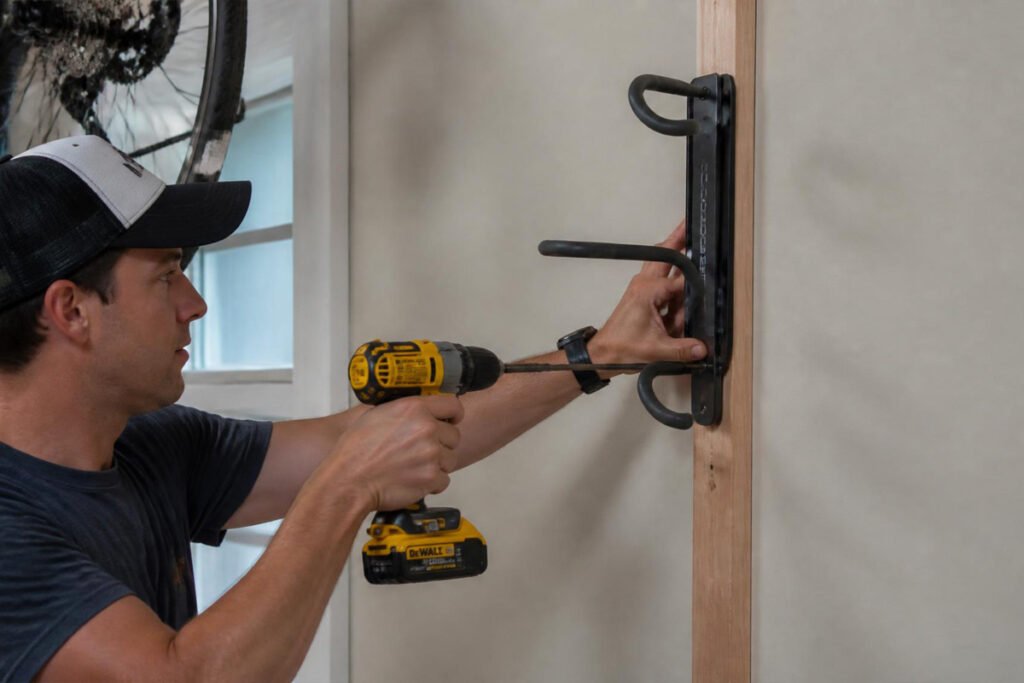
Step 1: Locate Wall Studs or Ceiling Joists
Use a stud finder before mounting any wall or ceiling rack — drywall alone won’t support a bike’s weight safely.
Step 2: Plan Spacing Before Drilling
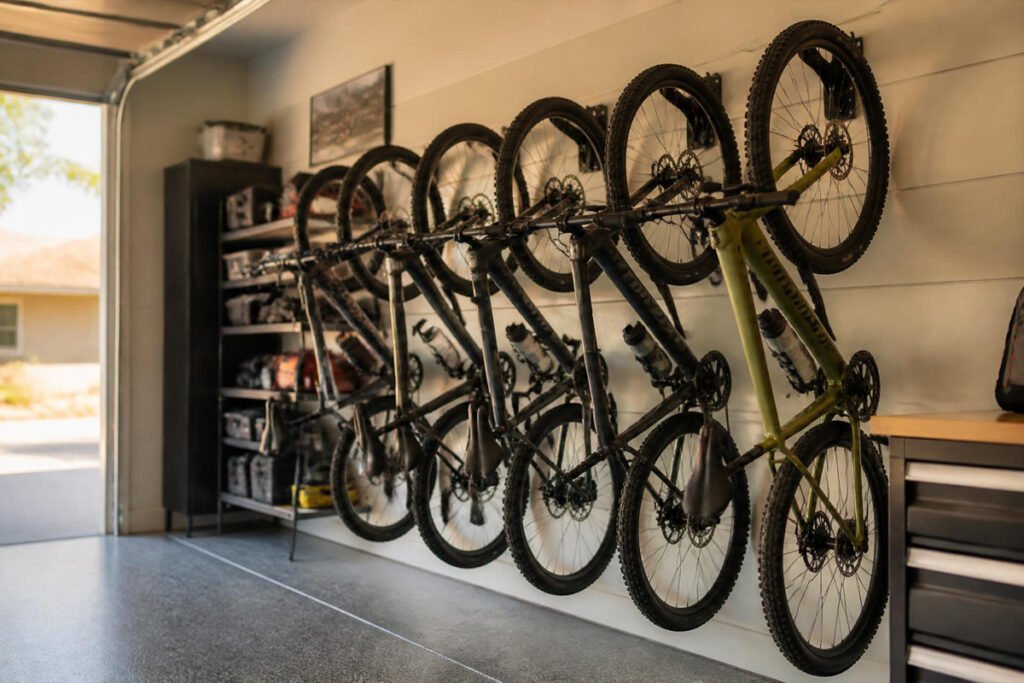
For multiple bikes, stagger heights and space hooks 14–16 inches apart to avoid handlebar collisions between adjacent bikes.
Step 3: Mount Securely With Provided Hardware
Use the manufacturer’s specified screws and anchors rather than substituting lighter hardware, especially for heavier e-bikes.
Step 4: Test Weight Capacity Before Full Use
Hang the heaviest bike first and confirm the mount holds securely before relying on it for daily use.
Step 5: Position for Realistic Daily Access
If you ride often, keep the rack at a height and location you’ll actually use — a technically efficient but inconvenient spot often gets abandoned within a month.
Common Mistakes {#common-mistakes}
Mounting into drywall alone instead of wall studs. This is the most common cause of rack failure — always locate and mount into studs, especially for anything beyond a single lightweight bike.
Underestimating e-bike weight. Standard racks rated for typical bikes often fall well short of an e-bike’s actual weight — check the rack’s rated capacity against your specific bike’s weight, not just its general category.
Placing racks too high for comfortable daily use. A rack mounted for maximum space efficiency but requiring real effort to load and unload often gets skipped entirely — balance space savings with realistic daily use.
Expert Tips {#expert-tips}
Stagger rack heights for multiple bikes on the same wall. Alternating high and low mounting points lets handlebars clear each other without needing significantly more wall length.
Keep a small storage bin nearby for helmets and locks. A rack solves bike storage, but gear tends to pile up separately — a labeled bin or hook set from your garage storage system keeps everything together.
Reassess your rack setup if your household’s bikes change. Kids outgrowing bikes, a new e-bike, or an added rider all shift what rack type makes sense — it’s worth revisiting rather than forcing new bikes into an outdated setup.
Final Thoughts {#final-thoughts}
Best Overall: A wall-mounted swivel hook rack for most single-bike or two-bike households wanting quick daily access. Best for Limited Wall Space: A ceiling-mounted hoist, reclaiming space nobody else is competing for. Best for Multi-Bike Families: A vertical wall track system or gravity rack, scaling cleanly as your household’s bike count grows.
Whichever rack you choose, it works best as part of a complete garage organization plan — see our garage storage bins and shelving guide and garage workshop setup guide to round out the rest of the space.
Frequently Asked Questions {#faq}
Do I need to drill into studs for a wall-mounted bike rack? For anything beyond the lightest bikes, yes — drywall alone typically can’t support a bike’s weight safely, especially for e-bikes or heavier mountain bikes.
How much weight can a typical ceiling bike hoist hold? Most residential hoists are rated for 50–100 lbs, which covers most standard bikes, though heavier e-bikes may need a higher-capacity or reinforced hoist.
Are freestanding bike racks stable enough, or do they tip over? Quality freestanding racks with a wide base and low center of gravity are stable for normal use, though they’re generally less secure than a wall or ceiling-mounted option for very active households.
Can I store an e-bike on a standard bike rack? Only if the rack’s rated capacity specifically covers your e-bike’s actual weight — e-bikes are often significantly heavier than standard bikes and can exceed a standard rack’s rating.
How many bikes can I realistically store on one wall? With staggered swivel hooks spaced 14–16 inches apart, most single-car garage walls comfortably fit 2–3 bikes; a full two-car garage wall can often fit 4 or more.
What’s the best rack for a garage that also needs to park a car? Wall-mounted or ceiling-mounted racks are the best choice here, since they don’t add any permanent floor footprint that would interfere with parking.
Do bike racks damage bike frames or tires? Quality racks use rubber-coated hooks or padded contact points specifically to avoid frame and rim damage — check for this feature, especially on any budget-priced option.
Is a gravity rack better than individual wall hooks? It depends on your household — gravity racks are faster to load and handle mixed bike sizes well, but individual wall hooks are more space-efficient if your bikes are similar in size.
How do I keep bikes from tangling handlebars in a multi-bike rack? Stagger mounting heights so handlebars sit at different levels, or angle bikes slightly using a swivel-style rack that lets you adjust each bike’s position independently.
Author: Danial Marquez Last Updated: August 2026




1 thought on “Best Garage Bike Storage Racks: Top 5 Picks & Buying Guide”
Pingback: Best Rust Remover for Tools: Proven Top Picks | GarageDaily.com – Master Your Garage with Expert Tips