A garage is one of the easiest targets in a home to break into and one of the least monitored. Tools, bikes, sometimes a second vehicle — all sitting behind a door that can be defeated faster than most people realize, with no one watching until it’s too late. A well-placed camera doesn’t just record what happens after the fact, it actively deters the attempt in the first place.
The challenge is that garage cameras aren’t quite the same purchase as a standard home security camera. Poor lighting, wide coverage areas, awkward mounting surfaces, and — for detached garages — no easy access to power or Wi-Fi all shape which camera actually works well in this specific space. This guide breaks down the best garage security cameras available right now and how to choose between them. If you’re building out garage security more broadly, our garage door security guide covers the bigger picture beyond cameras alone.
Quick Answer
The best garage security camera depends on your garage’s power and connectivity setup. For attached garages with outlet access, a wired PoE or plug-in camera offers the most reliable, always-on coverage. For detached garages without easy wiring, a battery-powered or solar wireless camera avoids running cable entirely. If you want a strong visual deterrent, a floodlight combo camera adds bright, motion-triggered lighting alongside recording. And if avoiding subscription fees matters to you, look specifically for a model with local SD card or on-device storage rather than cloud-only recording.
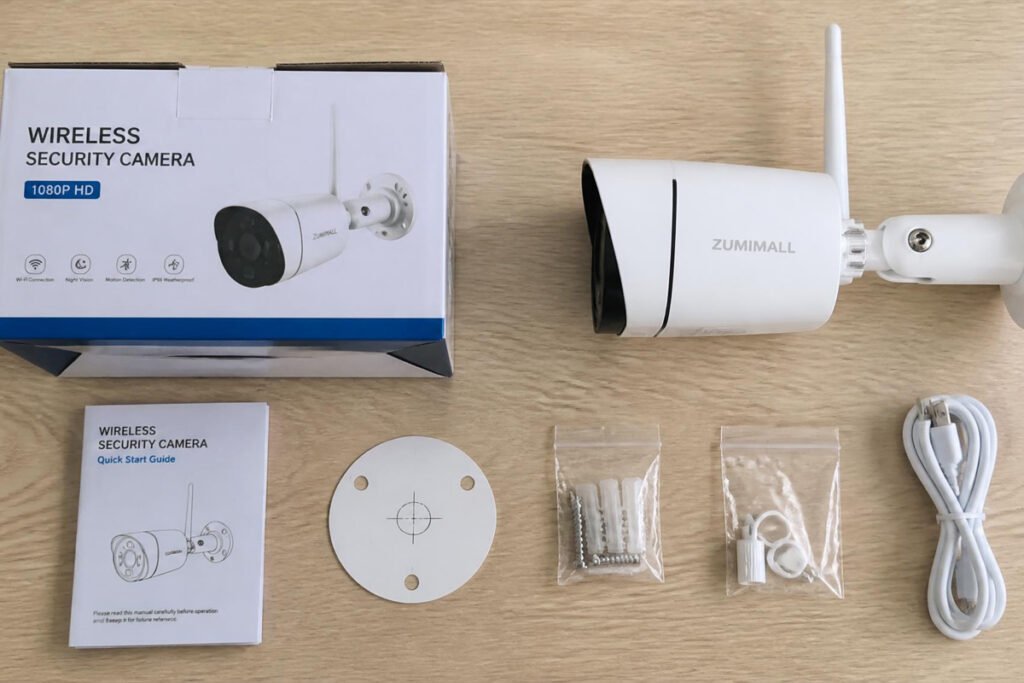
Table of Contents
- Why Garage Cameras Need Different Features Than Indoor Cameras
- How to Choose the Right Garage Security Camera
- Best Garage Security Cameras Available
- Comparison Table
- Best Cameras for Different Garage Setups
- How to Position a Garage Camera Correctly
- Common Mistakes
- Expert Tips
- Final Thoughts
- Frequently Asked Questions
Why Garage Cameras Need Different Features Than Indoor Cameras {#what-you-need}
Garages present a unique combination of challenges: they’re often dimly lit even during the day, cover a wider physical area than a typical room, and — for detached structures especially — may not have convenient power or a strong Wi-Fi signal. A camera built for a hallway or living room often underperforms here, which is why night vision quality, field of view, and power flexibility all matter more for a garage than they would elsewhere in the house.
Cameras work best as one layer of a broader security approach rather than a standalone fix — our garage door security guide covers locks, sensors, and door hardware that pair well with visual monitoring.
How to Choose the Right Garage Security Camera {#how-to-choose}
Before buying, ask three questions:
- Do I have reliable power and Wi-Fi at the mounting location? This single factor narrows the field fast — wired cameras need both; solar and battery cameras need neither but trade off some convenience.
- How wide an area do I actually need to cover? A single entry door needs a much narrower field of view than an open driveway approach or a detached structure’s full exterior.
- Do I want to avoid ongoing subscription costs? Local SD card or on-device storage avoids monthly fees, while cloud storage often unlocks more advanced smart features.
For general guidance on effective home camera placement and deterrence, the Federal Trade Commission’s home security resources are a solid, non-commercial reference, even though they aren’t garage-specific.
Best Garage Security Cameras Available {#best-tools}
1. Wired PoE (Power over Ethernet) Camera
Overview: For attached garages with existing wiring access, a PoE camera delivers the most reliable connection available — power and data run over a single Ethernet cable, eliminating both battery replacement and Wi-Fi dropout concerns entirely.
Key Features:
- Single cable for both power and network connection
- Continuous, always-on recording with no battery limitations
- Typically supports local NVR (network video recorder) storage
- Higher resolution options common in this category
Best For: Attached garages with existing wiring or easy cable runs
Pros: ✅ No battery to monitor or replace ✅ More reliable connection than Wi-Fi-dependent models ✅ Often supports the highest resolution and frame rates Cons: ❌ Requires running cable, which adds installation complexity ❌ Not practical for detached structures without existing infrastructure
Our Verdict: The most reliable long-term option if installation complexity isn’t a dealbreaker — pair it with our garage door security guide for a complete hardware and monitoring setup.
2. Battery-Powered Wireless Camera
Overview: Battery-powered cameras mount anywhere without any wiring at all, making them the fastest and most flexible option to install, particularly for detached garages or awkward mounting spots without a nearby outlet.
Key Features:
- No wiring required, fully wireless installation
- Rechargeable battery, typically lasting 1–6 months depending on use
- Weatherproof housing for exterior mounting
- App-based motion alerts and live viewing
Best For: Detached garages, renters, quick installs without wiring
Pros: ✅ Installs almost anywhere in minutes ✅ No electrician or wiring needed ✅ Easy to reposition if your needs change Cons: ❌ Requires periodic battery recharging or replacement ❌ Depends on a strong Wi-Fi signal reaching the mounting location
Our Verdict: The best starting point for most homeowners, especially with a detached garage — just confirm your Wi-Fi signal actually reaches the intended mounting spot before buying.
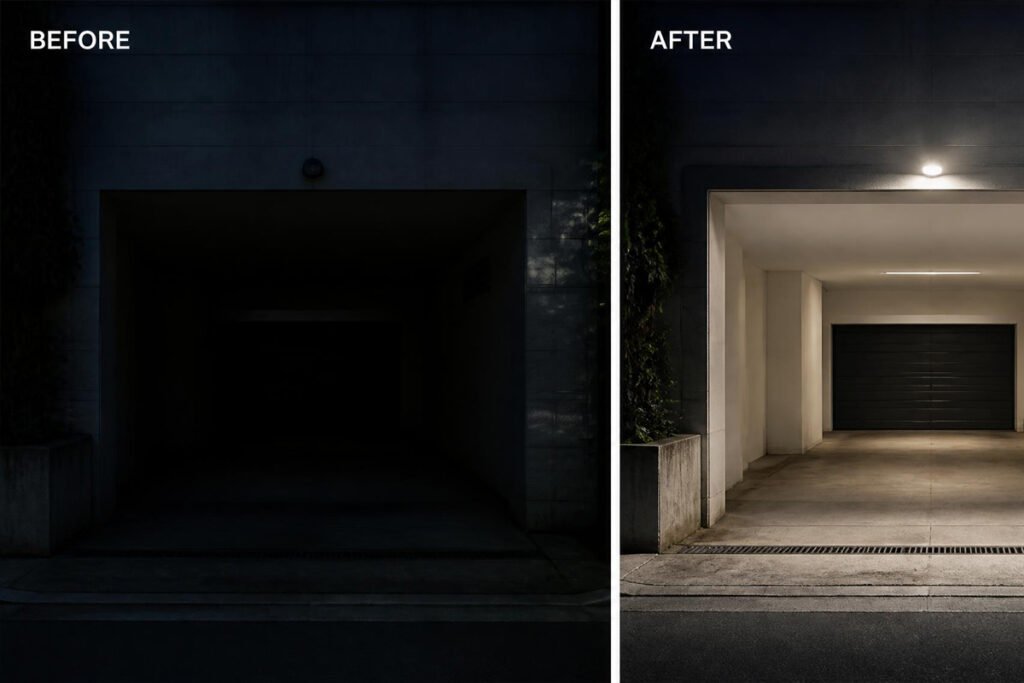
3. Floodlight Combo Camera
Overview: Combining a security camera with bright, motion-activated floodlights, this type doubles as both a deterrent and a functional light source for a dark garage entrance or driveway approach.
Key Features:
- Integrated motion-activated LED floodlights
- Wide field of view designed for driveway and entry coverage
- Often includes a loud built-in siren option
- Typically requires hardwiring for the light function
Best For: Dark garage entrances, driveway monitoring, maximum visual deterrence
Pros: ✅ Bright lighting adds real deterrence beyond recording alone ✅ Wide coverage suited for entry points and driveways ✅ Siren option adds an active deterrent, not just passive recording Cons: ❌ Usually requires hardwired installation ❌ Higher price point than a basic camera-only model
Our Verdict: A strong choice for a poorly lit garage entrance — pair the improved lighting with our complete garage lighting guide for a fully illuminated approach, not just the camera’s own floodlight.
4. Solar-Powered Camera
Overview: Solar cameras pair a battery-powered unit with a small solar panel, extending battery life significantly (or eliminating manual recharging entirely in sunny climates) — a strong fit for detached garages that see little foot traffic to manage charging.
Key Features:
- Integrated or add-on solar panel for continuous charging
- No wiring required, similar to standard battery models
- Reduces or eliminates manual battery recharging
- Weatherproof for permanent outdoor mounting
Best For: Detached garages in sunny climates, low-maintenance long-term installs
Pros: ✅ Dramatically reduces or eliminates battery maintenance ✅ No wiring required ✅ Ideal for hard-to-reach mounting locations Cons: ❌ Requires consistent sun exposure at the mounting location to work as intended ❌ Higher price than a standard battery-only model
Our Verdict: Worth the extra cost if your garage camera will be mounted somewhere genuinely inconvenient to access for regular charging.
5. Garage-Door-Integrated Smart Camera
Overview: These cameras are designed specifically to pair with smart garage door opener systems, letting you view your garage’s status and footage from the same app you already use to control the door itself.
Key Features:
- Designed for direct integration with compatible smart openers
- Combined door status and video monitoring in one app
- Often includes wide-angle interior coverage
- Two-way audio common on most models
Best For: Homeowners already using a smart garage door opener system
Pros: ✅ Single app for both door control and camera monitoring ✅ Purpose-built for interior garage coverage ✅ Convenient integration reduces app-switching Cons: ❌ Only works well within its specific compatible ecosystem ❌ Less flexible than a standalone camera if you switch systems later
Our Verdict: The most convenient option if you’ve already invested in a smart garage door opener, since it consolidates monitoring into a single, already-familiar app.
6. Local-Storage (No-Subscription) Camera
Overview: For anyone who wants to avoid recurring monthly fees, this category prioritizes on-device SD card or local hub storage over cloud-dependent recording, keeping full footage access without an ongoing subscription.
Key Features:
- Local SD card or hub-based storage, no required subscription
- Motion detection and alerts function without cloud dependency
- Often supports encrypted local storage for privacy
- Footage remains accessible even if internet service drops
Best For: Budget-conscious buyers, anyone wanting to avoid recurring fees or cloud dependency
Pros: ✅ No recurring subscription cost over the camera’s lifetime ✅ Footage stays accessible even during an internet outage ✅ Better data privacy since footage isn’t stored on a third-party server Cons: ❌ Local storage capacity is finite and requires periodic management ❌ Remote access features can be more limited than cloud-based competitors
Our Verdict: The most budget-friendly long-term choice if you’re comfortable managing local storage yourself rather than paying an ongoing cloud fee.
Comparison Table {#comparison-table}
| Camera Type | Best For | Installation | Approx. Price Range | Subscription Required |
|---|---|---|---|---|
| Wired PoE | Attached garages with wiring access | Professional or advanced DIY | $80–$250 | Usually no (local NVR) |
| Battery-Powered Wireless | Detached garages, quick installs | DIY, minutes | $50–$150 | Often optional |
| Floodlight Combo | Dark entrances, driveway coverage | Hardwired | $100–$250 | Often optional |
| Solar-Powered | Sunny climates, low-maintenance installs | DIY, minutes | $80–$200 | Often optional |
| Smart Opener-Integrated | Existing smart opener owners | DIY or professional | $80–$180 | Varies by brand |
| Local-Storage (No-Subscription) | Budget-conscious, privacy-focused buyers | DIY, minutes | $40–$150 | No |
Best Cameras for Different Garage Setups {#different-setups}
Attached Garages With Existing Wiring
A wired PoE camera offers the most reliable long-term performance, especially paired with the door hardware covered in our garage door security guide.
Detached Garages Without Easy Wiring
Battery-powered or solar cameras solve the access problem entirely, since neither requires running cable to a structure separate from the main house.
Dark or Poorly Lit Entrances
A floodlight combo camera adds real deterrence through lighting, not just recording — combine it with a broader lighting upgrade from our garage lighting guide for the best results.
How to Position a Garage Camera Correctly {#how-to-position}
Step 1: Cover the Main Entry Point First
Position at least one camera with a clear view of the garage door itself, whether from inside or outside, before covering secondary areas.
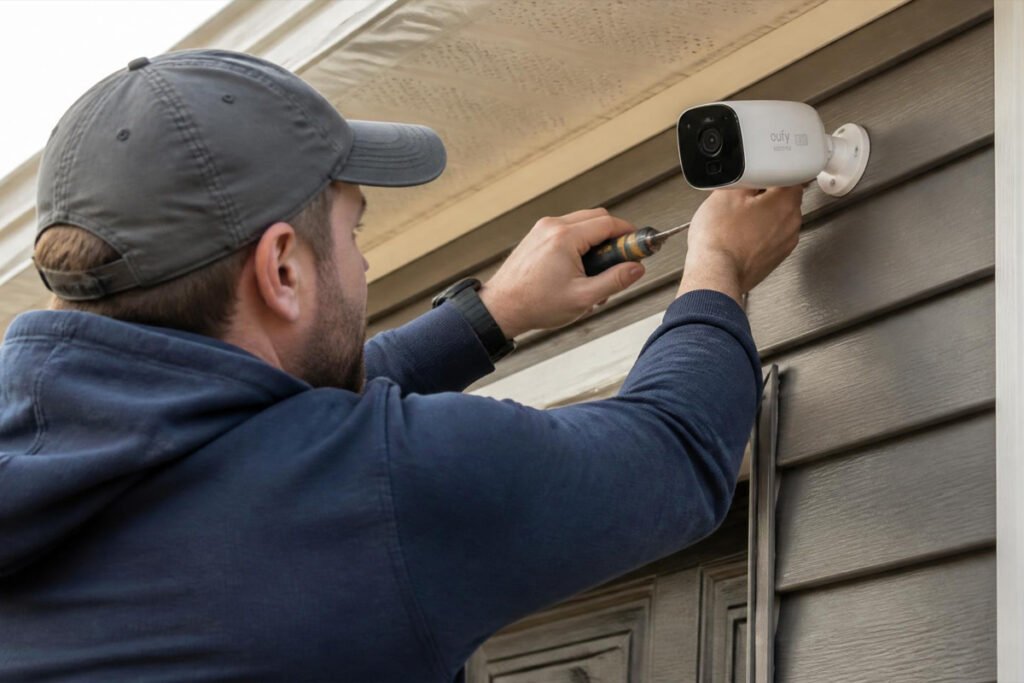
Step 2: Mount High Enough to Avoid Tampering
A height of 8–10 feet balances a wide field of view with making the camera harder to reach or disable.
Step 3: Account for Lighting Conditions
Check the camera’s performance in actual low-light conditions at your specific location, not just manufacturer specs, since real-world garage lighting varies widely.
Step 4: Test Wi-Fi Signal Strength Before Final Mounting
For wireless models, confirm signal strength at the exact mounting spot, not just nearby, before committing to permanent placement.
Step 5: Set Up Motion Zones to Reduce False Alerts
Most apps let you define specific zones — excluding areas like a street or sidewalk where passing traffic would otherwise trigger constant notifications.
Common Mistakes {#common-mistakes}
Mounting the camera too low, within easy reach. A camera an intruder can simply grab or disable defeats the purpose — mount high enough to stay out of reach while still capturing useful footage.
Ignoring the camera’s actual low-light performance. Many budget cameras advertise “night vision” that performs poorly in a genuinely dark garage — check real user reviews for low-light footage quality, not just the spec sheet.
Relying on a camera as your only security measure. A camera records or deters, but it doesn’t physically stop entry — pair it with the door hardware and locks covered in our garage door security guide.
Expert Tips {#expert-tips}
Cover both the door and the interior, not just one or the other. A camera watching only the door misses what happens if someone’s already inside; a second, lower-cost interior camera closes that gap.
Check subscription costs over the camera’s full lifespan, not just the sticker price. A cheaper camera with a mandatory subscription can cost more over 2–3 years than a pricier local-storage model.
Revisit camera placement after any garage layout change. Adding shelving, a workbench, or reorganizing storage can create new blind spots — a quick placement check after any major reorganization keeps coverage effective.
Final Thoughts {#final-thoughts}
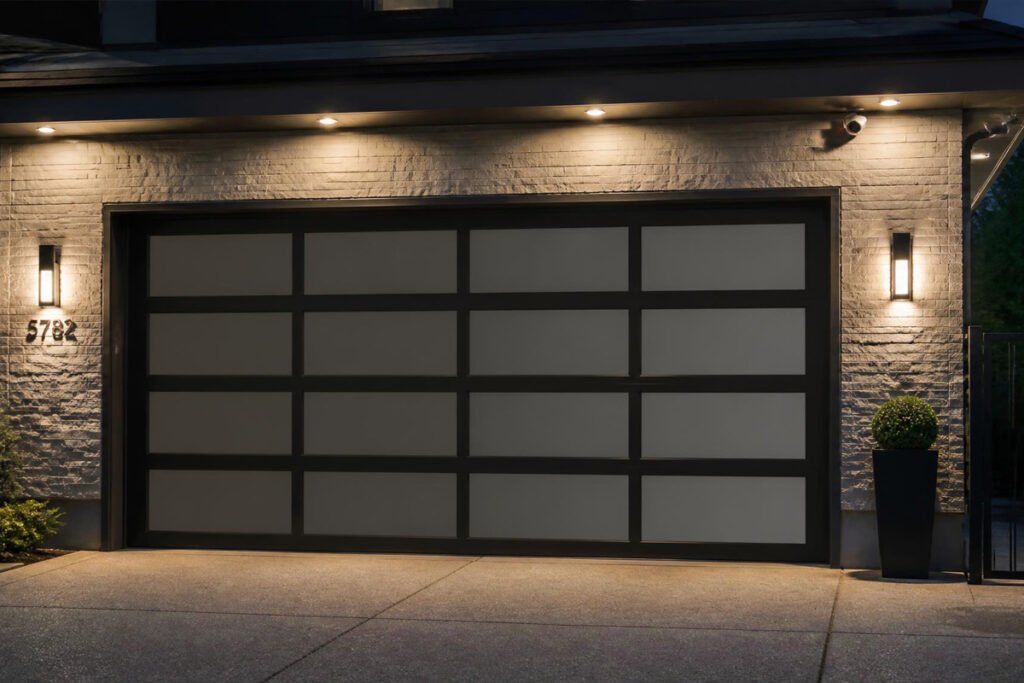
Best Overall: A battery-powered wireless camera for the best balance of easy installation and reliable coverage in most garages. Best for Detached Garages: A solar-powered camera, eliminating both wiring and ongoing battery maintenance. Best for Maximum Deterrence: A floodlight combo camera, combining bright lighting with recording at a dark entry point.
A camera works best as part of a complete security approach — see our garage door security guide and garage safety guide to round out the rest of your setup.
Frequently Asked Questions {#faq}
Do I need a wired or wireless camera for my garage? It depends on your access to power and Wi-Fi at the mounting location — wired cameras offer more reliable performance but require existing infrastructure, while wireless models install almost anywhere.
How do I cover a detached garage without running new wiring? Battery-powered or solar cameras solve this directly, since neither requires a cable run from the main house to the detached structure.
Do garage security cameras really deter theft? Visible cameras are a meaningful deterrent on their own, and models with floodlights or sirens add an active deterrent beyond simple recording.
Is a subscription required for garage security cameras? It depends on the model — many cameras offer local SD card or hub-based storage as a subscription-free alternative to cloud recording, though some smart features may be limited without a subscription.
How high should I mount a garage security camera? A common range is 8–10 feet, balancing a wide field of view with keeping the camera out of easy reach for tampering.
Will my garage camera work well in low light? This varies significantly by model — check specifically for real-world low-light or night vision performance reviews rather than relying on marketing specs alone.
Can I integrate a camera with my existing smart garage door opener? Some cameras are purpose-built for specific opener ecosystems, offering combined door status and video monitoring in a single app — check compatibility with your specific opener brand before buying.
How long does a battery-powered garage camera last before recharging? Typically 1–6 months depending on motion detection frequency and video quality settings, though solar-powered models can extend this significantly or eliminate manual recharging in sunny locations.
Should I get one camera or multiple for my garage? A single camera covering the main entry point is a reasonable starting point, but a second camera covering the garage interior closes an important gap that a door-only camera misses.
Author: Danial Marquez Last Updated: August 2026