
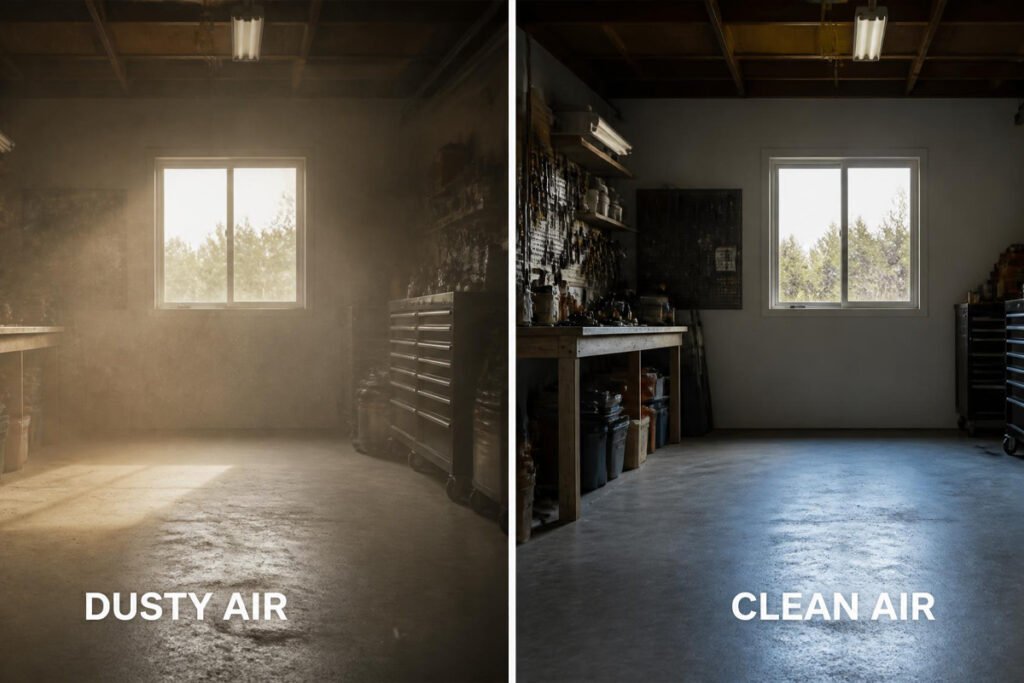
Sawdust hanging in the air after a project, faint exhaust fumes lingering after pulling the car in, a musty smell that never fully clears out — garage air quality is easy to ignore until it starts affecting how the space actually feels to work in. Unlike a bedroom or living room, a garage combines fine dust, chemical fumes, and moisture in ways most air purifiers were never designed to handle.
The right air purifier changes that, clearing out particulates and odors that ventilation alone can’t fully solve. This guide breaks down the best air purifiers for garage use, what actually matters when shopping for one, and how to match a unit to your garage size and use case. If lingering smells are your main concern rather than dust, our dedicated guide on garage odor removal is worth pairing with whichever purifier you choose.
Quick Answer
The best air purifier for a garage depends on what you’re filtering out. For general dust and allergens, a HEPA purifier with a large coverage rating handles most day-to-day needs. For chemical fumes, paint smells, or exhaust residue, look for a unit with a substantial activated carbon layer alongside HEPA filtration. For active workshop garages producing heavy sawdust or metal particulate, a high-capacity or ceiling-mounted dust collector outperforms a standard portable unit. Most garages do best with a purifier rated for a larger square footage than the room actually measures, since garages typically have less sealed airflow than a standard room.
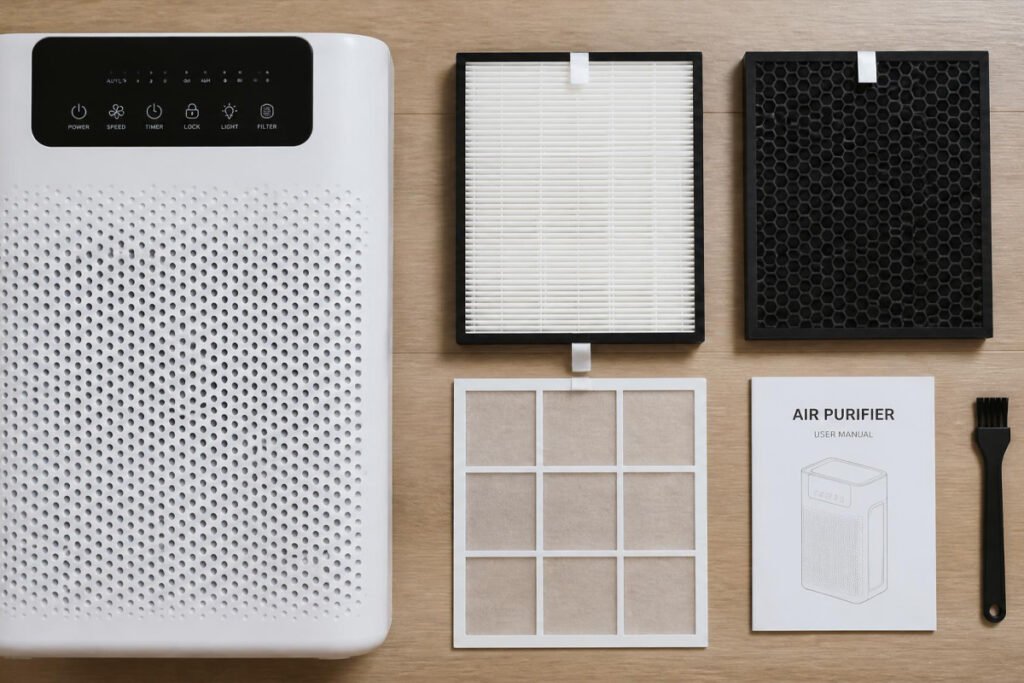
Table of Contents
- Why Garage Air Quality Needs Different Equipment
- How to Choose the Right Air Purifier
- Best Air Purifiers Available
- Comparison Table
- Best Purifiers for Different Garage Uses
- How to Set Up a Garage Air Purifier Correctly
- Common Mistakes
- Expert Tips
- Final Thoughts
- Frequently Asked Questions
Why Garage Air Quality Needs Different Equipment {#what-you-need}
A typical living-room air purifier is rated and tested for a sealed, climate-controlled space. Garages rarely fit that description — the door opens regularly, insulation is often minimal, and the space frequently contains sources of pollution a bedroom never sees: vehicle exhaust residue, sawdust, paint fumes, and stored chemicals. That combination means garage-appropriate purifiers need a higher coverage rating and more aggressive filtration than the same square footage would require indoors.
Good airflow and filtration work together, not as substitutes for each other — our garage ventilation guide covers the airflow side of this equation, while a purifier handles what airflow alone leaves behind.
How to Choose the Right Air Purifier {#how-to-choose}
Before buying, ask three questions:
- What am I actually filtering out? Dust and allergens call for strong HEPA filtration; fumes and odors need a substantial activated carbon layer as well.
- How big is my garage, really? Choose a unit rated for meaningfully more square footage than your garage’s actual size, since open doors and limited insulation reduce real-world efficiency.
- How often do I need it running? A garage used daily as a workshop needs a higher-capacity, more durable unit than one only needing occasional post-project cleanup.
For general guidance on indoor air quality standards, the U.S. EPA’s indoor air quality resources are a solid, non-commercial reference, even though they aren’t garage-specific.
Best Air Purifiers Available {#best-tools}
1. HEPA Purifier with Activated Carbon Layer
Overview: This is the most versatile option for a typical garage — a True HEPA filter captures fine dust and allergens down to 0.3 microns, while a dedicated activated carbon layer absorbs odors and light chemical fumes at the same time.
Key Features:
- True HEPA filtration rated for 99.97% particle capture
- Dedicated activated carbon layer for odor and fume absorption
- Coverage typically rated for 400–800+ sq ft
- Multiple fan speeds with auto air-quality sensing on many models
Best For: General dust, allergens, and light fume control in most garages
Pros: ✅ Handles both particulates and odors in one unit ✅ Wide range of coverage sizes available ✅ Auto sensing adjusts fan speed to actual air quality Cons: ❌ Filters need periodic replacement, adding ongoing cost ❌ Standard units may struggle with heavy workshop dust volume
Our Verdict: The right starting point for most garages — pair it with our garage ventilation guide for the best combined airflow and filtration setup.
2. Heavy-Duty Workshop Dust Collector
Overview: For garages that double as an active woodworking or metalworking shop, a dedicated dust collector — often ceiling-mounted or portable on wheels — handles a much higher volume of coarse dust than a standard air purifier is built for.
Key Features:
- High-capacity intake designed for sawdust and metal particulate
- Ceiling-mount or portable wheeled options
- Washable or replaceable pre-filters for heavy debris
- Higher CFM (airflow) rating than standard purifiers
Best For: Active woodworking, metalworking, or heavy DIY workshop garages
Pros: ✅ Handles far more particulate volume than a standard purifier ✅ Built to run continuously during active project work ✅ Washable pre-filters reduce ongoing filter costs Cons: ❌ Bulkier and louder than a standard air purifier ❌ Ceiling-mounted models require more involved installation
Our Verdict: Essential if your garage functions as a real workshop — see our garage workshop setup guide for how this fits into a broader dust-management plan.
3. Compact Portable Purifier
Overview: For smaller garages or occasional use rather than a full workshop setup, a compact purifier offers solid HEPA filtration in a smaller, more affordable, and easier-to-store footprint.
Key Features:
- Compact size, easy to move or store
- HEPA filtration rated for smaller coverage areas (150–350 sq ft)
- Lower price point than full-size units
- Quiet operation suited for occasional use
Best For: Small garages, occasional post-project cleanup, budget-conscious buyers
Pros: ✅ Most affordable option on this list ✅ Easy to store when not in use ✅ Quiet enough to run without much disruption Cons: ❌ Limited coverage compared to full-size units ❌ Filters may need more frequent replacement given the smaller filter surface area
Our Verdict: A practical choice if your garage is small or you only need periodic air cleanup rather than continuous operation.
4. Smart Air Purifier with App Monitoring
Overview: Smart purifiers add Wi-Fi connectivity and real-time air quality monitoring, sending alerts to your phone and letting you check and adjust the unit remotely without walking out to the garage.
Key Features:
- Wi-Fi connectivity with smartphone app control
- Real-time air quality index display
- Remote fan speed adjustment and scheduling
- Filter replacement alerts sent to the app
Best For: Homeowners who want data on garage air quality trends over time
Pros: ✅ Real-time air quality data, not just a running fan ✅ Convenient remote control and monitoring ✅ Filter alerts prevent forgetting replacements Cons: ❌ Requires stable home Wi-Fi to use smart features ❌ Higher price point than a comparable non-connected unit
Our Verdict: Worth it if you’re curious about exactly what’s in your garage’s air over time, especially alongside chemical storage or a home workshop — pair it with our garage safety guide for a broader air-quality and safety check.
5. Large-Capacity Purifier for Oversized or Multi-Car Garages
Overview: For two- and three-car garages, or garages combined with a workshop or living space conversion, a large-capacity unit rated for 1,000+ square feet delivers meaningful air turnover across a bigger area than standard units can cover effectively.
Key Features:
- Coverage rated for 1,000+ sq ft
- High CFM output for faster air turnover in large spaces
- Larger filter surface area for longer intervals between replacements
- Often includes multiple filtration stages (pre-filter, HEPA, carbon)
Best For: Multi-car garages, converted garage living spaces, combined workshop/storage garages
Pros: ✅ Genuinely effective in large, open garage spaces ✅ Longer intervals between filter changes ✅ Multi-stage filtration handles varied pollutant types Cons: ❌ Highest price point on this list ❌ Larger physical footprint takes up more floor or shelf space
Our Verdict: The right call if you’ve converted your garage into living or workshop space, where air quality expectations are closer to an actual room than a typical garage.
Comparison Table {#comparison-table}
| Purifier Type | Best For | Coverage | Approx. Price Range | Noise Level |
|---|---|---|---|---|
| HEPA + Carbon Purifier | General dust, allergens, light fumes | 400–800+ sq ft | $150–$350 | Low–Medium |
| Heavy-Duty Dust Collector | Active woodworking/metalworking | Workshop-rated CFM | $200–$500 | Medium–High |
| Compact Portable Purifier | Small garages, occasional use | 150–350 sq ft | $60–$150 | Low |
| Smart App-Connected Purifier | Air quality monitoring over time | 400–700 sq ft | $250–$450 | Low–Medium |
| Large-Capacity Purifier | Multi-car or converted garages | 1,000+ sq ft | $350–$600+ | Medium |
Best Purifiers for Different Garage Uses {#different-uses}
Everyday Parking and Storage Garages
A standard HEPA and carbon purifier covers most needs here, clearing light dust and vehicle-related residue without requiring a dedicated workshop-grade unit.
Active Woodworking or Metalworking Shops
A heavy-duty dust collector is worth the investment, ideally paired with the broader dust and safety planning covered in our garage workshop setup guide.
Converted Garages (Gyms, Living Space, Offices)
Treat air quality expectations like an actual room rather than a garage — a large-capacity or smart purifier fits better here than a basic unit, especially alongside our guide on converting a garage into living space.
How to Set Up a Garage Air Purifier Correctly {#how-to-set-up}
Step 1: Choose a Central, Unobstructed Location
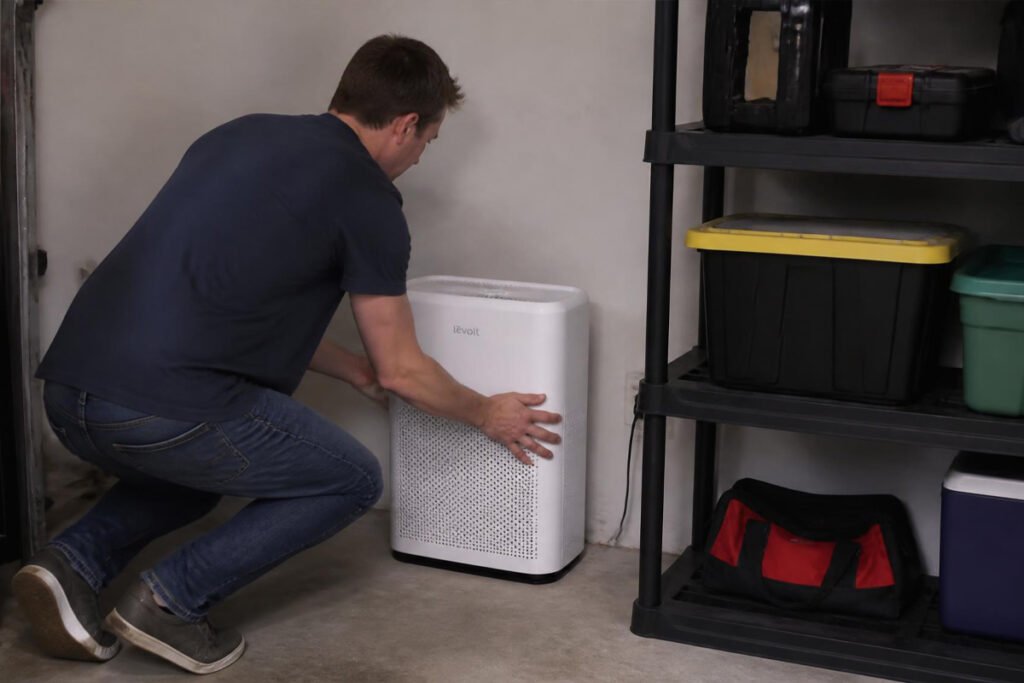
Place the unit where air can circulate freely around it, away from walls or stacked storage that would block intake and output vents.
Step 2: Confirm Power Access
Most units require a standard outlet — plan placement around available power rather than forcing an extension cord setup.
Step 3: Run It During and After Dusty Activities
Turn the purifier on before starting a dusty or fume-producing project, not just afterward, for the best real-time air quality.
Step 4: Check and Replace Filters on Schedule
Garage use wears through filters faster than typical indoor use — check monthly rather than relying solely on manufacturer-default reminders.
Step 5: Pair With Ventilation, Not Instead Of It
Keep the garage door or a vent cracked when practical — a purifier works best alongside airflow, not as a sealed-room replacement for it.
Common Mistakes {#common-mistakes}
Buying a purifier sized for the room, not the garage’s real airflow conditions. Garages leak air more than sealed rooms, so undersized units struggle to keep up — size up rather than matching the unit exactly to square footage.
Skipping the activated carbon layer for a garage with chemical storage. HEPA alone captures particulates but does little for fumes and odors — see our garage odor removal guide if odor, not dust, is your primary concern.
Forgetting filter maintenance in a heavy-use garage. A clogged filter dramatically reduces effectiveness — garage use typically demands more frequent filter checks than the same unit would need indoors.
Expert Tips {#expert-tips}
Run the purifier continuously during projects, not just as cleanup after. Capturing dust and fumes as they’re generated is far more effective than trying to clear the air after the fact.
Combine a purifier with a dehumidifier in humid climates. Moisture and airborne particulates often go hand in hand — a two-appliance approach handles both issues rather than relying on filtration alone.
Keep the purifier away from direct exhaust paths. Positioning it too close to where a vehicle exhaust naturally flows shortens filter life dramatically — a few feet of separation makes a real difference.
Final Thoughts {#final-thoughts}
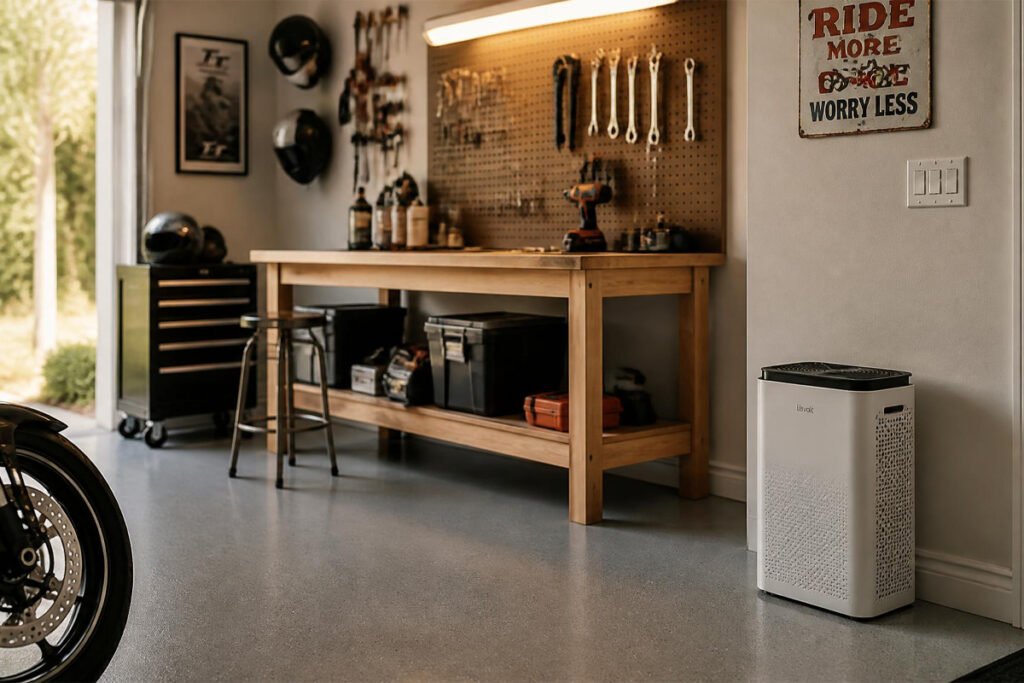
Best Overall: A HEPA and activated carbon purifier rated for 400–800 sq ft covers the majority of garage needs. Best for Active Workshops: A heavy-duty dust collector, ideally ceiling-mounted for continuous operation during projects. Best for Large or Converted Garages: A large-capacity purifier rated for 1,000+ sq ft, treating the space like an actual room rather than a standard garage.
Clean air is one piece of a broader garage comfort picture — for the rest, see our garage ventilation guide and garage odor removal guide to round out your setup.
Frequently Asked Questions {#faq}
Do air purifiers actually work in a garage, given how often the door opens? Yes, though real-world efficiency is lower than in a sealed room — this is exactly why sizing up to a higher coverage rating than your garage’s actual square footage matters.
HEPA vs. activated carbon — which do I actually need? HEPA captures particulates like dust and allergens; activated carbon absorbs odors and chemical fumes. Most garages benefit from a unit that includes both rather than choosing one over the other.
How often should I replace the filters in a garage air purifier? Garage use typically wears through filters faster than indoor use — check monthly and expect to replace HEPA filters every 3–6 months depending on how dusty your specific garage gets.
Can an air purifier remove vehicle exhaust fumes from my garage? It can meaningfully reduce residual fume levels, but it’s not a substitute for proper ventilation or a carbon monoxide detector — see our garage carbon monoxide safety guide for the full safety picture.
Do I need a workshop-grade dust collector, or will a standard purifier work? If you’re doing regular woodworking or metalworking, a dedicated dust collector handles the volume of coarse particulate far better than a standard purifier designed for finer, lower-volume dust.
Will an air purifier help with a musty garage smell? A unit with a strong activated carbon layer helps meaningfully, but persistent musty odors often point to an underlying moisture or mold issue — see our garage mold removal guide if the smell keeps returning.
Is it safe to run an air purifier continuously in a garage? Yes, most units are designed for continuous operation — just make sure filters are checked and replaced on a garage-appropriate schedule rather than the standard indoor timeline.
Can I use a regular household air purifier in my garage? You can, but it will likely be undersized and wear out faster than a unit specifically rated for garage-level dust and airflow conditions.
Do smart air purifiers actually improve air quality more than standard units? Not directly — the filtration technology is often similar. The advantage is in monitoring and automatic adjustment, which can lead to more consistent use rather than a purifier sitting off when it’s actually needed.
Author: Danial Marquez Last Updated: August 2026


1 thought on “Best Air Purifiers for Your Garage: Top 5 Picks & Buying Guide”
Pingback: Best Rust Remover for Tools: Proven Top Picks | GarageDaily.com – Master Your Garage with Expert Tips