Bare concrete takes a beating in a garage — oil drips, road salt, snowmelt, and tire marks all leave permanent stains if there’s nothing between your car and the floor. A good garage floor mat solves that without the cost or commitment of epoxy coating, and it rolls up and moves with you if you ever leave.
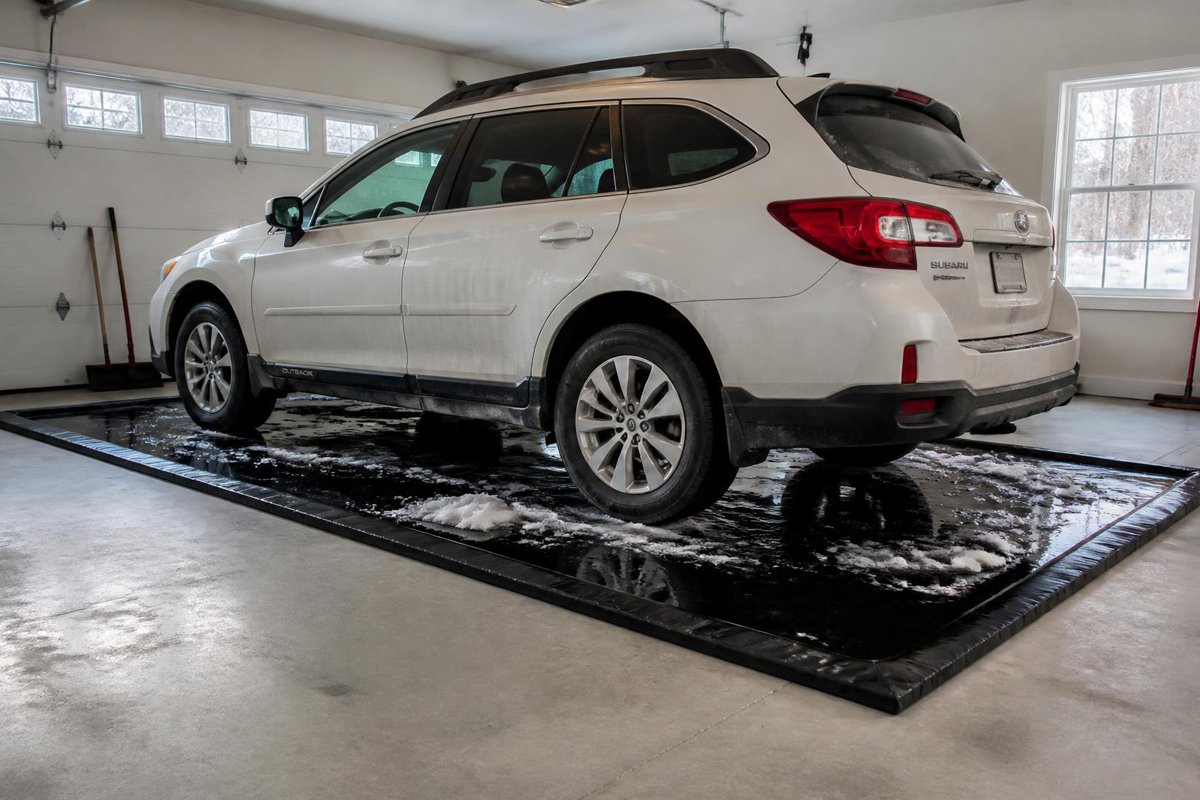
Quick answer: for most garages, a heavy-duty containment mat with raised edges is the best all-around pick, since it handles winter mess and everyday drips in one product. If you’ve already epoxy coated your floor, a softer mat under just the parking zone protects that investment without covering the whole floor. Full picks and a buying guide follow below.
Garage floor mats fall into a few genuinely different categories that solve different problems, which is worth understanding before you buy: containment mats with raised edges are built to hold liquid within the mat itself, absorbent mats soak drips directly into the material, and rubber or interlocking tile flooring prioritizes a tough, non-slip work surface over liquid containment. We compared products on material durability, containment capacity, ease of cleaning, and price-per-square-foot value specifically for garage use.

Quick Comparison
| Product | Best For | Material | Approx. Price |
| AutoFloorGuard Containment Mat | Best Overall / Winter Climates | PVC-coated polyester, raised edge | ~$130–$180 |
| Drymate Garage Floor Mat | Best Absorbent Everyday Mat | Recycled fiber, waterproof backing | ~$80–$120 |
| RaceDeck Free-Flow Tiles | Best Premium / Drainage System | Interlocking polypropylene tiles | ~$4–$6 per sq ft |
| Rubber-Cal Diamond Plate Roll | Best Durable Rubber Roll-Out | SBR rubber, fire retardant | ~$3–$4 per sq ft |
| NarwooAuto PVC Roll Mat | Best Budget Pick | 2.8mm thickened PVC | ~$60–$90 |
Note: prices vary by size and are approximate based on typical current listings — confirm exact dimensions and pricing before you buy.
1. AutoFloorGuard Heavy-Duty Containment Mat — Best Overall
⭐ Best Overall
PVC-coated polyester with 1-inch raised edge | Holds up to 64 gallons | Stay-Put corners | ~$130–$180
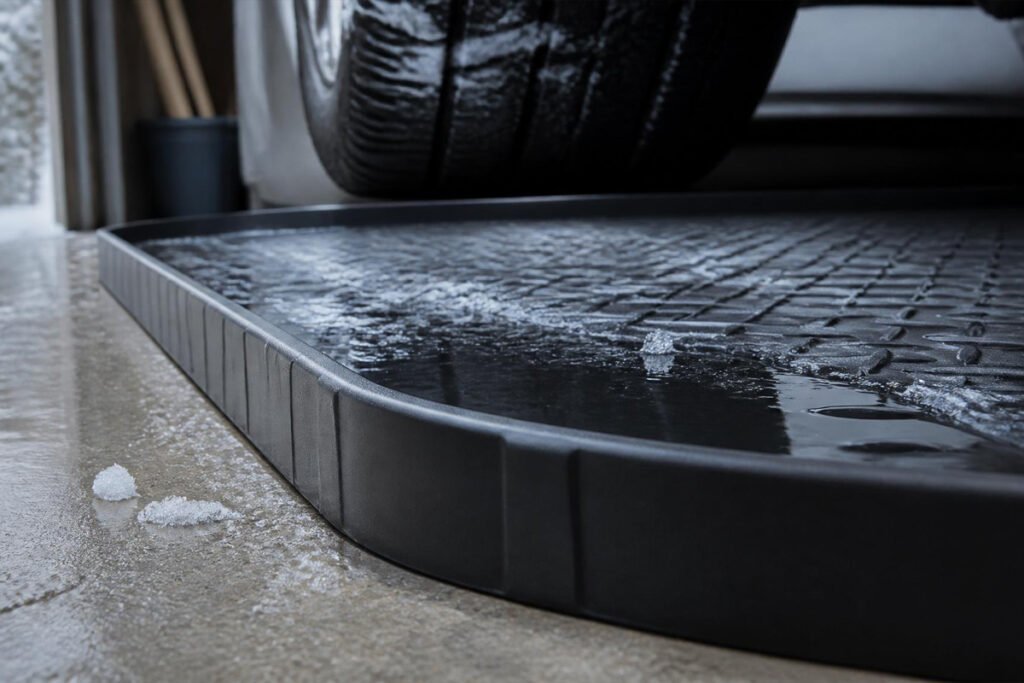
This is the mat most reviewers point to for genuinely messy climates — the raised containment edge actually holds a meaningful volume of snowmelt and road salt runoff instead of just slowing it down, and the heat-sealed watertight seams mean it stays that way for years rather than failing at the corners after one hard winter. A built-in squeegee and drainage approach makes cleanup a matter of pushing water out the door rather than mopping the whole garage.
Why buy it
- Raised edge genuinely contains large volumes of snowmelt, road salt, and mud rather than just slowing it down
- Heat-sealed seams hold up to years of daily vehicle use without failing at the corners
- No assembly — unroll and it’s ready, with corner anchors to reduce shifting
Worth knowing
- Corner anchors work better on sealed floors than bare concrete — may need extra tape on unsealed surfaces
- Requires periodic cleaning to avoid dirt and grime building up inside the containment edge
Verdict: the strongest all-around pick, especially for anyone dealing with real winter weather or wanting maximum containment rather than light protection.
2. Drymate Garage Floor Mat — Best Absorbent Everyday Mat
💧 Best Absorbent Mat
Over 50% recycled fiber surface | Waterproof polyester backing | No raised edge | ~$80–$120
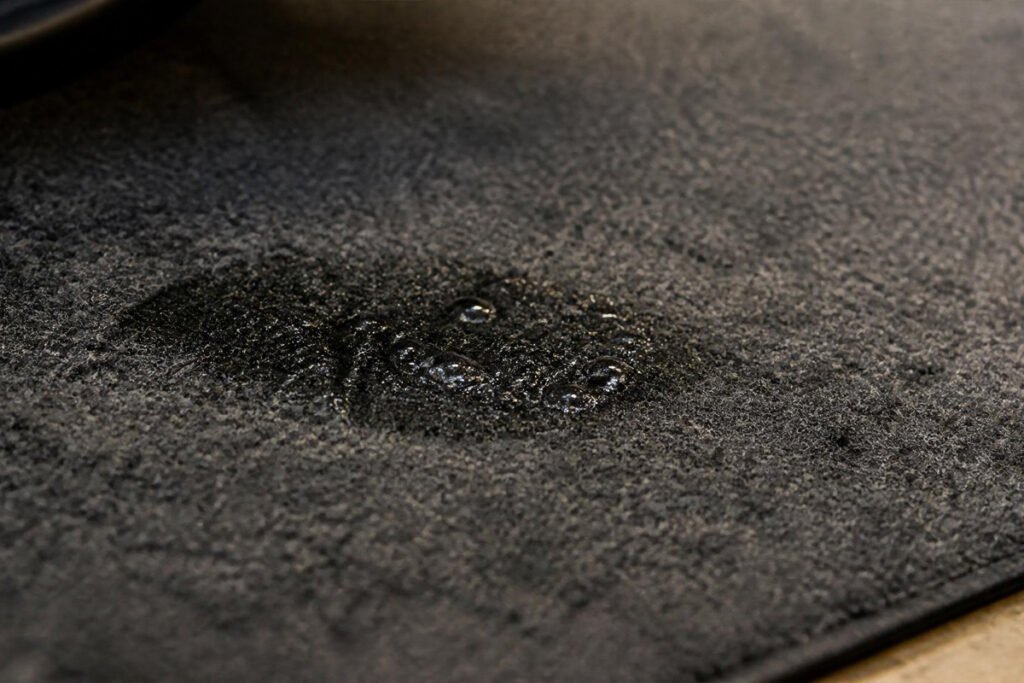
Instead of containing liquid within a raised edge, this mat absorbs it directly into a felt-like recycled fiber surface, backed by a waterproof layer that stops anything from reaching the concrete underneath. That makes it a genuinely good everyday mat for routine oil drips and minor leaks, and the fabric surface feels less industrial underfoot than a hard PVC or rubber mat, though it takes more effort to clean than a wipe-down surface.
Why buy it
- Genuinely absorbs drips and minor leaks rather than just letting them sit on the surface
- Waterproof backing protects concrete even as the top layer absorbs liquid
- Softer, less industrial feel underfoot than rubber or PVC alternatives
Worth knowing
- No raised edge, so it’s not built to contain large volumes like heavy snowmelt
- Fabric surface needs more effort to clean thoroughly than a smooth PVC or rubber mat
Verdict: the better choice for routine oil drips and everyday protection rather than heavy winter containment — pick this over the AutoFloorGuard if you’re in a milder climate.
3. RaceDeck Free-Flow Interlocking Tiles — Best Premium / Drainage System
🏆 Best Premium
Interlocking polypropylene tiles | Open-grid drainage design | Supports 80,000 lb rolling loads | ~$4–$6 per sq ft

This is a genuinely different category from the roll-out mats above it — a modular tile system that clicks together into a permanent-feeling floor rather than a mat you roll out and put away. The open-grid design lets liquid drain through to the concrete below instead of pooling on the surface, and the tiles support genuinely heavy rolling loads, which matters if you’re parking anything larger than a standard car or rolling heavy equipment across it.
Why buy it
- Open-grid drainage keeps the surface dry underfoot even with liquid passing through
- Interlocking tiles create a permanent, finished look rather than a rollable mat
- Rated for genuinely heavy rolling loads — well beyond what a standard car requires
Worth knowing
- Meaningfully more expensive than roll-out mats, especially for a full two-car garage
- Installation takes longer, since you’re laying and clicking together individual tiles rather than unrolling one mat
Verdict: worth the premium if you want a finished, showroom-quality floor rather than a temporary mat — skip it if you just need basic protection.
4. Rubber-Cal Diamond Plate Rubber Flooring Roll — Best Durable Rubber Roll-Out
🛡️ Best Durable Roll-Out
Styrene-butadiene rubber (SBR) | Fire retardant | Diamond or coin-grip surface | ~$3–$4 per sq ft
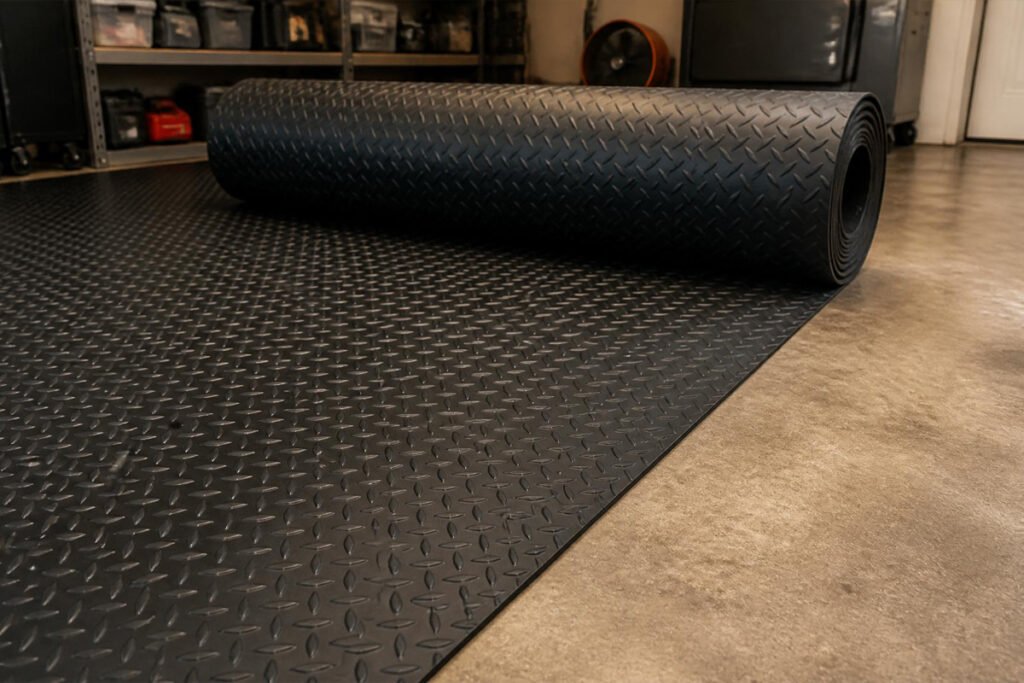
Rubber flooring rolls solve a different problem than containment mats — they’re less about catching snowmelt and more about giving you a genuinely tough, non-slip surface that holds up under dropped tools, rolling jacks, and years of foot traffic. The diamond or coin-grip texture provides real traction, and unlike PVC mats, it’s rated fire retardant, which matters if the garage doubles as a workshop with any hot-work activity.
Why buy it
- Genuinely tough surface that holds up to dropped tools and heavy equipment better than PVC mats
- Fire-retardant rating is a meaningful safety plus for a garage used as a workshop
- Textured surface provides real slip resistance underfoot, though it can get slick when wet
Worth knowing
- Not designed as a containment system — it’s a durable surface, not a liquid barrier
- Heavier and more physically demanding to install than a lightweight PVC roll
Verdict: the right pick if durability and a genuine work surface matter more to you than liquid containment — pair it with a smaller containment mat under the parking zone specifically if you need both.
5. NarwooAuto PVC Roll Mat — Best Budget Pick
💰 Best Budget
2.8mm thickened PVC | Diamond plate pattern | Includes mounting tape | ~$60–$90
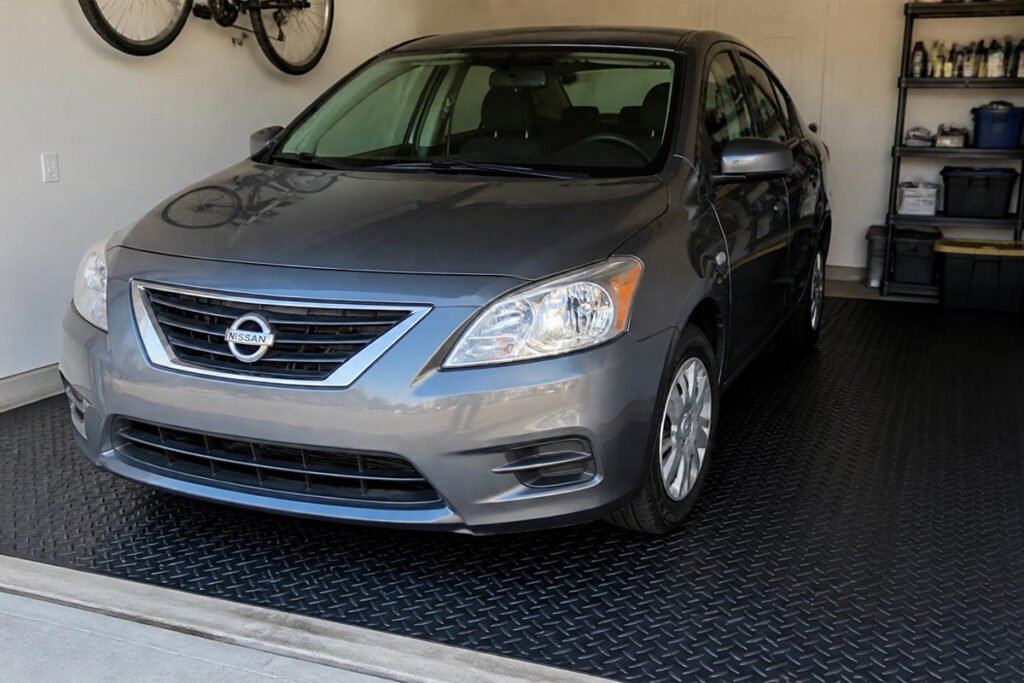
A straightforward PVC roll that covers the basics — a diamond plate pattern for grip, enough thickness to resist punctures from normal use, and a price that makes it an easy first upgrade from bare concrete. It won’t match the containment volume of the AutoFloorGuard or the durability of a rubber roll, but for the cost, it’s a clear step up from doing nothing.
Why buy it
- Lowest price on this list while still meaningfully protecting the floor underneath
- Included mounting tape helps keep it in place without a separate purchase
- Good option for a single parking spot rather than a whole-garage overhaul
Worth knowing
- Thinner material than the premium options, so it’s more prone to wear over time
- No raised containment edge — liquid can still run off the sides onto the surrounding floor
Verdict: the right call if budget is the primary constraint and you just need basic, affordable protection for one parking spot.
Which Mat Fits Your Garage?
- Snowy or salt-heavy climate: the AutoFloorGuard containment mat handles winter runoff better than anything else on this list.
- Mild climate, mostly worried about oil drips: the Drymate absorbent mat is a better everyday fit than a full containment system you don’t need.
- Workshop with tools, jacks, and heavy equipment: the Rubber-Cal rubber roll prioritizes durability and fire resistance over containment.
- Renovating for a permanent, showroom-style finish: RaceDeck interlocking tiles are worth the premium for the finished look and drainage.
- Tight budget, single parking spot: the NarwooAuto PVC roll covers the basics without a big investment.
Common Mistakes When Buying a Garage Floor Mat
Choosing based on price alone
A cheap thin mat that shifts, curls at the edges, or tears within a season often ends up costing more in replacements than a single quality mat would have upfront. Match the mat to your actual climate and use case rather than defaulting to the lowest price.
Ignoring your climate
A basic absorbent mat is a poor fit for a genuinely snowy climate, and a heavy containment mat is overkill if you never see snow or ice. Match the mat type to what your garage floor actually deals with most of the year.
Measuring the space incorrectly
Garage mats are sold in specific lengths and widths, and getting the size wrong either leaves gaps at the edges or requires cutting a mat that wasn’t designed to be trimmed. Measure the actual parking footprint, not just the garage’s overall dimensions, before ordering.
Forgetting about existing floor treatments
If you’ve already epoxy coated your garage floor, check whether a given mat’s backing can discolor or interact with the coating over time — some rubber-backed mats can leave marks on certain epoxy finishes if left in place for extended periods without occasional airing out.
Fast Buying Guide
Containment mat vs. absorbent mat vs. rubber flooring
Containment mats use a raised edge to hold liquid within the mat itself — the right choice for winter climates and heavy runoff. Absorbent mats soak liquid into the surface material — better for routine drips than large volumes. Rubber or interlocking tile flooring prioritizes a durable, non-slip work surface over liquid containment specifically. Pick based on what your garage actually deals with most: winter mess, everyday drips, or heavy equipment and foot traffic.
Sizing your mat
Measure the actual footprint you want covered — typically the length and width of your parking spot, with a few extra inches of margin on each side. Most containment and absorbent mats come in standard sizes like 7–8 feet by 16–20 feet for a single vehicle; interlocking tiles are sold by the square foot and can be sized to fit any layout.
Installation and maintenance
Roll-out mats need no real installation beyond unrolling and, ideally, taping the corners on bare concrete. Interlocking tiles take longer to lay but create a more permanent finish. For upkeep, a squeegee and occasional hose-down handles most containment and rubber mats; absorbent mats may need a stronger cleaner for stubborn stains. If you’re setting up the rest of the garage at the same time, our workshop setup guide and overhead storage guide cover the other half of building a genuinely functional space.
A note on ventilation and moisture
A containment mat catches liquid, but trapped moisture underneath any mat can still contribute to mold or mildew if the garage doesn’t get enough airflow. Pulling mats up occasionally to air out the floor underneath, and keeping the space generally well ventilated, prevents the mat itself from becoming a moisture trap rather than a solution.
Frequently Asked Questions
What’s the best garage floor mat for snowy climates?
A heavy-duty containment mat with a raised edge, like the AutoFloorGuard, is the strongest choice for snow and road salt — it actually holds meltwater rather than just slowing it down, which matters far more than material choice in genuinely snowy regions.
Do garage floor mats damage epoxy coating underneath?
Generally no, but some rubber-backed mats left in place for extended periods without airing out can leave discoloration on certain epoxy finishes. Check the mat manufacturer’s guidance on epoxy compatibility, and consider occasionally lifting the mat to let the floor breathe.
How do I clean a garage floor containment mat?
Most containment and rubber mats can be pulled outside, hosed down, and squeegeed dry. Absorbent fabric mats may need a stronger cleaner or a wet/dry vac for stubborn stains, since the liquid soaks into the fibers rather than sitting on the surface.
Are interlocking garage tiles worth the extra cost over a roll-out mat?
If you want a permanent, finished look and genuinely heavy load capacity, yes. If you mainly need basic protection and want the option to roll it up and take it with you if you move, a standard mat is the more practical and affordable choice.
What size garage floor mat do I need?
Measure your actual parking footprint with a few inches of margin on each side. Most single-vehicle mats run roughly 7–8 feet wide by 16–20 feet long; measure your specific space rather than assuming a standard size will fit.
Can I use a garage floor mat over a cracked or damaged concrete floor?
Yes — a mat can hide minor cracks and imperfections and adds a protective layer on top, though it won’t fix underlying structural issues. For significant cracking or settling, address the concrete itself before relying on a mat as a long-term cosmetic fix.
The Bottom Line
If you buy just one thing from this list, make it a heavy-duty containment mat like the AutoFloorGuard — it handles the widest range of real-world garage mess, from winter runoff to everyday drips. Step up to RaceDeck tiles if you want a permanent, showroom-quality finish, or down to the NarwooAuto roll if budget is the main constraint. Whichever you choose, it’s one of the easiest upgrades available for protecting a garage floor without the cost or commitment of a full epoxy job.
Last Updated: July 2026



![A standard smoke detector is the wrong tool for a garage — dust, vehicle exhaust, and temperature swings trigger enough false alarms that most people eventually just disable the unit, which defeats the purpose entirely. A heat detector solves that by responding to actual temperature change instead of airborne particles. For related garage fire and safety context, see our carbon monoxide and garage safety guide. This roundup focuses specifically on which heat detector to buy. Quick answer: for most attached garages, a hardwired, interconnectable unit like the First Alert HD6135FB is the most reliable choice, since it ties into your home's existing smoke/CO alarm system rather than operating as an isolated device. If wiring isn't an option or you want app alerts when you're not home, a smart or wireless model further down this list covers that instead. We compared products on detection method (fixed temperature vs. rate-of-rise), operating temperature range, interconnection capability, installation type, and price — specifically for garage use, where dust, exhaust, and wide temperature swings rule out options that work fine in a bedroom or hallway. [IMAGE 1 — THUMBNAIL: heat detector mounted on garage ceiling with LED indicator visible — full professional photo brief in SEO package] Quick Comparison Product Best For Detection Type Approx. Price First Alert HD6135FB Best Overall 135°F fixed + rate-of-rise ~$25–$35 Kidde HD135F Best for Whole-Home Interconnection 135°F fixed only ~$25–$35 X-Sense XH02-M Best Smart/App-Connected Heat + app alerts (needs base station) ~$30–$40 + base station RiSol Commercial Heat Detector Best for Large or Extreme-Range Garages Dual fixed + rate-of-rise, –4°F to 135°F ~$50–$80 Honeywell 5809SS Best Wireless (No Hardwiring) Fixed + rate-of-rise, 345MHz wireless ~$40–$55 Note: prices are approximate and based on typical current listings — confirm exact specs and compatibility before you buy. 1. First Alert HD6135FB — Best Overall ⭐ Best Overall 135°F fixed temperature + rate-of-rise (15°F/min) | Hardwired 120VAC with 9V battery backup | 85dB horn | UL539 compliant | ~$25–$35 [IMAGE 2 — First Alert HD6135FB mounted on garage ceiling, white housing visible — full professional photo brief in SEO package] This is the most widely stocked and referenced heat detector for exactly this use case, and the dual-sensing approach is the reason why: it triggers either when the temperature hits a fixed 135°F or when it rises more than 15°F in a single minute, whichever comes first. That rate-of-rise sensing catches a fast-developing fire earlier than a fixed-temperature-only unit would, without the false-alarm sensitivity of a smoke detector. Why buy it • Dual detection (fixed + rate-of-rise) catches fast-developing fires earlier than fixed-only units • Microprocessor control specifically reduces nuisance alarms from dust and temperature swings • Interconnects with other First Alert/BRK hardwired alarms so a garage fire triggers alarms throughout the house Worth knowing • Requires hardwiring into a 120V circuit — not a simple battery-only install • Not rated for extreme cold below –20°F or heat above 115°F, which covers the vast majority of garages but is worth checking for extreme climates Verdict: the safest default pick if your garage is already wired or you're comfortable having an electrician add the circuit — the interconnection with the rest of your home's alarm system is the real value here. 2. Kidde HD135F — Best for Whole-Home Interconnection 🔗 Best for Interconnection 135°F fixed temperature only | Hardwired with 9V battery backup | Interconnects up to 24 Kidde devices | 2 status LEDs | ~$25–$35 [IMAGE 3 — Kidde HD135F heat detector on ceiling with visible LED status lights — full professional photo brief in SEO package] If your home already runs on Kidde smoke and CO alarms, this is the natural fit — it interconnects with up to 24 other Kidde AC-interconnect devices, meaning a garage fire trips every alarm in the house, not just the one nearest the fire. The trade-off against the First Alert pick above is that this unit is fixed-temperature only, without rate-of-rise sensing, which means it won't catch a fast-developing fire quite as early. Pair it with our carbon monoxide safety guide if you're building out a full Kidde-based alarm ecosystem across the house. Why buy it • Seamless interconnection if the rest of your home already runs Kidde alarms • Two LED indicators make status checking simple at a glance • UL 539 certified with a straightforward, well-documented hardwired install Worth knowing • Fixed temperature only — no rate-of-rise detection, so it triggers slightly later on a fast-developing fire • Only interconnects with other Kidde AC-interconnect devices, not mixed brands Verdict: the right choice specifically if you're standardizing on Kidde across the house — otherwise the First Alert's rate-of-rise sensing is the stronger technical pick. 3. X-Sense XH02-M — Best Smart/App-Connected 📱 Best Smart Option Heat sensing + WiFi app alerts | Requires SBS50 base station (sold separately) | Push notifications, battery status alerts | ~$30–$40 + base station [IMAGE 4 — X-Sense XH02-M heat detector with smartphone showing app alert notification — full professional photo brief in SEO package] This is the pick if you want to know about a problem while you're at work or on vacation, not just when you're standing in the garage. It connects to X-Sense's SBS50 base station over 2.4GHz WiFi and pushes alerts, battery status, and incident updates straight to your phone through the X-Sense Home Security app — genuinely useful for anyone who travels or has a detached garage/workshop they don't check daily. Why buy it • Remote push notifications mean you find out about a problem even when you're away from home • Battery status alerts prevent the detector from silently going dead without your knowledge • Straightforward app setup compared to a full hardwired interconnect system Worth knowing • Requires the separate SBS50 base station to function — factor that cost into the total price • Depends on home WiFi and the manufacturer's app/cloud service staying online to deliver remote alerts Verdict: worth the added cost and setup if remote monitoring genuinely matters to your situation — skip it if you're rarely away from the property for long stretches. 4. RiSol Commercial-Grade Heat Detector — Best for Large or Extreme-Range Garages 🌡️ Best for Extreme Ranges Dual fixed + rate-of-rise thermistor sensing | Operating range –4°F to 135°F | Covers up to 900 sq ft | 85dB alarm | ~$50–$80 [IMAGE 5 — RiSol commercial heat detector mounted in a large workshop-style garage — full professional photo brief in SEO package] Built with commercial and industrial spaces in mind, this steps up both the coverage area and the operating temperature range compared to standard residential units — rated down to –4°F, which matters for an uninsulated garage in a genuinely cold climate. The wider 900 sq ft coverage also means a large two-car garage or combined garage/workshop can often get by with fewer total units than standard residential detectors would require. Why buy it • Wide operating range handles genuinely extreme cold better than standard residential units • Larger 900 sq ft coverage area reduces the total number of units needed for a big space • Dual-sensor design matches the fixed + rate-of-rise approach of the best residential picks Worth knowing • Costs more than standard residential heat detectors, reflecting the commercial-grade build • Overkill for a small single-car garage — sized for larger spaces specifically Verdict: the right pick for a large garage, detached workshop, or genuinely harsh climate where standard residential units are pushed past their comfortable operating range. 5. Honeywell 5809SS — Best Wireless (No Hardwiring) 📡 Best Wireless Fixed + rate-of-rise detection | 345MHz wireless | Requires a compatible security panel/receiver | ~$40–$55 [IMAGE 6 — Honeywell 5809SS wireless heat detector mounted with no visible wiring — full professional photo brief in SEO package] For a garage that isn't wired and where running new electrical isn't practical, this is a genuine wireless alternative — it communicates over 345MHz radio to a compatible security system receiver rather than needing a hardwired connection. The catch is real and worth stating plainly: this only works if you already have, or are willing to add, a compatible security panel. It's not a fully standalone battery unit that works on its own out of the box. Why buy it • No electrical work required — genuinely useful for an unwired detached garage or workshop • Same fixed + rate-of-rise dual detection as the best hardwired picks on this list • Integrates with an existing home security system if you already have compatible Honeywell/Resideo equipment Worth knowing • Requires a compatible 345MHz security panel or receiver — it will not function as a true standalone device • Adds an ongoing dependency on your security system staying powered and functional Verdict: the right pick only if you already have, or plan to add, a compatible security system — otherwise the hardwiring cost for a First Alert or Kidde unit is usually simpler. Which Heat Detector Fits Your Garage? • Standard attached garage, already wired: the First Alert HD6135FB is the safest, most tested default. • Home already runs Kidde smoke/CO alarms: the Kidde HD135F keeps the whole system on one interconnected brand. • You travel often or have a detached workshop you don't check daily: the X-Sense XH02-M's app alerts are worth the extra setup. • Large two-car garage, workshop, or genuinely cold climate: the RiSol commercial unit's wider range and coverage area earn the higher price. • Garage isn't wired and running new electrical isn't practical: the Honeywell 5809SS is the realistic wireless option, provided you have or plan to add a compatible security panel. If you're installing a detector alongside other garage upgrades — an EV charger, new overhead storage, or a full workshop build-out — it's worth planning detector placement at the same time rather than as an afterthought once everything else is installed. A Quick Reality Check on “Battery-Only” Heat Detectors If you've searched for a simple, standalone battery-powered heat detector with no wiring and no base station required, you've likely noticed there aren't many well-established options from major brands — that's not an oversight on this list, it reflects the actual market. Most “battery operated” heat detectors marketed online are either wireless units requiring a compatible security panel (like the Honeywell above) or generic, unbranded products without established testing history. If a fully standalone, no-ecosystem battery unit is a hard requirement, expect to do extra due diligence on UL listing and brand reputation before buying, since this is a thinner and less-regulated part of the market than hardwired or panel-based options. Common Mistakes When Buying a Garage Heat Detector Installing a smoke detector instead This is the single most common mistake, and the reason this guide exists — a standard smoke detector in a garage will false-alarm from dust and exhaust often enough that most people eventually disconnect it, leaving the garage with no working fire detection at all. Assuming any heat detector interconnects with any brand Interconnection is almost always brand-specific — a Kidde heat detector won't trip a First Alert smoke alarm elsewhere in the house, and vice versa. If whole-home interconnection matters to you, match the brand to what's already installed. Skipping the operating temperature range Standard residential units are typically rated for roughly –20°F to 115°F. An uninsulated garage in a genuinely extreme climate can exceed that range, which is exactly the gap a wider-range commercial unit like the RiSol pick is built to cover. Forgetting it's not a substitute for a CO detector A heat detector responds to fire risk, not carbon monoxide. Both belong in or near a garage, but they're solving different problems — see our carbon monoxide safety guide for the CO side of garage safety. Fast Buying Guide Fixed temperature vs. rate-of-rise Fixed-temperature detectors trigger at a set threshold, typically 135°F. Rate-of-rise detectors trigger when temperature climbs quickly, regardless of the absolute number, which catches a fast-developing fire earlier. Dual-sensor units combine both and are the stronger choice whenever the price difference is small. Where to mount it Ceiling-mounted, centered in the garage or near the highest-risk area (workbench, electrical panel), away from HVAC vents and garage door tracks that could cause airflow interference. If your garage doubles as a workshop, position it to cover the hot-work or highest-risk station specifically rather than just the geometric center of the room. Interconnected vs. standalone An interconnected unit (hardwired or app-based) alerts the rest of the house when the garage detector trips, buying more time to react. A standalone unit only sounds locally in the garage, which is a real limitation if no one is nearby to hear it. Interconnection is worth the small added cost or setup effort for most attached garages. How many detectors does a garage need A single-car garage under about 500 sq ft typically needs just one unit, centered on the ceiling. A two-car garage or workshop over that size may need two, especially if there's a distinct high-risk zone like a hot-work station on one side of the room. Frequently Asked Questions Why not just use a smoke detector in the garage? Dust, vehicle exhaust, and temperature swings cause frequent false alarms in a standard smoke detector, which tends to end with the unit being disabled entirely — the opposite of what you want. A heat detector responds to actual temperature change instead, avoiding that false-alarm problem. Do I need a hardwired or battery-powered heat detector? Hardwired units are generally more reliable for a garage that already has wiring nearby, and interconnect with the rest of the home's alarm system. If wiring isn't practical, a wireless option paired with a compatible security panel is the realistic alternative — true standalone battery-only heat detectors from major brands are uncommon. What temperature should a garage heat detector trigger at? 135°F is the standard fixed-temperature threshold used by most residential heat detectors, paired with rate-of-rise sensing (commonly 15°F per minute) on better units to catch fast-developing fires earlier. Can a heat detector replace a smoke detector everywhere in my house? No — heat detectors are specifically recommended for spaces where smoke detectors perform poorly, like garages, attics, and crawl spaces. Living areas and bedrooms should still use smoke detectors, which respond faster to smoldering fires that a heat detector wouldn't catch until much later. How often should I test or replace a garage heat detector? Test monthly using the built-in test button, and replace the unit every 10 years regardless of apparent condition, consistent with standard smoke/heat alarm replacement guidance — sensors degrade with age even when a unit still appears to power on correctly. The Bottom Line If you buy just one thing from this list, make it a hardwired dual-sensor unit like the First Alert HD6135FB — it solves the actual problem (a garage with no reliable fire detection) for most households without complicated setup. Go wireless only if hardwiring genuinely isn't an option, and step up to a commercial-grade unit only if your garage is unusually large or exposed to genuinely extreme temperatures. Last Updated: July 2026](https://garagedaily.com/wp-content/uploads/2026/08/Best-Heat-Detectors-for-the-Garage-Top-5-Picks-Buying-Guide-1.jpg)