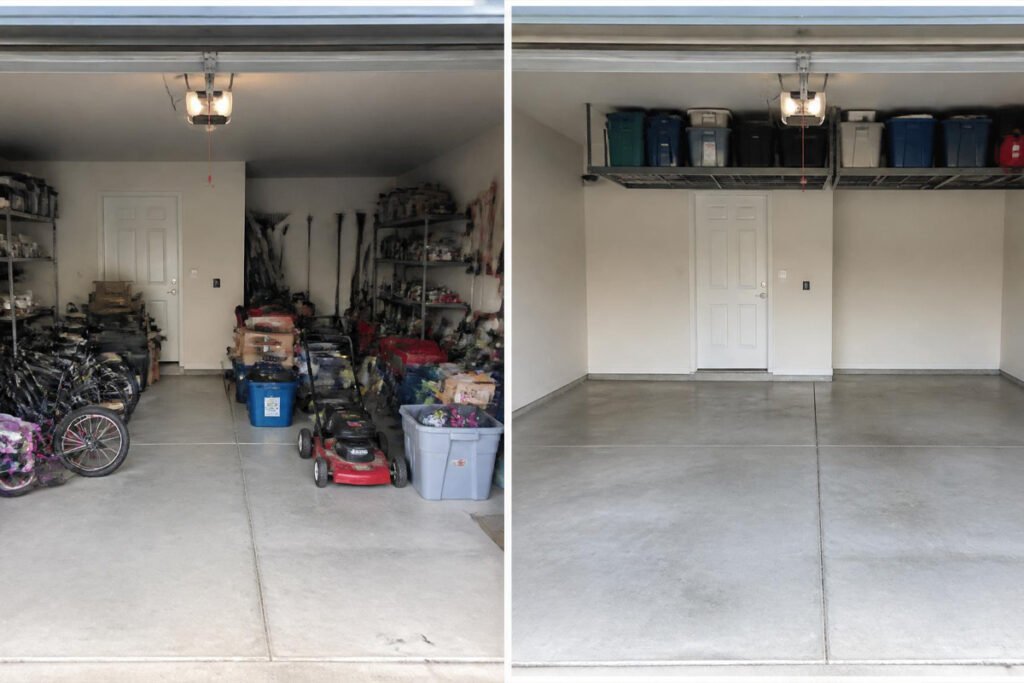
If your garage floor is disappearing under bins of holiday decorations, camping gear, and boxes you haven’t opened since the move, the fastest way to reclaim it isn’t more shelving — it’s looking up. The ceiling above a typical two-car garage is almost always empty space, and overhead storage racks turn that dead zone into real capacity without giving up an inch of floor.
The catch is that overhead storage carries real risk if it’s done wrong. A rack hanging above your car, your workbench, or your kids’ bikes needs to be rated correctly, mounted into the right structure, and loaded within its limits — because when an overhead rack fails, it fails downward. This guide covers the best types of overhead storage for different garages, how to choose the right weight rating, and the exact installation steps that keep a rack safely in place for years. If your garage already has floor storage totes or tarps competing for space, overhead racks are often the cleanest way to relocate them.
Quick Answer
The best overhead garage storage depends on how much weight you’re storing and how often you need access. Static steel ceiling racks are the most affordable and reliable option for seasonal items you access a few times a year. Motorized lift systems are worth the extra cost if you need frequent access to heavier gear, since they lower the load to arm height instead of requiring a ladder. Track and rail systems work best in garages with limited ceiling height or irregular joist spacing. Whatever type you choose, the single biggest factor in safety isn’t the rack’s weight rating — it’s whether it’s mounted into structural ceiling joists rather than drywall alone.
Table of Contents
- Why Overhead Storage Works So Well in a Garage
- How to Choose the Right Overhead System
- Best Overhead Storage Options
- Comparison Table
- Overhead Storage for Different Garage Situations
- How to Install Overhead Garage Storage Correctly
- Common Mistakes
- Expert Tips
- Final Thoughts
- FAQ
Why Overhead Storage Works So Well in a Garage {#why-works}
Most two-car garages have eight or more feet of unused vertical space above head height — space that’s completely wasted unless something is mounted up there. Unlike wall-mounted shelving or a storage loft, overhead ceiling racks don’t compete with parking space, workbench space, or door swing clearance, which makes them one of the highest-value additions for a cluttered garage.
They’re also naturally suited to items that don’t need frequent access — holiday decorations, out-of-season sports gear, spare parts, and bulky empty containers are all a better fit overhead than at eye level. If you’re setting up a garage workshop and need floor and wall space for active projects, moving low-frequency items overhead is often the single biggest space gain available.
How to Choose the Right Overhead System {#choose-method}
Before buying anything, answer three questions:
How much do you actually plan to store? Weigh a few representative bins on a bathroom scale rather than guessing — most homeowners underestimate total weight significantly once several full bins are combined.
How often do you need access? Static racks are cheapest but require a ladder every time. If you’re pulling items down monthly rather than seasonally, a motorized lift or lower-mounted track system is worth the extra cost.
What’s your ceiling structure? Racks must attach to solid joists or trusses, not drywall alone. Overhead storage recalls are almost always tied to hardware or mounting failures rather than the rack material itself — the CPSC’s 2022 recall of a popular overhead rack line involved defective mounting bolts that led to dozens of racks falling, which is a useful reminder to inspect hardware regularly regardless of brand.
Best Overhead Storage Options {#best-methods}
Static Steel Ceiling Racks
Overview: The most common and affordable overhead option, these are fixed steel racks bolted directly into ceiling joists, typically rated between 400 and 600 pounds for standard residential models.
Key Features:
- Fixed height, no moving parts
- Wire mesh or solid platform decking
- Standard sizes from 2’x8′ up to 4’x8′
- Most affordable overhead option
Best For: Seasonal items accessed only a few times a year.
Pros: ✅ Lowest cost per square foot ✅ No mechanical parts to fail ✅ Wide range of sizes available
Cons: ❌ Requires a ladder for every access ❌ Fixed height can’t adjust to ceiling variations
Our Verdict: This is the right starting point for most garages. Pair it with our garage organization guide to plan what goes overhead versus what stays within easy reach.
Motorized Lift Systems
Overview: These systems use a motor or hand crank to lower the entire platform to arm height for loading and unloading, then raise it back to the ceiling.
Key Features:
- Powered or manual crank lowering mechanism
- Often includes safety sensors and guardrails
- Lower typical weight capacity than static racks (around 250 lbs)
- Higher price point than static systems
Best For: Garages where overhead items are accessed frequently.
Pros: ✅ No ladder needed ✅ Safer loading/unloading process ✅ Good for heavier individual items
Cons: ❌ More expensive ❌ Lower weight capacity than static racks ❌ Mechanical parts need maintenance
Our Verdict: Worth the investment if you’re tired of hauling a ladder out every time you need something. Just budget for slightly less total capacity than a comparable static rack.
Track & Rail Systems
Overview: Instead of a single fixed platform, track systems use ceiling-mounted rails that baskets or platforms slide along, which makes them useful in garages with uneven joist spacing or irregular ceiling shapes.
Key Features:
- Modular components that adapt to the space
- Works well with sloped or interrupted ceilings
- Weight capacity varies significantly by component
- Easier to expand over time than fixed racks
Best For: Garages with irregular ceiling layouts or garages being organized in phases.
Pros: ✅ Highly adaptable layout ✅ Easy to add sections later ✅ Works around obstacles like garage door tracks
Cons: ❌ More complex installation ❌ Generally pricier per square foot than static racks
Our Verdict: A strong choice if you’re building out storage gradually or dealing with a ceiling that doesn’t fit standard rack dimensions — check clearance carefully if you’ve also installed an EV charger or overhead conduit that the rails need to route around.
Corner & Compact Overhead Racks
Overview: Smaller footprint racks designed for corners or narrow garages where a full 4’x8′ platform won’t fit.
Key Features:
- Smaller standard sizes (2’x2′ to 4’x4′)
- Fits in corners other rack types can’t use
- Lower total capacity due to smaller size
- Often more affordable per unit
Best For: Single-car or narrow garages with limited ceiling space.
Pros: ✅ Fits tight spaces ✅ Lower price point ✅ Easier one-person installation
Cons: ❌ Limited total storage volume ❌ May need multiple units for real capacity
Our Verdict: A good fit for smaller garages, especially when combined with wall-mounted storage for totes or fishing gear that don’t need to go overhead at all.
Comparison Table {#comparison}
| System Type | Best For | Typical Capacity | Access Effort | Relative Cost |
|---|---|---|---|---|
| Static Steel Rack | Seasonal storage | 400–600 lbs | Ladder required | $ |
| Motorized Lift | Frequent access | ~250 lbs | Push-button/crank | $$$ |
| Track & Rail | Irregular ceilings | Varies by section | Ladder required | $$ |
| Corner/Compact Rack | Small garages | 150–300 lbs | Ladder required | $ |
Overhead Storage for Different Garage Situations {#situations}
Seasonal Storage Households
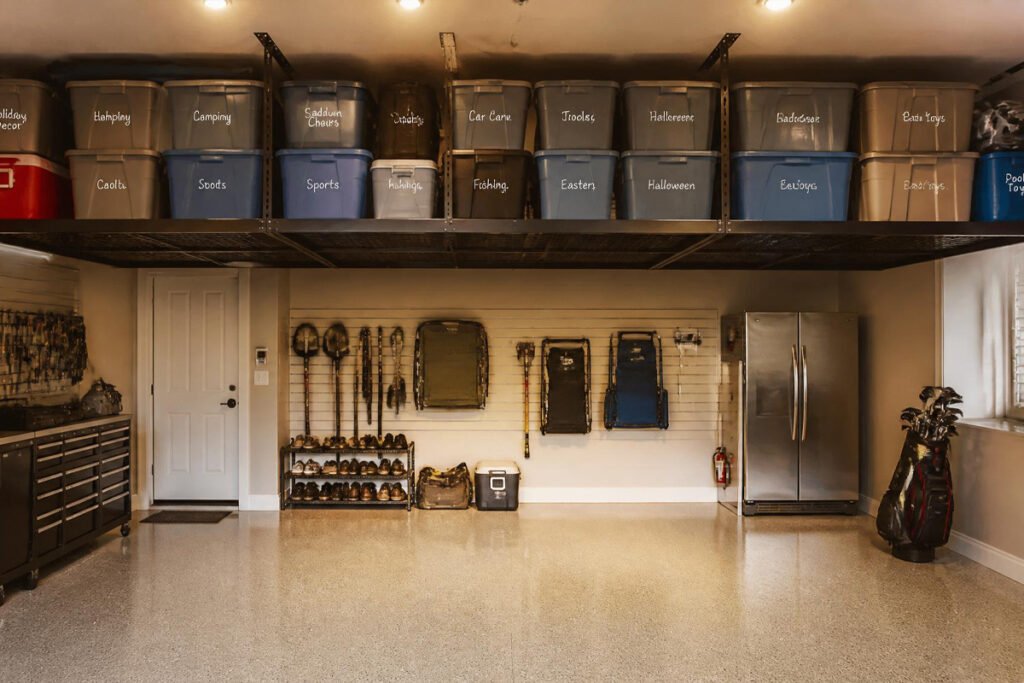
If your overhead needs are mostly holiday decorations, off-season sports equipment, and camping gear, a single static rack over the least-used part of the garage — often above where a car doesn’t park — is usually enough. Combine it with clearly labeled bins so you’re not guessing what’s up there each time.
Workshop & Heavy-Duty Garages
Garages set up as a dedicated workshop often need overhead storage for lumber, spare parts, and bulky supplies that don’t belong on a workbench. Heavier-duty static racks rated 800+ pounds, mounted with extra attention to joist spacing, handle this load better than standard residential models.
Small or Narrow Garages
Single-car and narrow garages benefit most from compact or corner racks combined with wall systems, since a full-size platform can eat up clearance needed for the garage door track or an insulation upgrade. Measure actual clearance above the door track before buying — this is the most common sizing mistake in smaller garages.
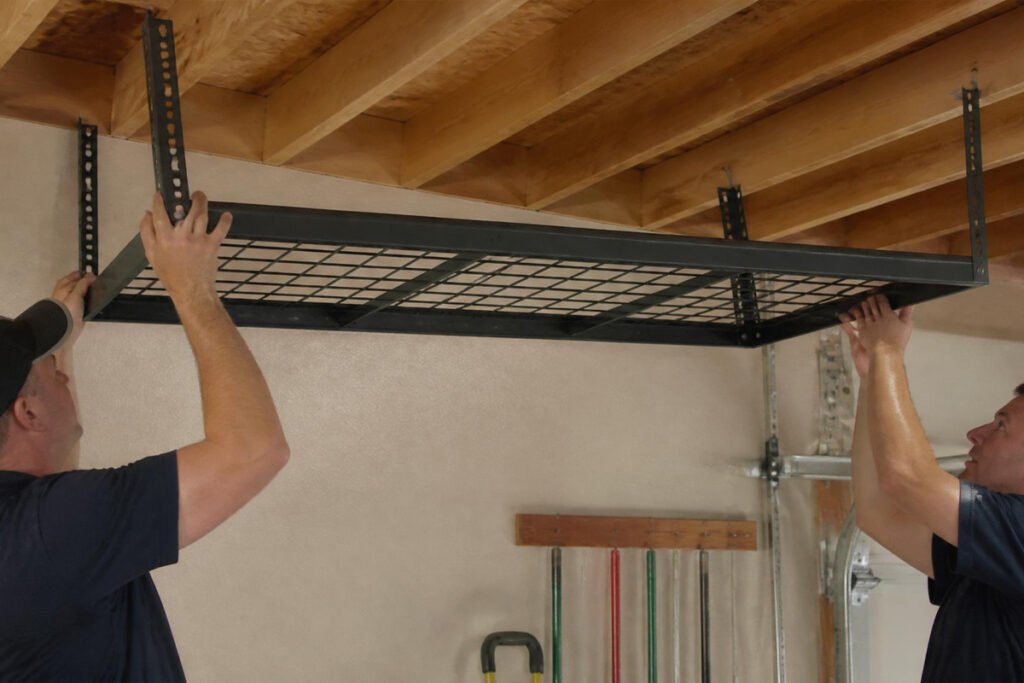
How to Install Overhead Garage Storage Correctly {#how-to}
Step 1: Prepare
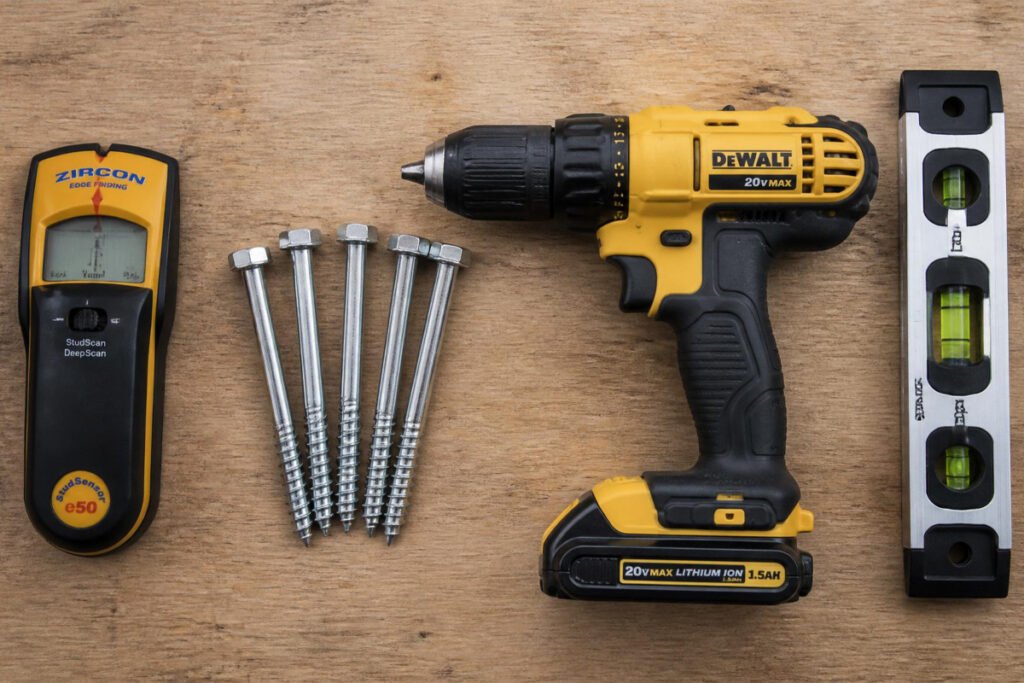
Locate ceiling joists with a stud finder and mark them clearly. Measure the space to confirm the rack size you’ve chosen fits with adequate clearance for the garage door and any lighting or conduit.
Step 2: Clean/Setup
Gather the correct hardware — always use the manufacturer’s provided lag bolts rather than substituting smaller screws, since undersized hardware is one of the leading causes of rack failure.
Step 3: Apply/Execute
Attach mounting brackets directly into the joists at every marked point, checking that the rack sits level before fully tightening. Get a second person to help lift the frame into place; most standard rack platforms are too large and awkward for one person alone.
Step 4: Wait/Cure/Process
Tighten every bolt fully, then re-check the entire rack is level and secure before loading anything onto it.
Step 5: Finish/Review
Load gradually, distributing weight evenly across the platform rather than piling everything at one end or in the center. Recheck bolt tightness after about a month of use, since normal settling can loosen initial hardware.
Common Mistakes {#mistakes}
Mounting into drywall instead of joists. This is the single most common cause of overhead storage failure. Every mounting point needs to hit solid structural wood, not just wallboard.
Overloading based on the rack’s maximum rating rather than a safe working load. Manufacturers rate racks at their structural maximum, but loading to 70–80% of that number leaves margin for uneven distribution and normal wear over time.
Ignoring hardware recalls or wear over time. Several major overhead rack brands have had recalls tied to defective mounting bolts. Periodically inspecting hardware — and registering your purchase so you’d be notified of any recall — is worth the five minutes it takes, especially if the rack hangs above where a car parks or where your safety checklist already flags other overhead hazards.
Expert Tips {#tips}
Weigh before you load, don’t estimate. A handful of full storage totes adds up faster than most people expect — a bathroom scale under a loaded bin takes ten seconds and prevents a costly guessing game.
Keep the heaviest items closest to the joists, not the center of the span. Weight distributed near mounting points puts less stress on the platform than weight concentrated in the middle of an unsupported section.
Label everything before it goes up, not after. Once bins are overhead, you won’t want to bring one down just to check what’s inside — clear labeling from the start saves repeated ladder trips later.
Final Thoughts / Final Verdict {#final}
Best overall: A static steel ceiling rack for most households — affordable, reliable, and more than enough capacity for seasonal storage. Best for frequent access: A motorized lift system, worth the added cost if you’re up in the overhead space regularly. Best for small garages: Compact or corner racks paired with wall-based storage for everything that doesn’t need to go overhead.
Overhead storage is one of the highest-value upgrades for a cluttered garage because it uses space nobody else is fighting you for. Once it’s installed, pair it with our garage organization guide and storage loft guide to plan exactly what goes where — and keep our garage safety guide handy while you’re working overhead.
Frequently Asked Questions {#faq}
How much weight can overhead garage storage actually hold? Standard residential racks are typically rated 400–600 pounds, with heavy-duty models rated up to 1,000+ pounds. The real-world safe load depends as much on installation quality as the rack’s spec sheet.
Do I need a professional to install overhead garage storage? Not necessarily, but you need to be confident locating and mounting into ceiling joists correctly. If you’re unsure about your ability to do that accurately, professional installation is worth the cost given the consequences of a failure.
What’s the difference between static racks and motorized lifts? Static racks are fixed in place and require a ladder for access but cost less and hold more weight. Motorized lifts lower to arm height for easier loading but typically have a lower weight capacity and higher price.
Can I install overhead storage if my joists aren’t evenly spaced? Yes, but you may need a track and rail system or cross-cleats to bridge irregular spacing rather than a standard fixed-size rack. Measure joist spacing before choosing a system.
Is it safe to store items above where I park my car? Yes, as long as the rack is properly installed into structural joists, loaded within its rated capacity, and inspected periodically. This is the most common placement for overhead racks, but it’s also why installation quality matters so much.
How do I know if my overhead rack has been recalled? Check the brand and model number against the CPSC’s recall database, and register your product with the manufacturer when you buy it so you’re notified directly of any future recalls.
What shouldn’t I store overhead? Avoid storing items you need daily or weekly, anything fragile enough that a fall would be dangerous, and total loads that exceed the rack’s rated capacity even by a small margin. Overhead storage is best reserved for low-frequency, non-critical items.
How often should I inspect an installed overhead rack? Check bolt tightness and overall stability about a month after installation, then roughly twice a year afterward. Garages with temperature swings or heavy vibration from tools may need more frequent checks.
Can overhead racks be combined with wall shelving and cabinets? Yes, and this is usually the most effective approach — overhead racks for low-frequency bulky items, wall systems for everyday tools, and cabinets for enclosed storage all work together rather than replacing one another.
What ceiling height do I need for overhead storage? Most systems need at least 8 feet of ceiling height to leave usable clearance below the rack. Garages with lower ceilings may be better suited to compact racks or wall-based storage instead.
Author: Danial Marquez Last Updated: July 2026