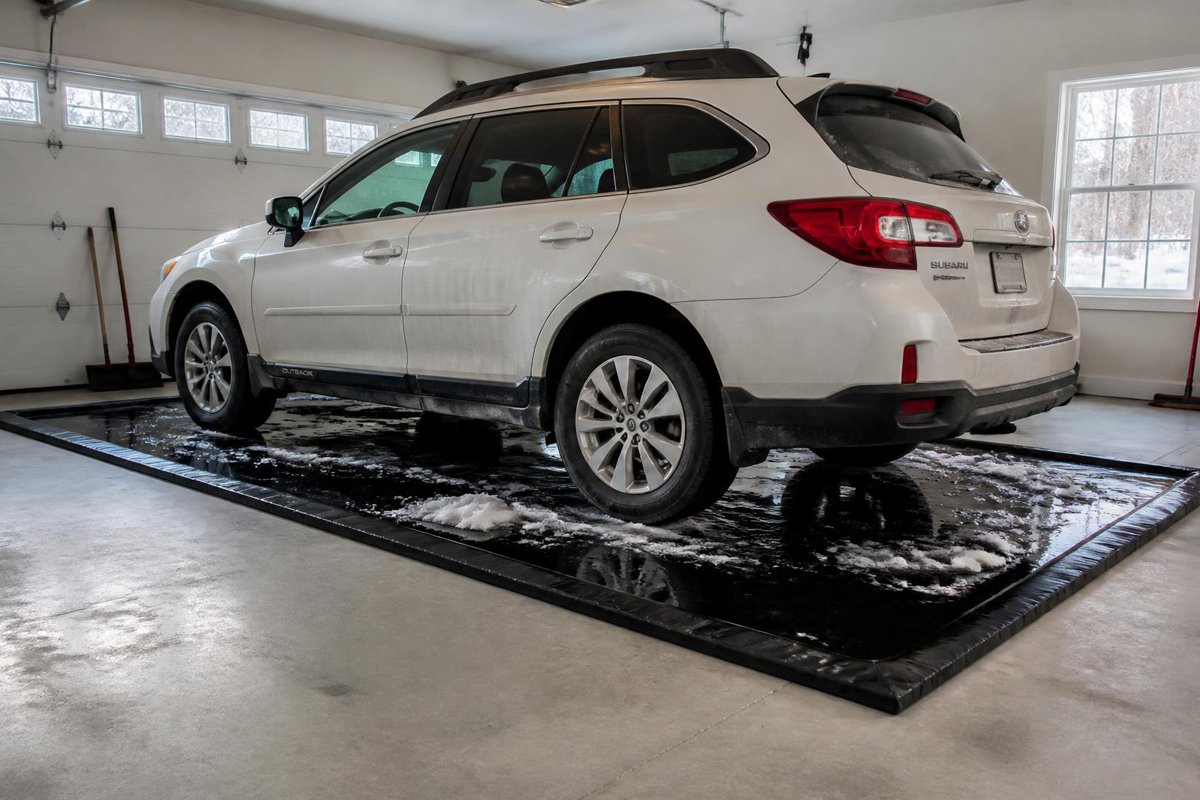
Quick answer: for most garages, a 10 lb ABC-rated, all-metal rechargeable extinguisher is the best balance of capacity, durability, and long-term cost. If budget is the priority, a disposable 10 lb ABC unit gets you nearly the same fire-fighting capacity for less upfront money. Read on for the full breakdown.
Why does the garage specifically need special consideration when a lot of home fire-safety advice treats “a fire extinguisher” as a single, interchangeable purchase? Because a garage is one of the only rooms in a house that regularly contains all three common residential fire classes at the same time: ordinary combustibles like cardboard and stored lumber, flammable liquids like gasoline and paint thinner, and energized electrical equipment from the panel to power tools to an EV charger. A kitchen extinguisher optimized for grease fires, or a small aerosol unit meant for a glove box, simply isn’t sized or rated for that combination.
We evaluated products based on UL/ULC listing status, published fire-class ratings, build quality (metal versus plastic valve construction), rechargeable versus disposable design, and realistic price-to-capacity value specifically for a residential garage — not a kitchen, workplace, or vehicle, where the right pick often differs.
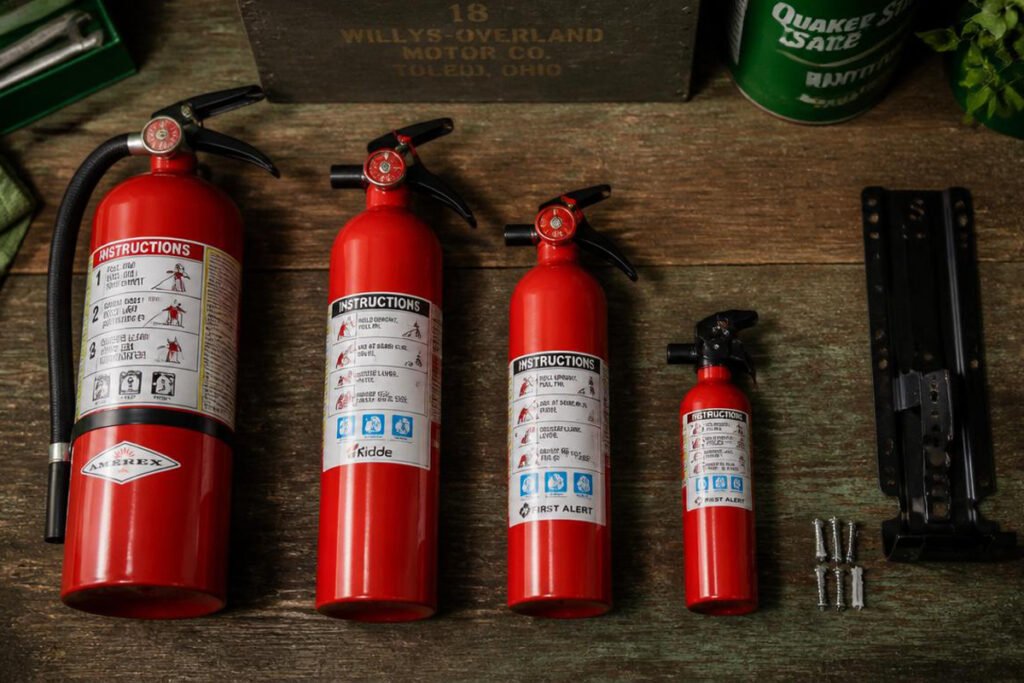
Quick Comparison
| Product | Best For | Rating / Class | Approx. Price |
| Amerex B402 (10 lb ABC) | Best Overall for the Garage | UL 4-A:60-B:C, rechargeable | ~$65 |
| First Alert PRO10 (10 lb ABC) | Best Budget Pick | UL 4-A:60-B:C, disposable | ~$55 |
| Kidde Pro 210 (2.5 lb ABC) | Best Compact/Secondary Unit | UL 1-A:10-B:C, disposable | ~$45 |
| Amerex B260 (5 lb CO2) | Best for EV Chargers & Electronics | UL 5-B:C, rechargeable | ~$120 |
1. Amerex B402 (10 lb ABC) — Best Overall for the Garage
⭐ Best Overall
10 lb ABC dry chemical | UL 4-A:60-B:C | All-metal valve | Rechargeable | ~$65
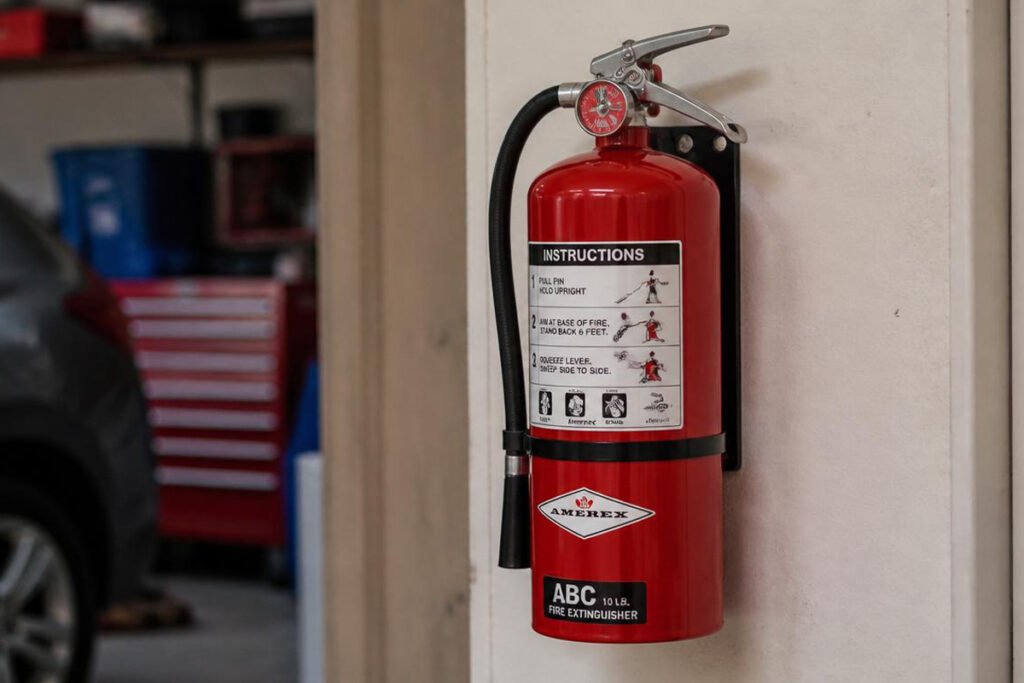
This is the extinguisher most fire-safety reviewers point to specifically for garages and workshops, and for good reason: at 10 lb of agent and a 4-A:60-B:C rating, it has real capacity for a room that mixes flammable liquids, ordinary combustibles, and electrical equipment. The all-metal valve construction is the meaningful difference from consumer-grade plastic units — it’s built to be professionally recharged and serviced rather than thrown away after one use, which matters over a 10+ year ownership horizon.
The 4-A:60-B:C rating specifically means it handles a Class A fire roughly equivalent to 4 square feet of burning wood and up to 60 square feet of flammable liquid — both meaningfully higher figures than the 5 lb, 3-A:40-B:C units marketed for general home use. For a garage that stores gas cans, a lawnmower, or workshop solvents, that extra capacity is the difference between fully knocking down a fire and running out of agent partway through.
Why buy it
- Highest realistic capacity for a single-car or two-car garage without stepping up to commercial sizing
- All-metal construction holds up better to garage temperature swings and occasional bumps than plastic-valve units
- Rechargeable design means one purchase can last well over a decade with periodic professional service
Worth knowing
- At roughly 15 lb fully loaded, it’s heavier to lift and aim than a 5 lb unit — make sure everyone in the household can handle it comfortably
- Costs more upfront than a disposable equivalent, though the math favors it over a long ownership period
2. First Alert PRO10 (10 lb ABC) — Best Budget Pick
💰 Best Budget
10 lb ABC dry chemical | UL 4-A:60-B:C | Disposable | ~$55
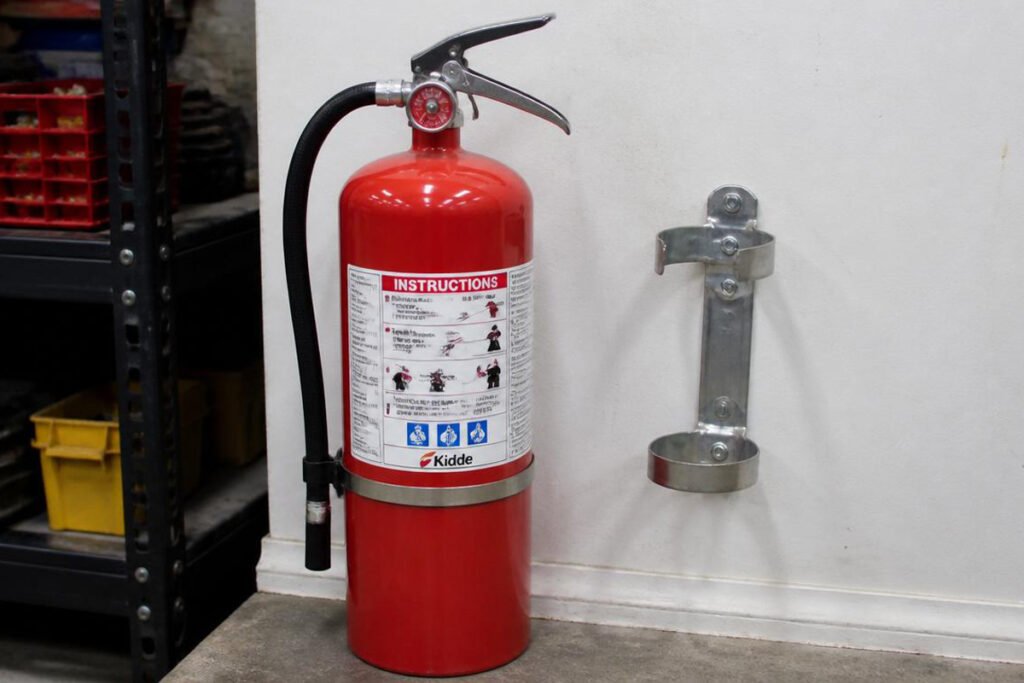
This unit matches the Amerex B402’s fire-fighting rating — the same 4-A:60-B:C capacity — at a lower price, by trading rechargeable metal construction for a disposable design with some plastic components. For a lot of homeowners, that’s a completely reasonable trade: you get commercial-level coverage without the recharge cost down the line, and you simply replace the unit after 12 years or any discharge.
The math is worth spelling out: over a 12-year service life, a disposable unit like this one costs its purchase price once. A rechargeable unit costs more upfront, then adds periodic inspection and recharge fees, but can outlast several disposable replacement cycles if properly serviced. Neither approach is objectively wrong — it comes down to whether you’d rather pay a bit more now and maintain it, or pay less now and replace it later.
Why buy it
- Same UL rating as a unit costing roughly $10 more, so you’re not sacrificing fire-fighting capacity for the lower price
- Trusted, widely available brand with easy replacement parts and mounting hardware
- Simple pressure-gauge check keeps monthly maintenance quick
Worth knowing
- Non-rechargeable — any discharge, even partial, means replacing the whole unit rather than refilling it
- Plastic handle and valve components are less durable long-term than the all-metal Amerex build
3. Kidde Pro 210 (2.5 lb ABC) — Best Compact / Secondary Unit
📦 Best Compact Pick
2.5 lb ABC dry chemical | UL 1-A:10-B:C | Disposable | ~$45
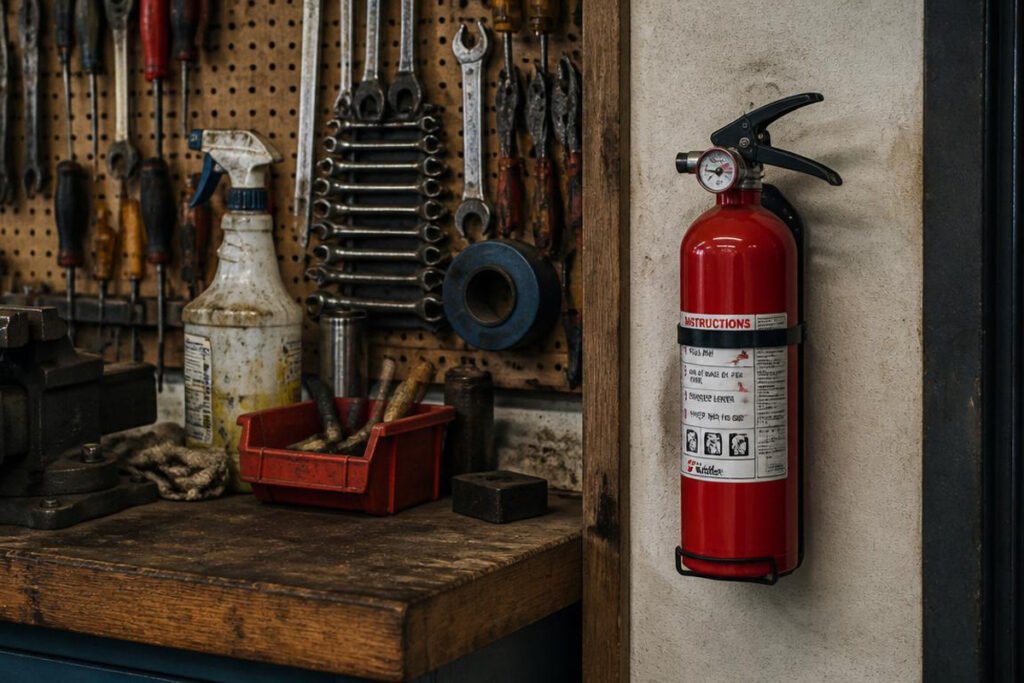
This size also makes sense as a starter purchase for renters or anyone equipping a garage on a tight budget who plans to upgrade to a full-capacity unit later. It’s meaningfully better than having no coverage at all while you save toward a primary 10 lb extinguisher, and the same unit stays useful afterward as the second, easy-grab option.
Why buy it
- Light enough for quick, one-handed operation — useful for anyone who might struggle with a 10 lb unit’s weight
- Clear pressure gauge makes the monthly check fast and easy to read at a glance
- Affordable enough to justify as a second unit near a specific high-risk workstation
Worth knowing
- Lower UL rating means it’s not sized to be the only extinguisher covering a full garage on its own
- Disposable — replace after 12 years or any use, same as other non-rechargeable units on this list
4. Amerex B260 (5 lb CO2) — Best for EV Chargers & Electronics
🔌 Best for Electronics
5 lb CO2 | UL 5-B:C | Rechargeable | ~$120
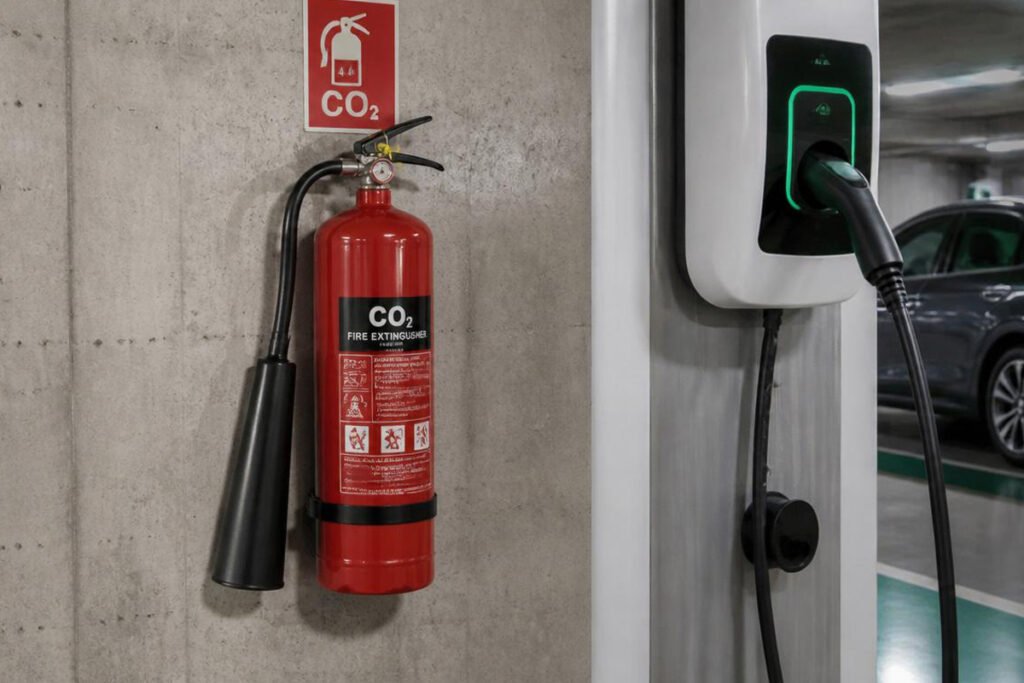
This is a genuinely different use case from the other three picks on this list, which is why it’s worth thinking of as an addition rather than a replacement. A dry chemical extinguisher would put out a small electrical fire at a charging station just as effectively in the moment, but the residue it leaves behind can damage the charger’s internals well after the flames are gone — turning a small, contained fire into a total loss of the charging hardware anyway.
Why buy it
- Zero residue means no secondary damage to an EV charger, battery chargers, or other electronics after use
- All-metal, rechargeable Amerex construction matches the B402’s long-term durability
- Concentrated discharge from the hard-horn nozzle gives precise application right at the source
Worth knowing
- No Class A rating, so it’s not a substitute for an ABC unit — it’s a supplemental extinguisher for one specific corner of the garage
- Highest price on this list, and CO2 dissipates quickly in open or ventilated spaces, which limits it to close-range use
How to Choose Between These Four
Which Pick Fits Your Garage?
- Single-car garage, mostly storage: one Amerex B402 or First Alert PRO10 near the entry door is sufficient coverage on its own.
- Two-car garage or garage doubling as a workshop: the same primary 10 lb unit, plus a Kidde Pro 210 mounted near the workbench or hot-work area for quick access without walking across the room.
- Garage with an EV charger or valuable power tool electronics: primary ABC unit plus the Amerex B260 CO2 extinguisher positioned near the charging station specifically.
- Renter or tight budget, single-car garage: start with the First Alert PRO10 for the best capacity-per-dollar, or the Kidde Pro 210 alone as a minimum-viable starting point if a 10 lb unit isn’t in the budget yet.
- Detached garage or workshop with significant fuel/solvent storage: consider stepping up to a 10 lb unit with an even higher rating (4-A:80-B:C class) than the picks above, and treat a second extinguisher as a requirement rather than an option.
Common Mistakes When Buying a Garage Fire Extinguisher
Buying a kitchen-only unit for the garage
A wet chemical Class K extinguisher, built specifically for cooking oil fires, is the wrong tool for a garage — it isn’t rated for the flammable liquids and electrical equipment a garage actually contains. If a listing markets an extinguisher primarily as a kitchen or cooking-fire unit, it’s not the right pick for this room.
Assuming any ABC rating is enough
Not all ABC extinguishers are sized the same. A 1 lb or 2.5 lb unit carries an ABC rating but a much lower UL number (often 1-A:10-B:C), which is fine as a supplemental or vehicle unit but undersized as a garage’s primary defense. Check the specific rating number, not just the letters.
Skipping the mounting bracket
An extinguisher left sitting on a shelf or the floor tends to get buried behind stored items exactly when it’s needed. Every unit on this list ships with or supports a wall bracket — use it, and mount near an exit rather than tucked into a corner.
Forgetting the monthly check
Even the best-rated extinguisher is useless if the pressure has silently dropped over a few years of storage. A 30-second monthly glance at the gauge is the single highest-value habit on this entire list, and it costs nothing.
Fast Buying Guide
Fire class refresher
Garages typically need ABC coverage: Class A for ordinary combustibles (cardboard, wood), Class B for flammable liquids (gasoline, paint, solvents), and Class C for energized electrical equipment. A CO2 or clean-agent unit is a smart addition around electronics specifically, but shouldn’t replace your primary ABC extinguisher. Using the wrong class on the wrong fire isn’t just ineffective — water or an inappropriate agent on a liquid or electrical fire can actively make things worse by spreading burning fuel or creating a shock hazard, which is exactly why the ABC rating matters more in a garage than almost any other room.
Sizing for your garage
A single-car garage with light storage is reasonably covered by a 5 lb ABC unit. Two-car garages, workshops, or any garage storing meaningful fuel or solvent volume are better matched to a 10 lb unit with a 4-A:60-B:C rating or higher. As a rule of thumb, the more flammable liquid you store — gas cans, paint, solvents — the more weight in the “B” portion of the rating you want, since that number reflects flammable-liquid coverage specifically.
Rechargeable vs. disposable
Rechargeable units cost more upfront but can be professionally serviced and refilled indefinitely, which usually wins out over a long ownership period. Disposable units cost less upfront and get replaced outright after 12 years or any discharge — a fine choice if you’d rather not deal with recharge logistics. Neither choice compromises on fire-fighting capability at the moment you’d actually need it; the difference is entirely about what happens after that moment, whether that’s a trip to a service center or a trip to the store for a replacement.
Where to mount it
Ongoing maintenance, briefly
Whichever unit you buy, plan on three habits: a monthly 30-second gauge check, professional inspection and recharge on rechargeable units roughly every 6 years, and full replacement at 12 years for disposable units or after any discharge. None of this requires special tools or expertise — the gauge check is visual, and recharge/inspection is handled by a fire equipment dealer or, in some areas, your local fire department.
Frequently Asked Questions
What’s the single best fire extinguisher for a garage?
For most garages, the Amerex B402 (10 lb ABC, rechargeable) is the strongest all-around pick — it has the capacity and durability to handle a garage’s mixed fire risk without needing to size up further.
Do I need more than one fire extinguisher in the garage?
A single 10 lb ABC unit covers most single- or two-car garages. Add a second, smaller unit near a workshop station, or a CO2 unit near an EV charger or electronics, if your garage has concentrated risk in a specific area.
Is a rechargeable extinguisher worth the extra cost?
Usually, if you plan to keep it for more than a few years — the metal construction tends to be more durable, and professional recharge service is typically cheaper than replacing a disposable unit outright. If you’d rather avoid the logistics of recharge service entirely, a quality disposable 10 lb unit is a perfectly reasonable choice.
Can I use a CO2 extinguisher as my only garage extinguisher?
No — CO2 units aren’t rated for Class A fires (wood, cardboard, paper), which are common in a garage. Use CO2 as a supplemental unit near electronics, paired with a primary ABC extinguisher.
How much should I expect to spend to fully equip a garage?
A single ABC unit runs roughly $45–$65. A more complete setup — a primary 10 lb ABC unit plus a compact secondary unit — typically lands in the $90–$130 range. Adding a CO2 unit for an EV charger or electronics area brings a full setup to roughly $200–$250.
Should I buy the same brand for every extinguisher in my garage?
Not necessary. Mixing brands is fine as long as each unit is genuinely UL-listed and rated for the fire types you’re protecting against. What matters more than brand consistency is making sure each extinguisher is appropriately sized and rated for its specific location — primary ABC coverage, a compact secondary unit, and a CO2 unit for electronics can reasonably come from three different manufacturers.
Do these extinguishers work in a cold, unheated garage?
Most consumer ABC dry chemical units are rated for a wide temperature range, commonly around -40°F to 120°F, which covers the vast majority of unheated garages. CO2 units can lose some pressure in extreme cold, so check the specific temperature rating on the label if your garage regularly sees deep winter temperatures.
The Bottom Line
If you buy just one thing from this list, make it a 10 lb ABC extinguisher — the Amerex B402 if you want rechargeable, all-metal durability, or the First Alert PRO10 if you’d rather save on upfront cost. Everything else here is a smart addition once that baseline is covered, not a replacement for it. None of these purchases requires special skills to install — a wall bracket, a few screws, and fifteen minutes gets any of them mounted and ready, which makes this one of the highest safety-return-per-dollar upgrades available for a garage.
Carbon Monoxide Safety in the Garage: Detector Placement, Risks & What to Do
Last Updated: July 2026