A dead battery always seems to happen at the worst possible moment — rain moving in, three miles from home, or just trying to leave for work. Keeping the right tool in the garage turns that into a two-minute fix instead of a call for a tow truck. But “battery charger” and “jump starter” aren’t actually the same tool, and picking the wrong one for your situation means it’s not there for you when you need it.
Quick answer: for most drivers, a compact lithium jump starter like the NOCO Boost Plus GB40 covers the actual emergency-use case people buy these for. If you also want to keep a seasonal or rarely driven vehicle’s battery topped off long-term, add a dedicated smart charger/maintainer like the NOCO GENIUS5 — they solve different problems and most garages benefit from having both eventually.
Jump Starter vs. Battery Charger: Know the Difference First
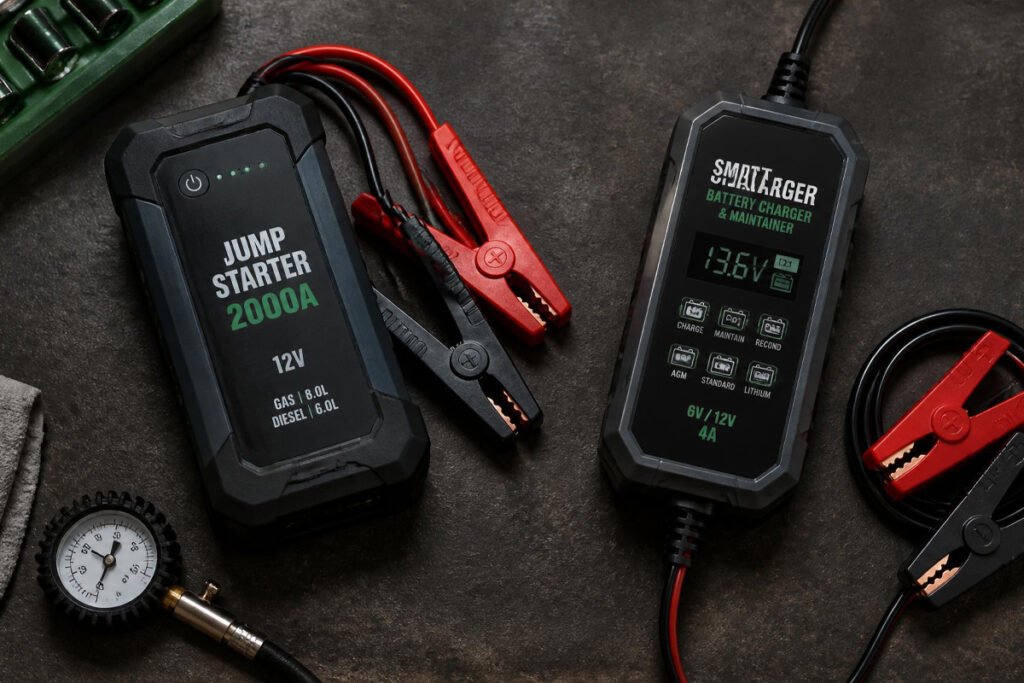
These solve two different problems, and half the buying mistakes people make come from not knowing which one they actually need:
- Jump starters deliver an instant, high-current burst to start an engine with a dead battery right now — built for emergencies, not long-term charging.
- Smart battery chargers/maintainers slowly restore and then maintain a battery’s charge over hours or days — the right tool for a battery that’s simply been sitting unused, not one that needs to start an engine immediately.
If you only buy one, a jump starter covers the more common emergency scenario. If you have a second vehicle, motorcycle, boat, or anything that sits for weeks at a time, a maintainer prevents the dead battery in the first place.
Quick Comparison
| Product | Best For | Key Spec | Approx. Price |
| NOCO Boost Plus GB40 | Best Overall Jump Starter | 1,000A, gas to 6.0L / diesel 3.0L | ~$100–$130 |
| WOLFBOX MegaVolt24 | Best for Trucks & Multi-Use | 4,000A peak, 88.8Wh, 65W USB-C | ~$150–$200 |
| Gooloo GT4000S (w/ Compressor) | Best Value / 2-in-1 | 3,000A, 150 PSI air compressor | ~$70–$100 |
| AstroAI S8 | Best Budget Jump Starter | 800A, gas to 6.0L | ~$60–$75 |
| NOCO GENIUS5 | Best Battery Charger/Maintainer | 5A, 6V/12V, multi-chemistry | ~$65–$75 |
Note: prices and amp ratings are approximate and based on typical current listings — confirm exact specs and pricing before you buy.
1. NOCO Boost Plus GB40 — Best Overall Jump Starter
⭐ Best Overall
1,000A peak | Gas engines to 6.0L, diesel to 3.0L | ~2.4 lb | Lithium-ion | ~$100–$130
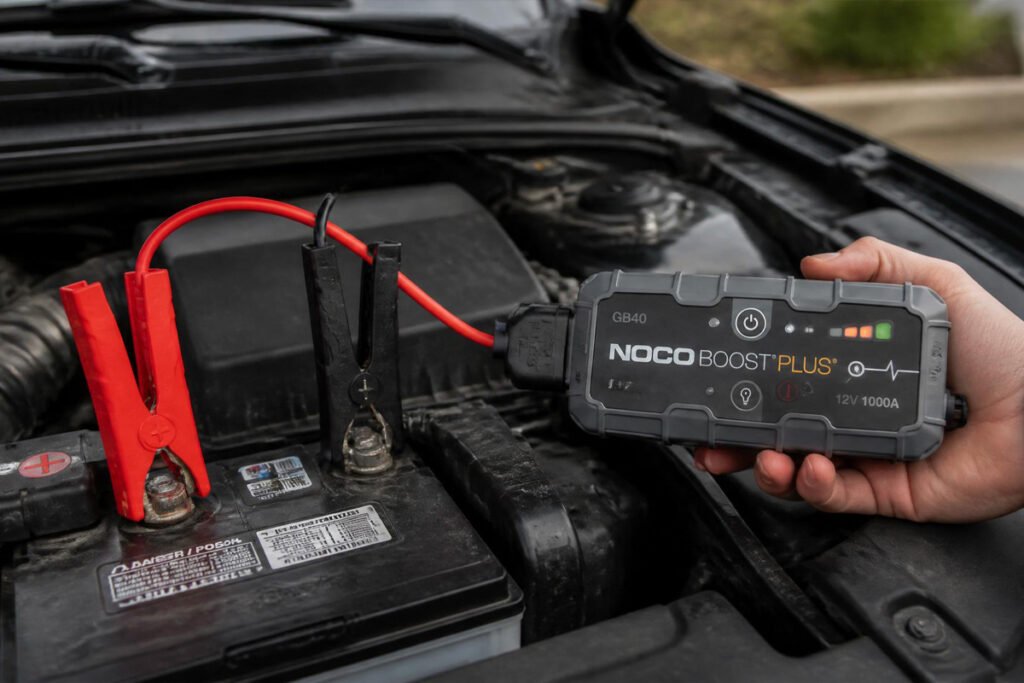
This is the jump starter most reviewers reach for first, and the reputation is earned: it’s small enough to fit in a glove box, refined clamp design that’s been iterated on for years, and enough real-world power to start the vast majority of cars, small trucks, and motorcycles on the road. The compact size is the whole point — a jump starter that’s inconvenient to carry is a jump starter that ends up left at home.
Why buy it
- Small enough to genuinely keep in the car at all times, not just the garage shelf
- Well-tested safety features — reverse polarity and spark-proof protection built in
- Doubles as a USB power bank for phones in a pinch
Worth knowing
- Roughly 20 jumps per charge before it needs recharging itself
- USB-A only — no USB-C fast charging like some newer competitors
Verdict: the safe default pick for most cars and small trucks — compact, trusted, and sized right for the emergency-use case most people actually have.
2. WOLFBOX MegaVolt24 — Best for Trucks & Multi-Use
🚛 Best for Large Vehicles
4,000A peak | 88.8Wh battery | 65W USB-C in/out | Starts gas & diesel up to 10L | ~$150–$200
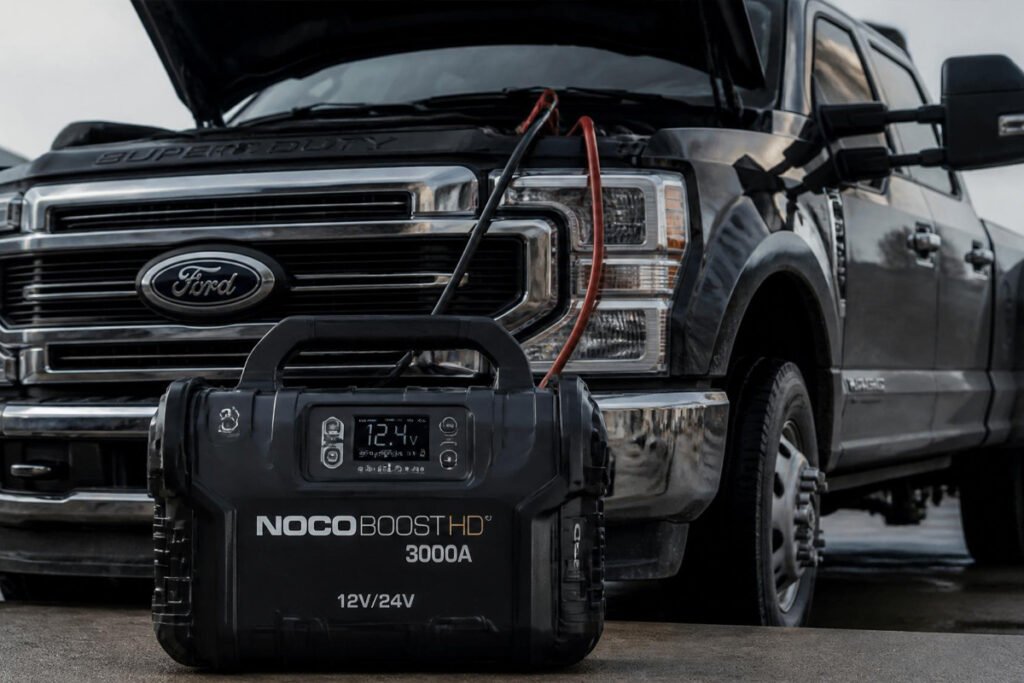
This steps well past “commuter car insurance” into genuine heavy-duty territory — large enough to reliably start big trucks and diesel engines that smaller jump starters simply aren’t rated for, while still functioning as a legitimate backup power bank. The 65W USB-C port can fast-charge a laptop or two phones simultaneously, which matters if you’re using this for road trips or camping as much as emergency starts.
Why buy it
- Genuinely handles large trucks and diesel engines other jump starters can’t
- Doubles as a capable power bank for laptops and devices, not just a phone-charging afterthought
- Large enough battery capacity that you can largely forget about it between uses
Worth knowing
- Bigger and heavier than a compact jump starter — better suited to a garage shelf than a glove box
- Costs meaningfully more than a basic jump starter, which only makes sense if you need the extra capacity
Verdict: buy this if you drive a truck or diesel vehicle, or want one device that covers jump-starting and serious portable power at once.
3. Gooloo GT4000S with Air Compressor — Best Value / 2-in-1
💰 Best Value
3,000A peak | 150 PSI digital tire inflator built in | Gas to 9.0L, diesel to 6.5L | ~$70–$100
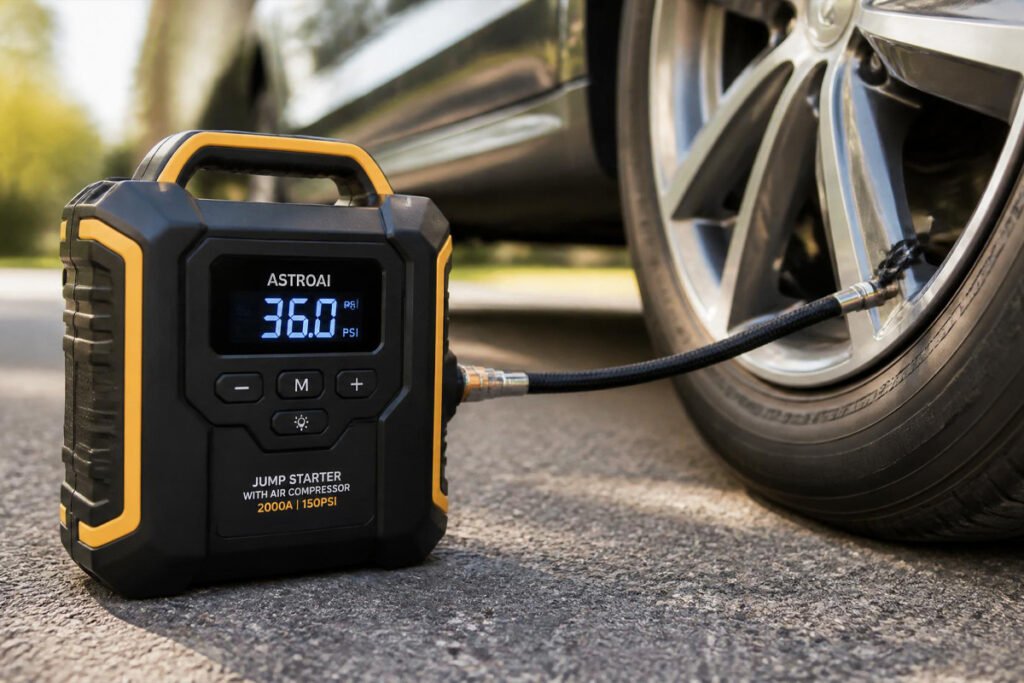
Folding a 150 PSI digital tire inflator into the same device as the jump starter is a genuinely useful combination — a dead battery and a low tire are two of the most common reasons people get stranded, and this covers both from one unit that lives in the trunk. The digital display and auto-shutoff on the compressor side make it easy to hit an exact PSI without guessing.
Why buy it
- Covers two common roadside problems — dead battery and low tire — from a single device
- Rated for genuinely large engines, gas up to 9.0L and diesel to 6.5L
- Digital PSI display and auto-shutoff make the compressor side simple to use accurately
Worth knowing
- Bulkier than a dedicated jump-starter-only unit, since it’s carrying two tools in one housing
- The air compressor draws down the same battery as the jump starter function — don’t run both back-to-back on a low charge
Verdict: the best pick if you want maximum utility per dollar and don’t mind a slightly bulkier device living in the trunk.
4. AstroAI S8 — Best Budget Jump Starter
🏷️ Best Budget
800A peak | Gas engines to 6.0L | Compact | USB-A (Ultra version adds USB-C) | ~$60–$75
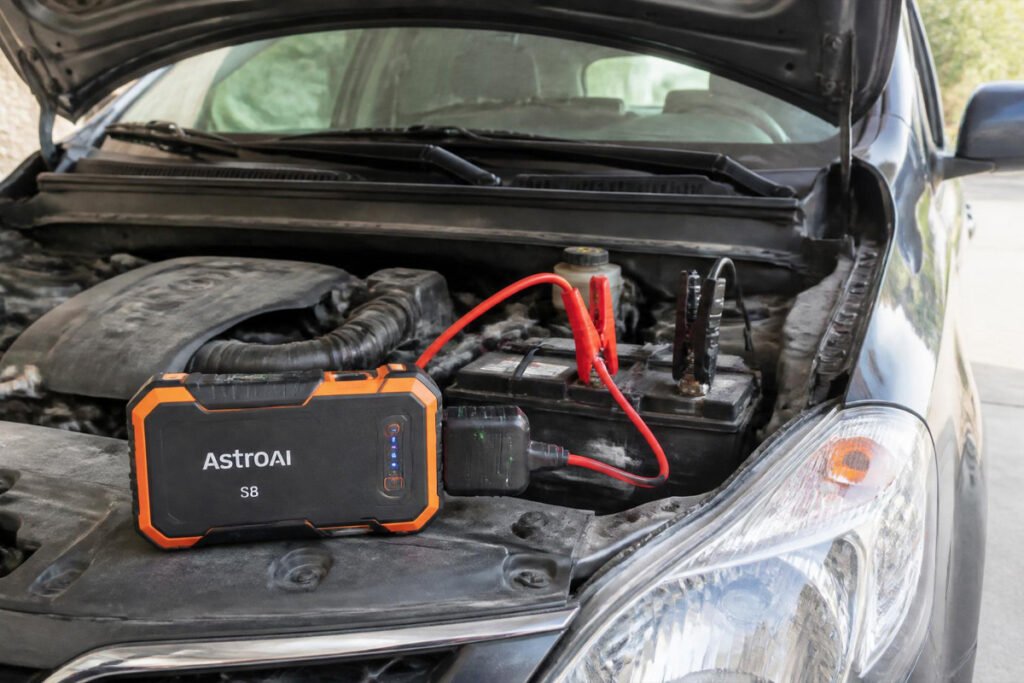
Think of this as cheap insurance for a commuter car rather than a workhorse for a truck. It covers the genuinely common scenario — a small-to-midsize gas car with a battery that died from a light left on — at a price that makes it an easy add to any glove box. Real-world performance runs a bit below the advertised spec in cold weather, which is worth knowing rather than a dealbreaker.
Why buy it
- Lowest price on this list for a dedicated jump starter, while still handling the common case
- Compact and simple — no learning curve to operate under stress
- Reasonable choice as a first jump starter or a backup kept in a second vehicle
Worth knowing
- Advertised engine-size ratings run optimistic — real-world power, especially in cold weather, is somewhat lower
- Standard version is USB-A only; the Ultra variant adds USB-C for a small price increase
Verdict: solid budget insurance for a regular car used occasionally — not the pick for a truck, cold climate, or frequent heavy use.
5. NOCO GENIUS5 — Best Battery Charger & Maintainer
🔌 Best Charger/Maintainer
5A output | 6V/12V, multi-chemistry (lead-acid & lithium) | Up to 120Ah | Force Mode for dead batteries | ~$65–$75
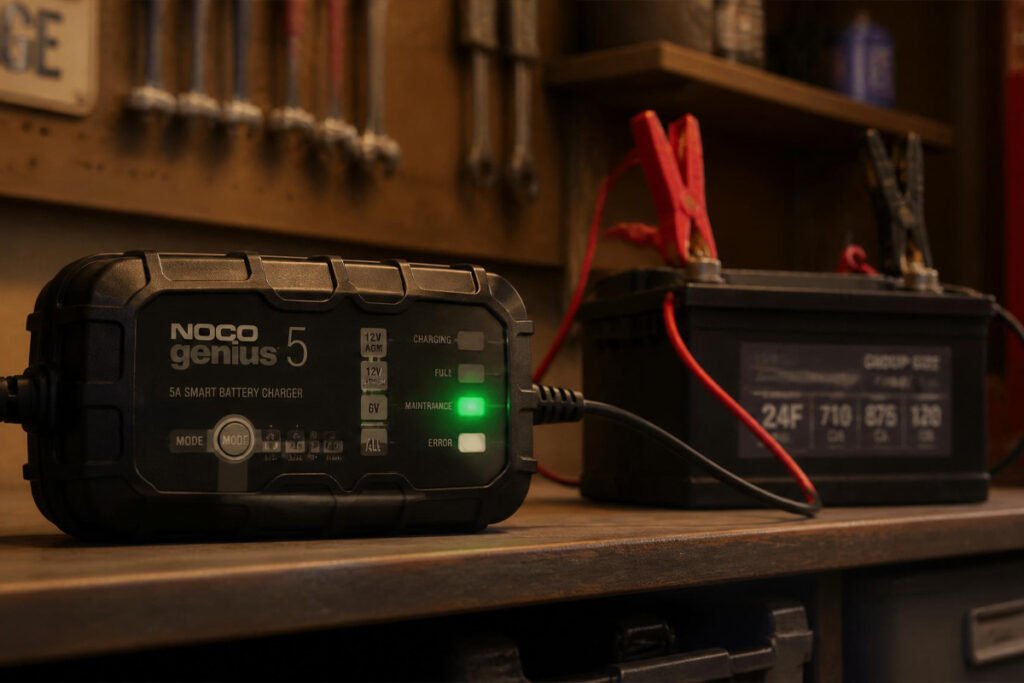
This is a genuinely different tool from everything else on this list — not built for an emergency jump, but for keeping a battery healthy over weeks or months of light or no use. It automatically charges, then switches to a maintenance mode that tops off the battery indefinitely without overcharging, which is exactly what a seasonal car, motorcycle, boat, or garage workshop project vehicle needs. Force Mode can even bring a battery back from as low as zero volts, which a standard charger typically can’t do.
Why buy it
- Prevents dead batteries in stored or rarely driven vehicles instead of just fixing them after the fact
- Works across lead-acid and lithium chemistries and a wide range of vehicle types
- Temperature-compensated charging protects battery health long-term rather than just delivering raw current
Worth knowing
- Not a substitute for a jump starter — it charges over hours, not seconds, so it won’t get you moving in an emergency
- Best left connected and plugged in for extended periods, which requires a spot near an outlet
Verdict: the right tool if you own a seasonal vehicle, motorcycle, or anything that sits for weeks at a time — pair it with a jump starter rather than choosing between them.
Common Mistakes When Buying
Buying a jump starter when you actually need a maintainer
If your battery keeps dying because a vehicle sits unused for weeks, a jump starter treats the symptom every time without fixing the cause. A maintainer left connected during storage prevents the problem instead.
Trusting the advertised amp rating at face value
Peak amp ratings are often measured under ideal lab conditions. Real-world cranking power — especially in cold weather — typically runs below the number on the box. When in doubt, size up rather than buying the bare minimum for your engine.
Letting the jump starter itself sit dead
Lithium jump starters slowly self-discharge over months in storage. Check the charge level every few months, especially before winter, so it’s actually ready when you need it rather than dead itself.
Ignoring engine size compatibility
A jump starter rated for a 4-cylinder sedan won’t reliably start a diesel truck. Match the amp rating and engine-size spec to your actual vehicle, not just the cheapest option on the shelf.
Fast Buying Guide
Peak amps: how much do you need
As a rough guide, small gas engines need 400–600 peak amps, midsize V6 engines want 800–1,200, and large trucks or diesel engines are safer with 2,000+ peak amps. Buying above the minimum for your engine gives you margin for cold weather, when batteries and jump starters both lose effective power.
Lithium vs. lead-acid jump starters
Modern lithium jump starters are smaller, lighter, and hold a charge in storage far longer than older lead-acid “jump box” designs, which is why every pick on this list uses lithium. The one caveat is cold-weather performance — standard lithium cells lose some ability to deliver current quickly in extreme cold, which is why cold-climate buyers should look for a model with cold-weather pre-heat technology if winters get genuinely harsh. This matters more in an unheated garage than people expect: a jump starter stored on a cold shelf all winter can start noticeably weaker than the same unit kept somewhere with more stable temperatures, so consider storage location alongside the unit’s cold-weather rating.
When you need a maintainer instead
If a vehicle sits for more than a couple of weeks at a time — a seasonal car, boat, motorcycle, or RV — a smart charger/maintainer left connected prevents the dead battery altogether, which is a better long-term solution than repeatedly jump-starting the same battery. This is especially relevant in an unheated garage: cold temperatures accelerate battery drain in a vehicle that’s already sitting unused, so a garage that’s been insulated to stay closer to a stable temperature year-round gives stored batteries an easier time even before a maintainer gets involved.
Where to keep each tool
A jump starter belongs in the vehicle itself, not the garage shelf — it’s useless three miles from home if it’s sitting at the house. A maintainer, by contrast, needs to stay near an outlet in the garage, connected to whatever vehicle or battery it’s maintaining. If you’re setting up garage storage or shelving, keep the maintainer’s outlet and cable run in mind when planning the layout.
Basic Safety When Jump-Starting a Car
- Connect clamps in order: positive to the dead battery’s positive terminal, then positive to the jump starter, negative to the jump starter, and finally negative to an unpainted metal ground point away from the battery — not the dead battery’s negative terminal directly.
- Never let the positive and negative clamps touch each other while connected to a power source — this can cause sparks or a short circuit.
- Keep the jump starter away from any spilled battery acid or corrosion on the terminals; clean corroded terminals before attempting to connect.
- Disconnect in reverse order once the engine starts: negative/ground first, then negative from the jump starter, then both positive connections.
If a vehicle is in an enclosed garage, keep the space well ventilated while jump-starting — running engines and battery off-gassing both benefit from airflow. Our garage safety guide covers broader ventilation and electrical safety habits worth pairing with this.
Frequently Asked Questions
What’s the difference between a jump starter and a battery charger?
A jump starter delivers a high-current burst to start an engine immediately, built for emergencies. A battery charger/maintainer slowly restores and then maintains a battery’s charge over hours or days — the right tool for a battery that’s been sitting unused rather than one that needs to start a car right now.
What amp rating do I need for my car?
Small gas engines need roughly 400–600 peak amps, midsize V6 engines want 800–1,200, and large trucks or diesel engines are safer with 2,000+ peak amps. When in doubt, size up rather than buying the bare minimum.
Can I leave a jump starter in a hot car all summer?
Most lithium jump starters are rated for a reasonable temperature range, but extreme heat over long periods can degrade battery life faster than normal use. Check the manufacturer’s storage temperature spec, and avoid leaving it in direct sun on the dashboard for extended periods.
Do I need both a jump starter and a battery maintainer?
If you only have one daily-driven vehicle, a jump starter alone usually covers your needs. If you also own a seasonal car, motorcycle, boat, or anything that sits for weeks at a time, add a maintainer — they solve genuinely different problems.
How often should I check or recharge my jump starter?
Every 2–3 months is a reasonable check-in interval, since lithium jump starters slowly self-discharge in storage. Many models include a percentage display specifically so you can check this without guessing.
The Bottom Line
If you buy just one thing from this list, make it a compact lithium jump starter like the NOCO Boost Plus GB40 — it covers the emergency scenario most people actually face. Step up to the WOLFBOX or Gooloo if you drive something larger or want built-in tire inflation, and add the NOCO GENIUS5 separately if you own a vehicle that sits unused for weeks at a time. None of these are a substitute for the others — they’re solving different problems, and a well-equipped garage eventually has both.
Last Updated: July 2026