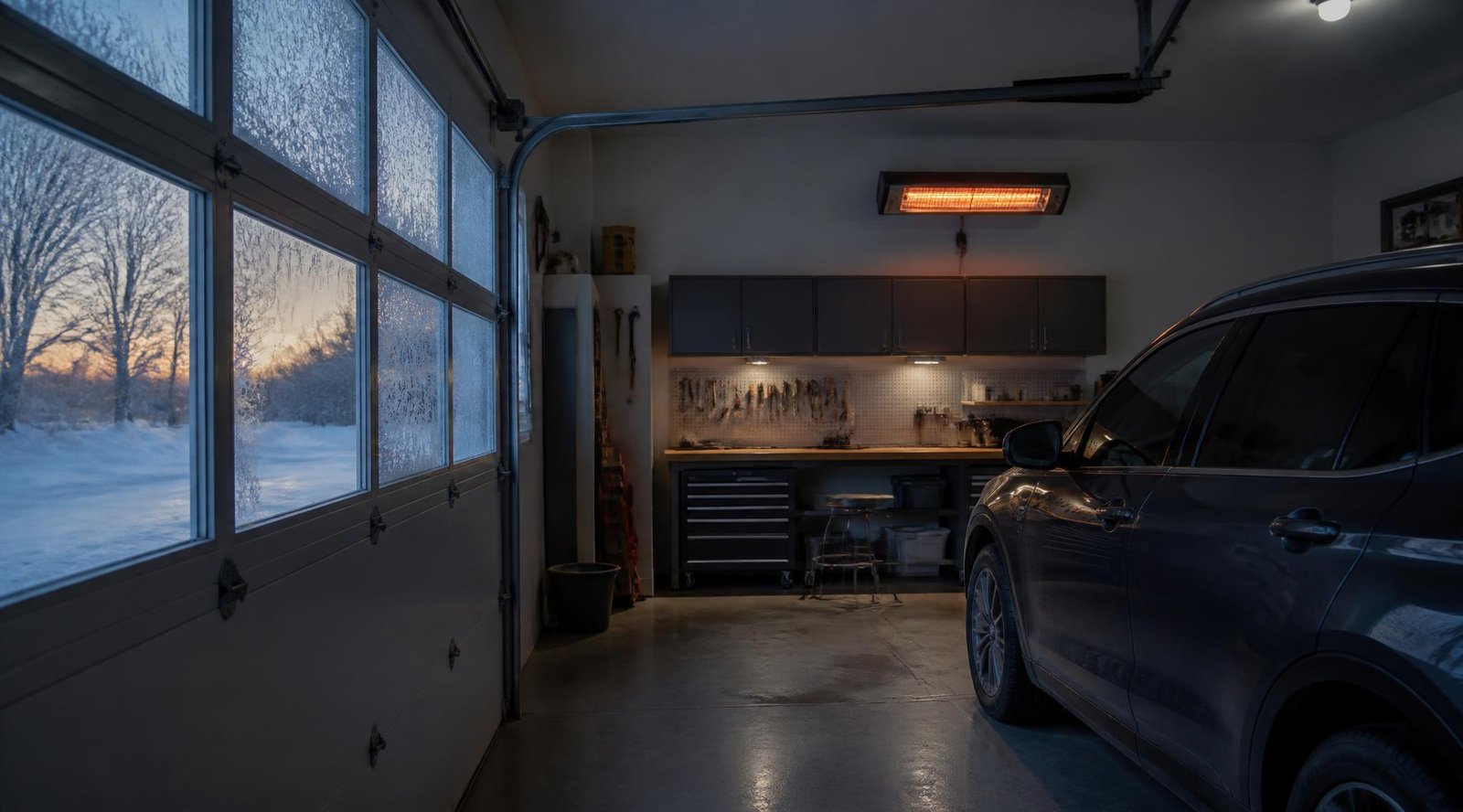
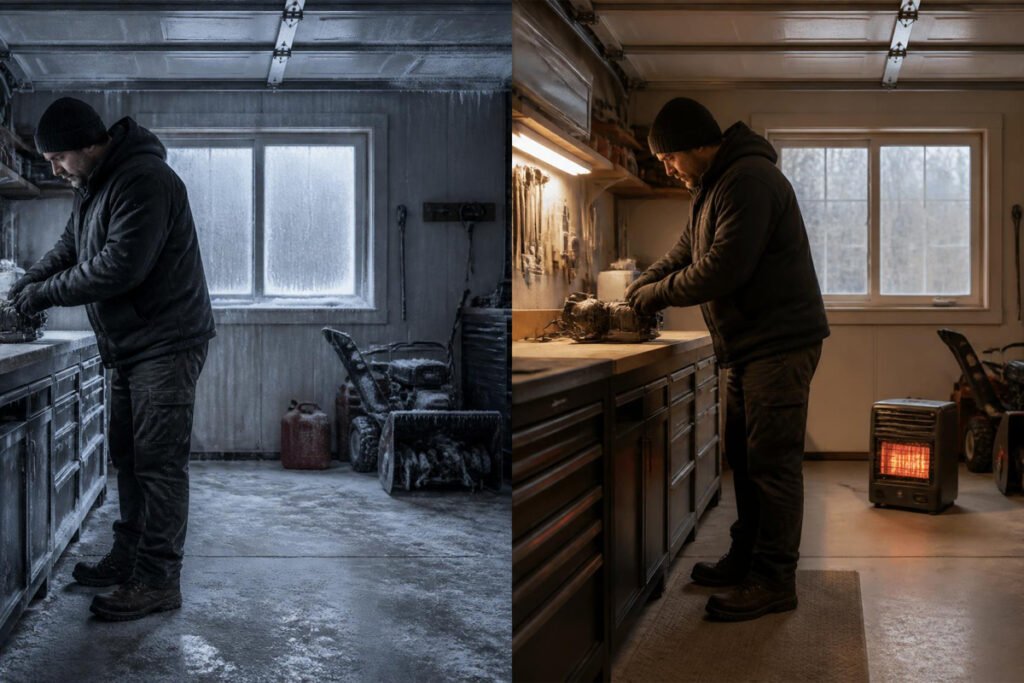
There’s a specific kind of miserable that comes from trying to finish a project in a 40-degree garage — stiff fingers, a space heater from the hallway closet that isn’t cutting it, and the growing suspicion that you’re just going to give up and go inside. If your garage has slowly become unusable every winter, the fix usually isn’t more layers. It’s the right heater for your specific space.
This guide covers five real garage heaters worth buying in 2026, what actually separates them, and which one fits your garage — whether that’s a small one-car space you use occasionally or a full workshop you’re in every weekend. Once your garage is comfortable, it’s also worth checking whether the space itself is holding heat — our guide on how to insulate a garage covers the other half of the equation.
Quick Answer
The right garage heater depends mostly on how big your space is and whether you have access to 240V power or propane. For small garages and occasional use, a plug-in electric unit like the Lasko Pro-Ceramic Utility Heater is the simplest option — no installation, no fuel. For a mid-size garage you want to heat evenly without floor clutter, the Dr. Infrared DR-238 mounts to a wall or ceiling and runs on a standard outlet. For garages without any electrical hookup at all, the Mr. Heater Big Buddy runs entirely on propane cylinders. For larger spaces needing serious heat output fast, the Mr. Heater MH60QFAV forced-air propane heater covers up to 1,500 square feet. And for a permanent, whole-garage solution, the Dr. Infrared DR-988 is a hardwired 240V unit built for daily workshop use.
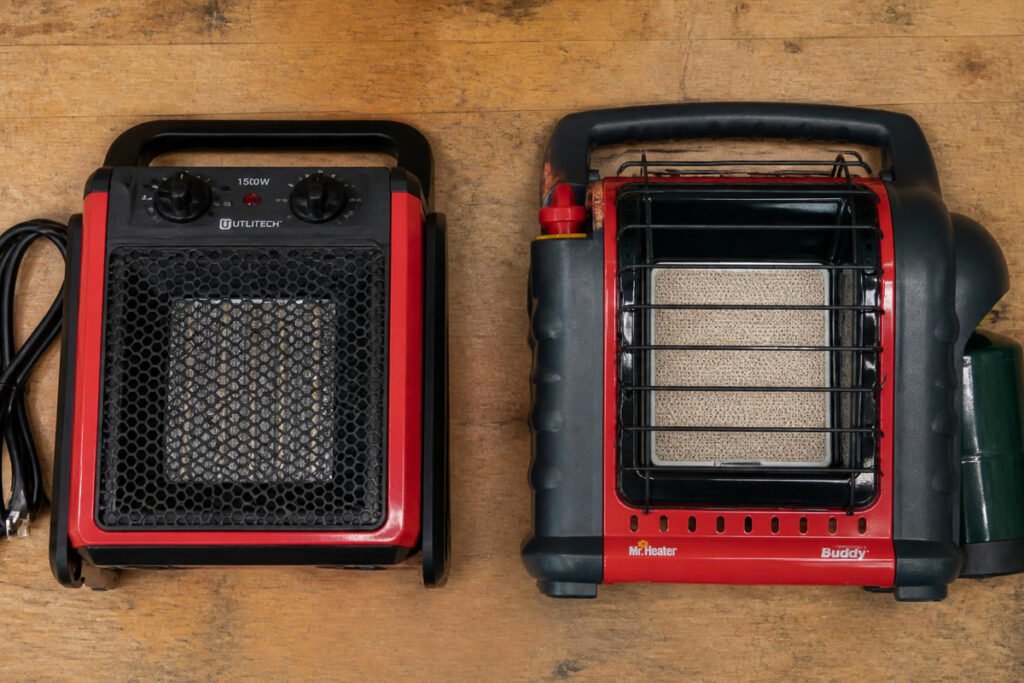
Table of Contents
- Electric vs. Propane: The Real Trade-Off
- How to Choose the Right Garage Heater
- 5 Garage Heaters Worth Buying
- Comparison Table
- Best Heaters for Different Garage Setups
- How to Set Up a Garage Heater Safely
- Common Mistakes
- Expert Tips
- Final Thoughts
- Frequently Asked Questions
Electric vs. Propane: The Real Trade-Off
Electric garage heaters are simpler to live with — plug in and go, no fuel to store, no combustion byproducts to ventilate. Their limitation is power: a standard 120V outlet caps how much heat you can realistically generate, which is fine for a small or occasionally used garage but underwhelming for a large, poorly insulated one. Stepping up to a 240V hardwired unit solves that, but requires an electrician and a dedicated circuit.
Propane heaters trade that simplicity for raw output — they can generate far more heat per dollar of equipment cost and don’t depend on your garage’s electrical capacity at all. The trade-off is fuel storage, the need for ventilation, and carbon monoxide risk if used incorrectly in an enclosed space. Neither option is universally “better” — it comes down to your garage’s size, insulation, and how often you’re actually using the space.
How to Choose the Right Garage Heater
Before buying, ask yourself:
- How big is my garage, and how well insulated is it? An uninsulated two-car garage needs meaningfully more heat output than a small, insulated single-car space.
- Do I have 240V power or a propane setup, or neither? This narrows your options fast — a hardwired unit needs an electrician, propane needs cylinder storage and ventilation, and a basic plug-in unit needs neither.
- How often will I actually use it? Occasional weekend use rarely justifies a permanent hardwired installation; daily workshop use often does.
5 Garage Heaters Worth Buying
1. Lasko Pro-Ceramic Utility Heater with Pivot Power
Overview: A straightforward, plug-in ceramic heater built specifically for utility spaces like garages and workshops rather than living rooms. It needs no installation, no fuel, and no special outlet — just a standard 120V plug.
Key Features:
- Ceramic heating element with pivoting head for directional heat
- Standard 120V plug-in operation, no installation required
- Compact, portable design for moving between work areas
- Built-in overheat protection
Best For: Small garages, occasional use, or anyone who wants zone heating near a specific workbench.
Pros: ✅ Zero installation, works immediately ✅ Inexpensive relative to hardwired or propane options ✅ Easy to move to wherever you’re actually working
Cons: ❌ Limited by standard outlet power — won’t heat a large or drafty garage effectively ❌ Not designed to run unattended for long periods
Our Verdict: If you’re not ready to commit to an electrician visit or propane setup, this is the lowest-friction way to take the edge off a cold garage while you work. View on Amazon
2. Dr. Infrared Heater DR-238 (1,500W Infrared, Wall/Ceiling Mount)
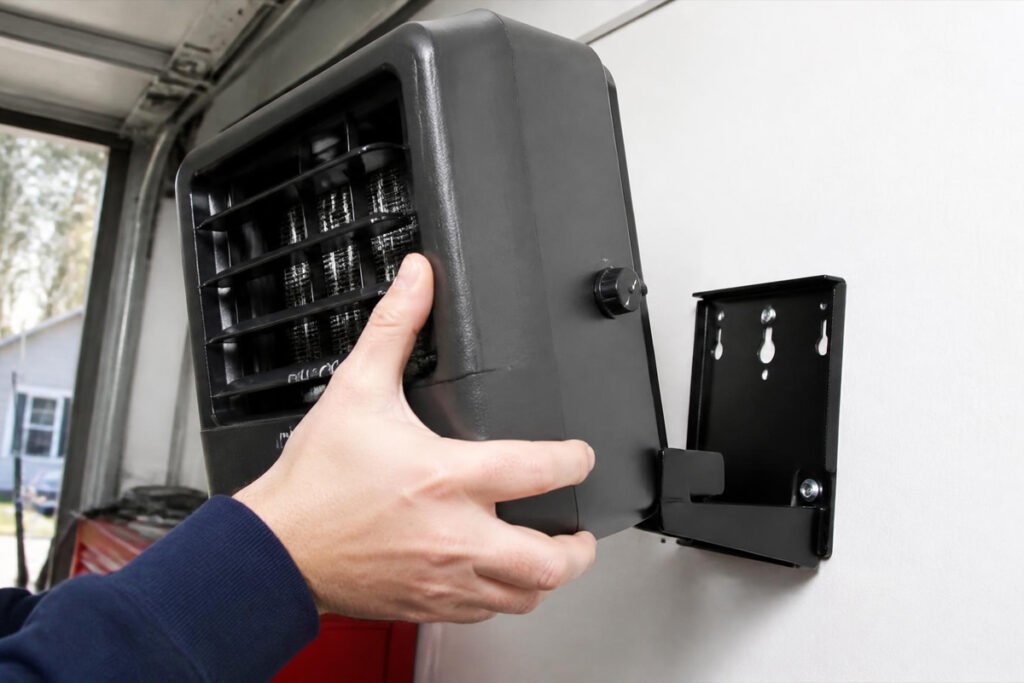
Overview: This infrared heater mounts to a wall or ceiling and runs on a standard 120V outlet, delivering instant, odorless radiant heat with three output settings (900W, 1200W, 1500W) and remote control operation. Because it’s infrared, it warms objects and people directly rather than just heating the air, which holds up better in a garage with a door that opens and closes.
Key Features:
- 900W / 1200W / 1500W adjustable heat settings
- Wall or ceiling mount, freeing up floor space
- Instant, odorless carbon infrared heat
- Remote control included
- Weatherproof anodized aluminum housing
Best For: Mid-size garages or workshops where floor space matters and you want heat that recovers quickly after a door opens.
Pros: ✅ Off the floor and out of the way ✅ Infrared heat is less affected by door drafts than forced-air ✅ Standard outlet, no special electrical work needed
Cons: ❌ Coverage is more limited than a hardwired 240V unit ❌ Mounting requires basic wall or ceiling installation, even if wiring is simple
Our Verdict: A strong middle-ground option — more permanent and evenly distributed than a portable plug-in unit, without needing an electrician for 240V service. View on Amazon
3. Mr. Heater MH18B Big Buddy (Portable Propane)
Overview: For garages with no electrical access at all — or as a heater you can move between a garage, workshop, and job site — the Big Buddy runs entirely on propane cylinders, delivering up to 18,000 BTU with radiant and forced-air heat for spaces up to 450 sq ft.
Key Features:
- 4,000–18,000 BTU adjustable output
- Runs on two 1lb propane cylinders or a remote tank hookup
- Oxygen Depletion Sensor (ODS) and tip-over safety shutoff
- No electricity required to operate
Best For: Detached garages without power, or anyone who wants a heater they can also use for camping, job sites, or other outdoor spaces.
Pros: ✅ No electrical dependency whatsoever ✅ Genuinely portable between locations ✅ Built-in safety sensors for indoor use
Cons: ❌ Requires proper ventilation even with ODS protection ❌ Ongoing propane cylinder cost and storage
Our Verdict: This is the answer for a detached garage with no wiring run to it — reliable heat with no dependency on an outlet. View on Amazon
4. Mr. Heater MH60QFAV Forced Air Propane Heater (60,000 BTU)
Overview: Built for jobsites and large workshops, this forced-air propane heater delivers a variable 30,000–60,000 BTU output, covering up to 1,500 sq ft — enough for a large two-car or oversized garage that a plug-in electric unit simply can’t warm.
Key Features:
- Variable 30,000–60,000 BTU output
- Heats up to 1,500 sq ft, runs up to 14 hours on a 20lb tank (low setting)
- Quiet Burner Technology, roughly 50% quieter than standard forced-air heaters
- High-temperature limit switch and thermoelectric safety valve
- Plugs into a standard 110V outlet for the fan; heat comes from propane
Best For: Large garages, workshops, or spaces needing to go from cold to workable fast.
Pros: ✅ Serious heat output for large or drafty spaces ✅ Long runtime on a single tank ✅ Quieter than typical forced-air propane heaters
Cons: ❌ Requires proper ventilation — not for fully sealed spaces ❌ Bulkier and less discreet than wall-mounted options
Our Verdict: When a space is genuinely too large or too drafty for electric heaters to keep up, this is the tier that actually gets the job done, and quickly. View on Amazon
5. Dr. Infrared Heater DR-988 (240V Hardwired, 5,600W)
Overview: A permanent, hardwired solution for garages used daily as a workshop or extra living space. This 240V unit delivers 5,600 watts through a dedicated NEMA 6-30 outlet, with an adjustable thermostat (37–113°F) and the option to mount it on a wall or ceiling to keep it fully out of the way.
Key Features:
- 5,600W output via dedicated 240V circuit
- Adjustable thermostat, 37°F–113°F range
- ON/AUTO fan modes for continuous or automatic operation
- Wall, ceiling, or portable floor installation options
- Automatic overheat cut-off protection
Best For: Garages used daily as a workshop, home gym, or converted living space, where a permanent solution makes sense.
Pros: ✅ Consistent, thermostat-controlled whole-space heating ✅ No fuel storage or refilling required ✅ Flexible mounting options
Cons: ❌ Requires a dedicated 240V circuit — typically an electrician job ❌ Higher upfront cost than portable options
Our Verdict: If your garage has essentially become a second room you use year-round, this is the tier worth investing in — set-and-forget heat without babysitting fuel levels. View on Amazon
Comparison Table
| Heater | Power Source | Output | Best For | Installation |
|---|---|---|---|---|
| Lasko Pro-Ceramic Utility Heater | Electric (120V) | Standard plug-in wattage | Small garages, occasional use | None — plug and go |
| Dr. Infrared DR-238 | Electric (120V) | 900–1,500W | Mid-size garages, floor space matters | Basic wall/ceiling mount |
| Mr. Heater MH18B Big Buddy | Propane | 4,000–18,000 BTU | No electrical access | None — cylinder hookup |
| Mr. Heater MH60QFAV | Propane | 30,000–60,000 BTU | Large garages, fast heat-up | None — tank hose hookup |
| Dr. Infrared DR-988 | Electric (240V) | 5,600W | Daily-use workshops | Dedicated circuit, electrician |
Prices and exact specifications change frequently — always confirm current details on the product page before purchasing.
Best Heaters for Different Garage Setups
Small, Occasionally Used Garages
The Lasko Pro-Ceramic Utility Heater is the obvious starting point — no commitment, no installation, and enough output to make a small space workable for a couple hours of weekend projects.
Mid-Size Garages Used Regularly
The Dr. Infrared DR-238 strikes a good balance here, mounted out of the way and running on a standard outlet, with infrared heat that recovers faster after the door opens than a purely forced-air unit would.
Detached Garages Without Power
Both Mr. Heater propane options solve this directly — the Big Buddy for smaller spaces or portability, the MH60QFAV for larger areas needing serious BTU output. Pairing either with proper insulation makes a real difference in how long that heat actually lasts — see our garage insulation guide for the full process.
Daily-Use Workshops or Converted Spaces
The Dr. Infrared DR-988’s hardwired, thermostat-controlled setup is built for exactly this — a garage that’s functionally a second room deserves a heating solution that doesn’t require managing fuel or moving a portable unit around.

How to Set Up a Garage Heater Safely
Propane and other fuel-burning heaters can produce carbon monoxide, and improper use in enclosed spaces has caused injuries — the Consumer Product Safety Commission recommends proper ventilation and a working carbon monoxide detector any time a fuel-burning heater is used indoors.
Step 1: Assess Your Power and Ventilation Options
Confirm whether you have 240V access, a standard outlet, or need to rely on propane, and check that any fuel-burning unit has adequate ventilation.
Step 2: Choose Placement
For mounted units, position them for even heat distribution and required safety clearance from combustibles; for portable units, keep them on a stable, level surface.
Step 3: Install a Carbon Monoxide Detector
If using any propane or fuel-burning heater, install a CO detector in the garage before first use — this isn’t optional for enclosed or semi-enclosed spaces.
Step 4: Test Before Relying On It
Run the heater for a full cycle to confirm it reaches temperature and shuts off or regulates as expected before depending on it for a full work session.
Step 5: Maintain Clearance and Storage
Keep flammable materials, including fuel cans and rags, well clear of any heater, whether electric or propane.
Common Mistakes
Buying a plug-in electric heater for a large, uninsulated garage. Standard outlet power simply can’t generate enough heat for a big, drafty space — this mismatch is the single most common source of disappointment with garage heaters.
Running a propane heater without a carbon monoxide detector. Even models with an Oxygen Depletion Sensor benefit from an independent CO detector as a second layer of protection — never treat the built-in sensor as the only safeguard.
Skipping insulation and expecting the heater to compensate. A heater fighting constant heat loss through an uninsulated door and walls works far harder than it should — pairing heating with basic insulation, as covered in our garage insulation guide, makes any heater more effective and cheaper to run.
Expert Tips
Match heater output to square footage, not just budget. A heater that’s slightly underpowered for your space will run constantly and still underperform — sizing correctly the first time saves frustration and energy cost.
Consider mounted units for daily-use spaces. Floor-standing portable heaters are convenient for occasional use, but they eat up usable floor space and present a tripping hazard in a workshop you’re in every day.
Factor in noise if you’ll be working nearby. Forced-air propane heaters, even “quiet” rated ones, are noticeably louder than infrared or hardwired electric units — worth considering if you’re doing detailed work nearby.
Final Thoughts
Best Overall: The Dr. Infrared DR-238, for its balance of easy installation, floor-space efficiency, and standard-outlet convenience.
Best Budget Option: The Lasko Pro-Ceramic Utility Heater, for anyone who just wants immediate, no-commitment warmth.
Best for No Electrical Access: The Mr. Heater MH18B Big Buddy, for detached garages without wiring.
Best for Large Spaces: The Mr. Heater MH60QFAV, for fast, serious heat output.
Best for Daily Use: The Dr. Infrared DR-988, for a genuinely permanent, thermostat-controlled solution.
For the other half of keeping your garage comfortable, see our guide on how to insulate a garage.
Frequently Asked Questions
What size heater do I need for a two-car garage? Most uninsulated two-car garages need at least 30,000–60,000 BTU of propane heating, or a hardwired 240V electric unit in the 5,000W+ range, to heat effectively.
Are propane heaters safe to use in a garage? Yes, when used with proper ventilation and a working carbon monoxide detector — models with built-in Oxygen Depletion Sensors add a layer of protection, but shouldn’t be relied on as the only safety measure.
Can I use a regular indoor space heater in my garage? You can for occasional light use, but standard indoor heaters aren’t built for the dust, temperature swings, or power demands of a real garage workshop the way utility-rated units are.
Do I need an electrician to install a 240V garage heater? In most cases, yes — a dedicated 240V circuit typically requires professional electrical work to install safely and up to code.
How much does it cost to run a garage heater regularly? This varies significantly by heater type, local energy or propane prices, and how well-insulated your garage is, but insulating the space first noticeably reduces ongoing running costs for any heater type.
Is infrared heat better than forced-air for a garage? Infrared heats objects and people directly rather than just the air, which holds up better with frequent door openings, while forced-air heats the whole space faster but loses that heat more quickly once a door opens.
How long does a 20lb propane tank last with a forced-air heater? At the low setting, a 20lb tank typically runs a 60,000 BTU forced-air heater for up to roughly 14 hours; higher settings reduce that runtime.
Can I mount an electric garage heater myself? Basic 120V wall or ceiling mounts are often DIY-friendly, but any unit requiring a new 240V circuit should be installed by a licensed electrician.
Do garage heaters help prevent frozen pipes? A heater can help keep an attached garage above freezing, which reduces the risk to any pipes running through it, though pipe insulation is still recommended as a primary protection.
What’s the quietest garage heater option? Electric infrared or hardwired units are generally quieter than forced-air propane heaters, even “quiet burner” rated propane models, since they don’t rely on a loud fan-driven combustion process.
Author: Danial Marquez Last Updated: July 2026