At some point, every DIY-minded car owner ends up needing to get underneath their vehicle — an oil change, a brake job, a quick look for a leak — and that’s the exact moment a lot of garages reveal they aren’t actually equipped for it. Working with an unstable jack, mismatched blocks, or ramps that slide on a smooth concrete floor isn’t just frustrating, it’s genuinely dangerous.
The good news is that getting properly equipped doesn’t take much: a solid set of ramps or jack stands, sized and rated correctly for your vehicle, closes this gap for good. This guide breaks down the best car ramps and jack stands for home garage use, what actually separates a safe setup from a risky one, and how to choose between the two approaches. If you’re building out a full home workshop around this kind of work, our guide on setting up a garage workshop covers the bigger picture.
Quick Answer
The best choice between car ramps and jack stands depends on the job. For quick tasks that don’t require wheel removal — oil changes, fluid checks, visual inspections — drive-on ramps are faster and require less physical effort. For anything involving the wheels, brakes, or suspension, jack stands are the only safe option, since ramps can’t support a vehicle with a wheel removed. Most serious home mechanics eventually own both, along with a quality floor jack to lift the vehicle onto the stands in the first place.
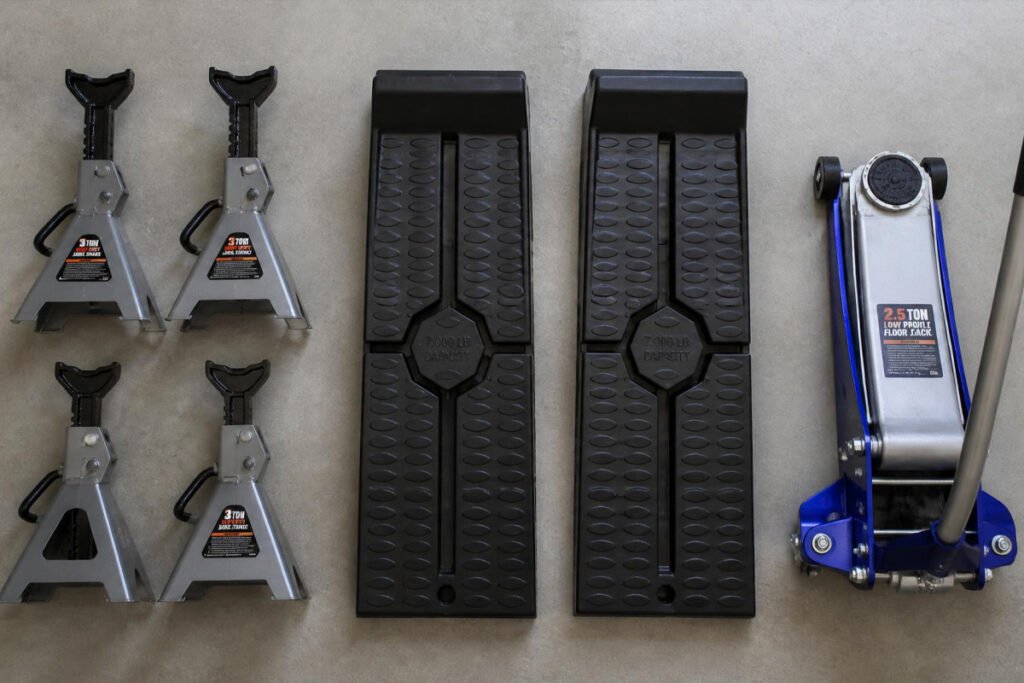
Table of Contents
- Why Proper Lifting Equipment Matters
- How to Choose the Right Ramps or Jack Stands
- Best Car Ramps & Jack Stands Available
- Comparison Table
- Best Setup for Different Types of Garage Work
- How to Safely Lift and Support a Vehicle
- Common Mistakes
- Expert Tips
- Final Thoughts
- Frequently Asked Questions
Why Proper Lifting Equipment Matters {#why-you-need}
A car weighs thousands of pounds, and the equipment you use to get under it is not a place to cut corners. Cheap, poorly rated ramps or stands can fail under load, and a vehicle that shifts or drops while someone is underneath it is one of the most serious injuries a home garage can produce. Beyond safety, the right equipment also makes routine maintenance dramatically easier — something worth pairing with a solid set of hand tools and enough overhead lighting to actually see what you’re working on.
If your garage doubles as a dedicated workspace for this kind of work, a stable, level floor matters just as much as the equipment itself — our guide on cleaning and maintaining a garage floor is worth a look if oil stains or uneven surfaces have become a recurring issue.
How to Choose the Right Ramps or Jack Stands {#how-to-choose}
Before buying, ask three questions:
- What kind of work am I actually doing? Oil changes and fluid checks favor ramps; anything involving wheel removal requires jack stands.
- What’s my vehicle’s actual curb weight? Every set of ramps or stands has a rated capacity — check it against your heaviest vehicle, not your lightest.
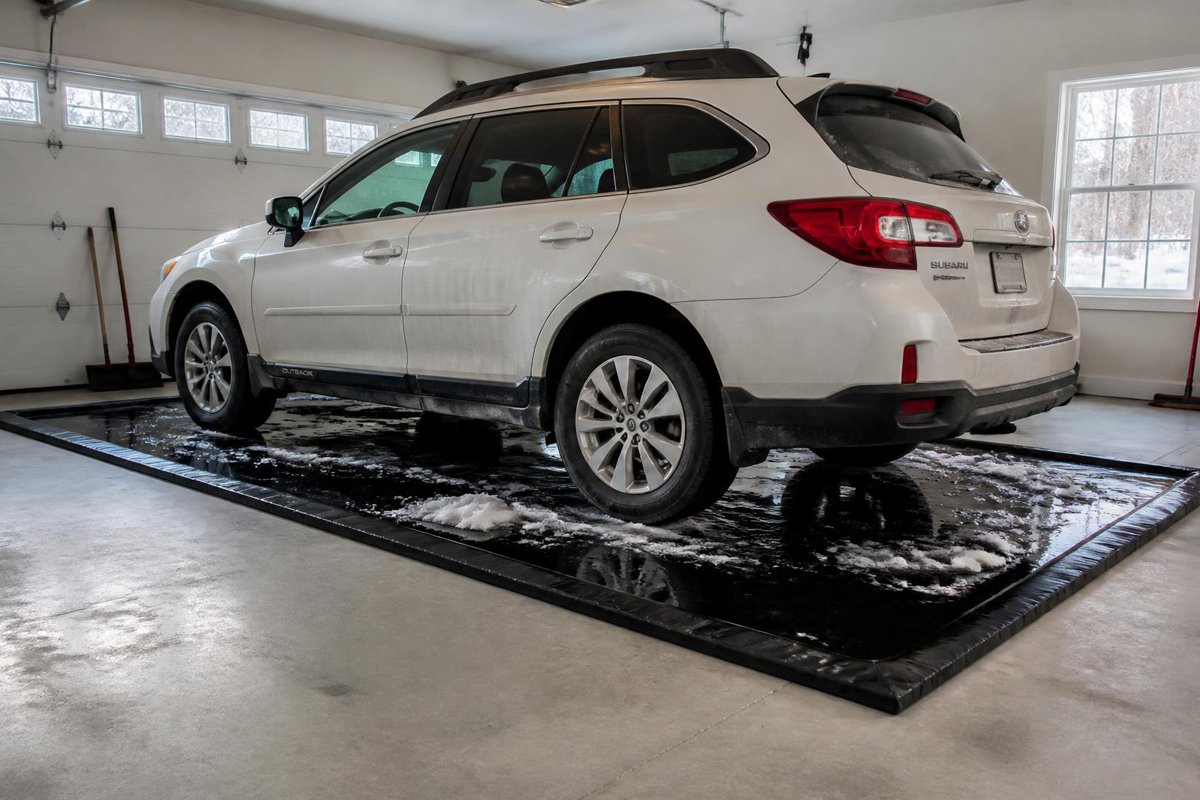
- What’s my garage floor surface like? Smooth, sealed, or epoxy-coated floors increase the risk of ramps sliding — look for models with rubberized or textured grip if this applies to you.
For general vehicle-lifting safety standards, the Occupational Safety and Health Administration’s vehicle lifting and jacking guidance is a useful, non-commercial reference even for home use.
Best Car Ramps & Jack Stands Available {#best-tools}
1. Steel Drive-On Ramps
Overview: Traditional steel ramps are the most affordable and widely available way to gain clearance under a vehicle without a jack at all. Drive up slowly, set the parking brake, and you’re ready for fluid checks or oil changes in under a minute.
Key Features:
- Solid steel construction rated for typical passenger vehicle weight
- Textured or ribbed surface for tire grip
- Stackable, low-profile storage
- No jack required for setup
Best For: Oil changes, fluid checks, visual inspections that don’t require wheel removal
Pros: ✅ Fastest setup of any option on this list ✅ No jack needed ✅ Compact for storage Cons: ❌ Can slide on smooth or sealed concrete without added grip ❌ Not usable for any job requiring wheel removal
Our Verdict: The right first purchase for anyone doing basic maintenance — just make sure your garage floor has enough grip, or add a rubber mat underneath for extra traction.
2. Low-Profile Ramps for Sports Cars
Overview: Standard ramps often don’t work for lowered vehicles or sports cars with minimal ground clearance. Low-profile ramps use a shallower approach angle specifically to avoid scraping the front bumper or splitter on the way up.
Key Features:
- Shallow approach angle for low-clearance vehicles
- Reinforced construction despite the lower profile
- Often made from high-density polymer instead of steel
- Wheel chocks frequently included
Best For: Lowered vehicles, sports cars, anything with aggressive front-end styling
Pros: ✅ Prevents front-end scraping that standard ramps cause ✅ Purpose-built for low-clearance vehicles ✅ Lightweight polymer construction is easy to move Cons: ❌ More expensive than standard steel ramps ❌ Lower weight capacity than heavy-duty steel models
Our Verdict: A must-have if you own a lowered vehicle — standard ramps and this type of car are simply not compatible.
3. Heavy-Duty Steel Jack Stands (3-Ton Rated)
Overview: For any work involving wheel removal, jack stands are non-negotiable. A 3-ton-rated pair covers most passenger cars and light trucks, with a ratcheting or pin-lock height adjustment for a secure, stable hold.
Key Features:
- 3-ton (6,000 lb) rated capacity per pair
- Ratchet or pin-lock height adjustment
- Wide base for stability on flat concrete
- Often sold in pairs or four-packs
Best For: Brake work, suspension work, tire rotations, any job requiring wheel removal
Pros: ✅ Essential safety equipment for real under-car work ✅ Wide stability base reduces tip risk ✅ Adjustable height fits a range of vehicles Cons: ❌ Requires a separate floor jack to lift the vehicle first ❌ Takes more setup time than ramps
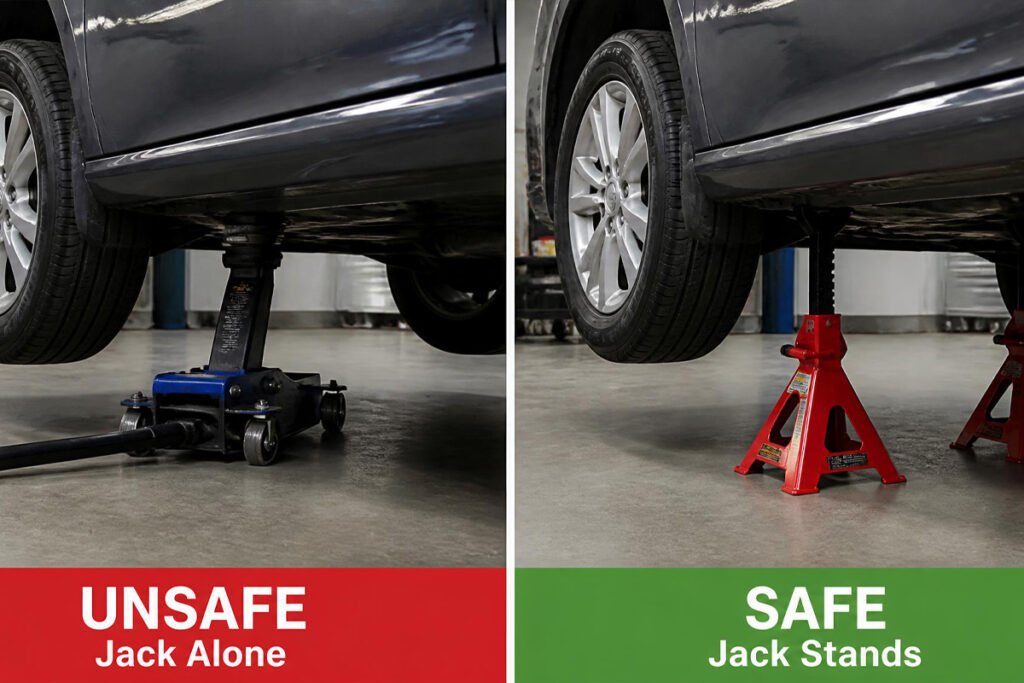
Our Verdict: This is the piece of equipment that actually makes serious home maintenance safe — never substitute a jack alone for a proper set of stands.
4. Hydraulic Floor Jack (2–3 Ton Capacity)
Overview: A floor jack isn’t a substitute for jack stands, but it’s the tool that gets a vehicle up to stand height safely in the first place. Look for a low-profile design if your vehicle has limited ground clearance.
Key Features:
- 2–3 ton lifting capacity for most passenger vehicles
- Low-profile designs for lowered or sports cars
- Smooth hydraulic pump action
- Wheeled base for easy positioning under the vehicle
Best For: Lifting a vehicle onto jack stands, tire changes, general lifting tasks
Pros: ✅ Fast, controlled lifting compared to a scissor jack ✅ Low-profile models fit under most vehicles ✅ Reusable across countless maintenance tasks Cons: ❌ Never rated for supporting a vehicle unattended — must be paired with jack stands ❌ Heavier and bulkier to store than ramps
Our Verdict: Buy this alongside jack stands, not instead of them — see our garage workshop setup guide for how to organize both within a functional work area.
5. Combo Ramp-and-Chock Kit
Overview: Combo kits bundle a set of drive-on ramps with matching wheel chocks, giving you a complete, matched system for quick maintenance tasks without piecing components together separately.
Key Features:
- Matched ramp and wheel chock set
- Chocks prevent rolling on the opposite end of the vehicle
- Often includes a carrying case or storage bag
- Sized for typical passenger vehicles
Best For: Home mechanics who want a complete, ready-to-use kit without separate purchases
Pros: ✅ Everything you need in one purchase ✅ Wheel chocks add real safety margin ✅ Convenient storage in a single case Cons: ❌ Sometimes higher combined cost than buying pieces separately ❌ Chock sizing may not fit oversized trucks or SUVs
Our Verdict: A smart pick for anyone just building out their first home maintenance kit — pair it with a labeled spot on your garage shelving or storage system so it’s always easy to grab.
Comparison Table {#comparison-table}
| Equipment | Best For | Setup Time | Approx. Price Range | Wheel Removal Compatible |
|---|---|---|---|---|
| Steel Drive-On Ramps | Oil changes, fluid checks | Very fast | $30–$60 | No |
| Low-Profile Ramps | Lowered vehicles, sports cars | Fast | $60–$120 | No |
| Heavy-Duty Jack Stands (3-Ton) | Brake work, suspension, tire rotation | Moderate | $50–$100/pair | Yes |
| Hydraulic Floor Jack (2–3 Ton) | Lifting the vehicle onto stands | Moderate | $80–$200 | N/A (lifting tool) |
| Combo Ramp-and-Chock Kit | All-in-one starter kit | Fast | $50–$90 | No |
Best Setup for Different Types of Garage Work {#different-setups}
Routine Maintenance (Oil Changes, Fluid Checks)
Steel drive-on ramps are the fastest, simplest option here. Add a rubber traction mat underneath if your floor is sealed or epoxy-coated to prevent sliding — see our epoxy floor guide if that applies to your setup.
Brake, Suspension, or Tire Work
A floor jack paired with a proper set of heavy-duty jack stands is the only safe combination here. Never work under a vehicle supported only by a jack.
Lowered Vehicles and Sports Cars
Low-profile ramps and low-profile floor jacks are essential — standard-height equipment simply won’t clear the vehicle’s undercarriage without scraping.
How to Safely Lift and Support a Vehicle {#how-to-use}
Step 1: Park on a Level, Solid Surface
Never lift a vehicle on gravel, asphalt in hot weather, or any uneven surface — level concrete is the only safe base.
Step 2: Set the Parking Brake and Chock the Opposite Wheels
Before jacking anything, engage the parking brake and place wheel chocks on the end of the vehicle you’re not lifting.
Step 3: Lift With the Floor Jack at a Rated Lift Point
Consult your owner’s manual for the correct jacking points — lifting from the wrong spot can damage the vehicle or cause it to slip off the jack.
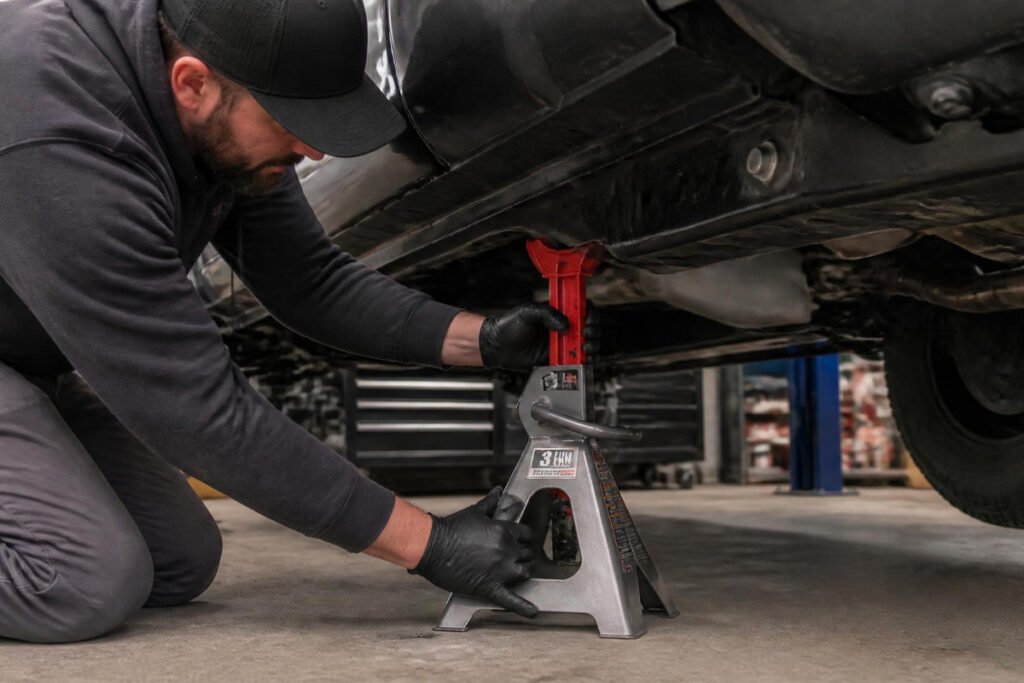
Step 4: Position and Lock the Jack Stands
Place stands under a rated frame point, then lower the vehicle slowly onto them until fully seated and stable.
Step 5: Test Stability Before Getting Underneath
Give the vehicle a firm shake test before sliding underneath — it should not rock or shift on the stands.
Common Mistakes {#common-mistakes}
Working under a vehicle supported only by a jack. Jacks can fail or slip under sustained load — jack stands are the only safe support for extended work underneath a vehicle.
Using ramps on an unlevel or sloped surface. This dramatically increases the risk of the vehicle sliding backward off the ramps mid-task.
Skipping wheel chocks. Even with the parking brake set, chocks on the opposite wheels add a critical extra layer of safety that’s easy to skip and shouldn’t be.
Expert Tips {#expert-tips}
Always check the rated capacity against your heaviest vehicle, not your average one. If you own multiple vehicles, buy equipment rated for the heaviest one you’ll ever lift.
Inspect ramps and stands for wear before every use. Cracks in polymer ramps or bent stand legs are a sign it’s time to replace the equipment entirely, not a cosmetic issue to ignore.
Store equipment where it’s easy to reach, not buried behind other gear. A properly organized garage shelving system means you’re actually likely to use safety equipment consistently instead of skipping it because it’s inconvenient to dig out.
Final Thoughts {#final-thoughts}
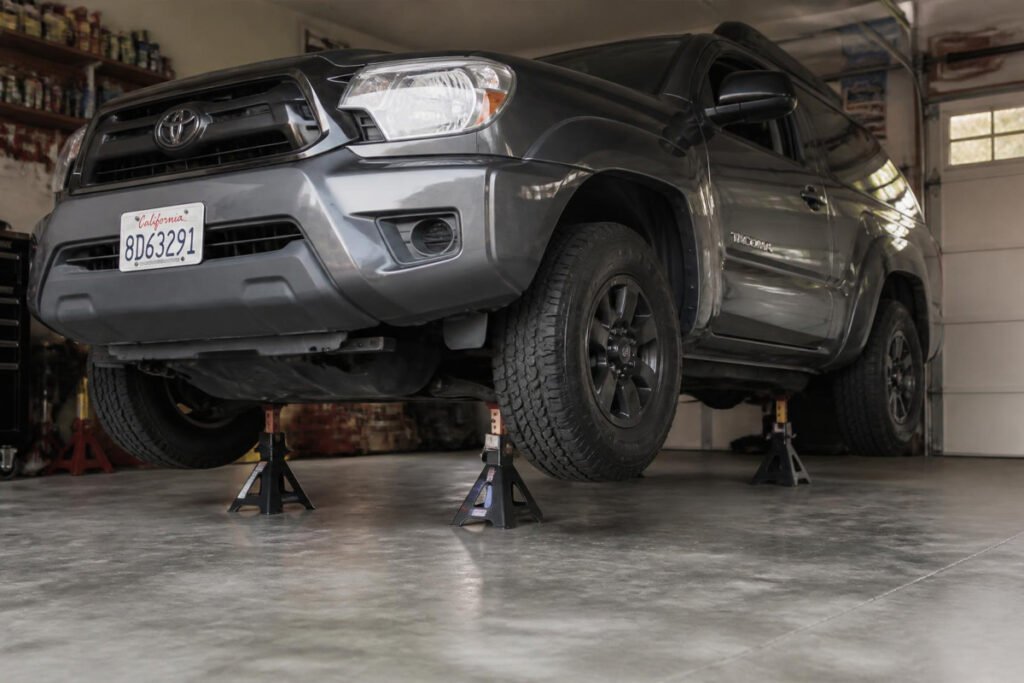
Best Overall: A set of heavy-duty jack stands paired with a hydraulic floor jack covers the widest range of maintenance tasks safely. Best Budget: Steel drive-on ramps, for anyone mostly doing oil changes and basic fluid checks. Best for Lowered Vehicles: Low-profile ramps and a low-profile floor jack, since standard equipment simply won’t clear the undercarriage.
Whichever setup you choose, proper lifting equipment is one of the most important safety investments in a DIY home garage — for the rest of your workshop setup, see our garage workshop guide and garage safety guide.
Frequently Asked Questions {#faq}
Can I use ramps instead of jack stands for everything? No. Ramps only work for tasks that don’t require wheel removal, since the wheel itself is what’s resting on the ramp. Any job involving the wheels, brakes, or suspension requires jack stands instead.
Is it safe to work under a car supported only by a floor jack? No. Floor jacks are lifting tools, not support tools, and can fail or slip under sustained load. Always transfer the vehicle’s weight onto rated jack stands before working underneath.
What weight rating do I need for my jack stands? Check your vehicle’s actual curb weight and choose stands rated well above that per pair — most passenger cars are safely covered by a 3-ton (6,000 lb) rated pair.
Why do my ramps keep sliding when I drive up them? This is usually caused by a smooth or sealed concrete floor without enough traction. A rubber mat placed under the ramps, or ramps with a more aggressive ribbed surface, typically solves this.
Do I need low-profile ramps for a normal sedan? Most standard sedans clear regular ramps without issue — low-profile ramps are specifically for lowered vehicles or sports cars with reduced ground clearance.
How often should I inspect my jack stands for safety? Check them before every use for bent legs, worn ratchet mechanisms, or cracked welds — this takes seconds and catches a failing stand before it becomes dangerous.
Can I lift an SUV or truck with the same equipment as a sedan? Only if the equipment’s rated capacity covers the vehicle’s actual weight — SUVs and trucks often require higher-capacity ramps, jacks, and stands than standard sedans.
What’s the safest surface to use ramps or jack stands on? Level, solid concrete is ideal. Avoid asphalt in hot weather, since it can soften and allow stands to sink, and never use either on gravel or dirt.
Do I need both ramps and jack stands, or just one? Most serious home mechanics eventually own both, since they cover different jobs — ramps for quick fluid work, jack stands for anything requiring wheel removal.
Author: Danial Marquez Last Updated: August 2026