A splinter from raw lumber, a knuckle scraped against a wrench, a stray spark from the grinder — a working garage produces small injuries constantly, and the standard bathroom-cabinet Band-Aid box usually isn’t built for it. Between power tools, sharp metal edges, and chemicals like solvents and adhesives, a garage workshop carries a meaningfully different risk profile than the rest of the house, and the first aid kit stocked for it should reflect that.
This isn’t about replacing a trip to the ER for anything serious — it’s about handling the cuts, splinters, minor burns, and eye irritation that happen often enough that having supplies within arm’s reach genuinely changes the outcome. Pair it with the basics covered in our garage workshop setup guide, which touches on first aid placement as part of a broader safety layout.
This guide compares five first aid kits that hold up specifically to workshop conditions — mechanical injuries, splinters, and chemical exposure — and breaks down which one fits which situation.
Quick Answer
The best first aid kit for a garage depends on how seriously you use the space. For most homeowners doing occasional projects, the Johnson & Johnson All-Purpose Portable Kit is an affordable, trusted foundation that covers everyday cuts and scrapes. For a genuine workshop with regular tool use, the Surviveware Large First Aid Kit adds the organization and higher-quality supplies — including proper trauma shears and precision tweezers for splinters — that a serious hobbyist needs. Anyone wanting maximum supply volume on a budget should look at the First Aid Only 299-Piece Kit, which delivers real quantity at a low price. A wall-mounted, always-visible option like the First Aid Only 25-Person ANSI Wall Cabinet suits a dedicated workshop where multiple people work regularly. And for households with kids in and around the garage, the Be Smart Get Prepared 100-Piece Kit adds broader coverage at a reasonable price point.
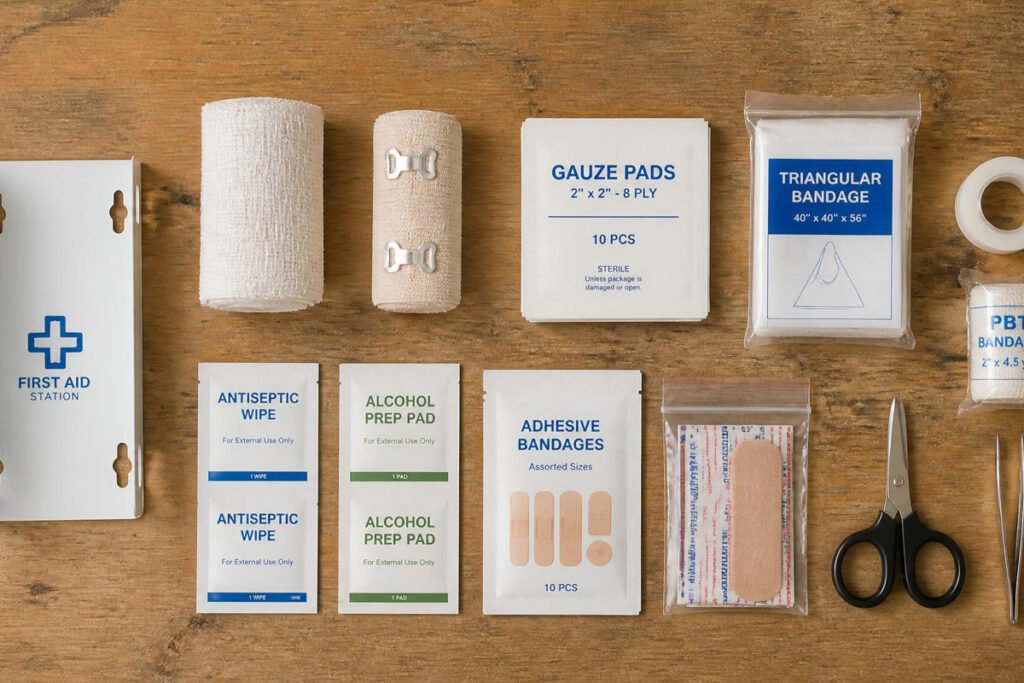
Table of Contents
- Why a Garage Needs a Dedicated First Aid Kit
- How to Choose the Right Kit
- Best First Aid Kits Available
- Comparison Table
- Best Kits for Different Garage Setups
- How to Position and Maintain a Garage First Aid Kit
- Common Mistakes
- Expert Tips
- Final Thoughts
- Frequently Asked Questions
Why a Garage Needs a Dedicated First Aid Kit
A garage workshop combines several injury risks the rest of the house doesn’t: sharp tool edges, wood splinters, hot surfaces from soldering or welding, and chemical exposure from solvents, adhesives, or battery acid. A generic household kit is built around minor domestic injuries — a kitchen cut, a kid’s scraped knee — and often lacks the tools a workshop actually needs, like real trauma shears, precision splinter tweezers, or eye wash for chemical splashes.
For anyone running a business out of a garage or regularly hosting others in the space, it’s also worth knowing that OSHA’s general workplace first aid requirement (29 CFR 1910.151(b)) and the ANSI/ISEA Z308.1-2021 standard define what an adequately stocked kit looks like — Class A kits cover minor, common injuries, while Class B kits are built for higher-risk, higher-traffic environments. Most homeowners don’t need to be formally compliant, but the ANSI classifications are still a useful benchmark for what “adequately stocked” actually means. The Occupational Safety and Health Administration’s first aid guidance is a solid independent reference for that standard.
Beyond injury care, it’s worth pairing the kit with the broader chemical and ventilation basics covered in our garage ventilation guide, since fumes from solvents and finishing products are a hazard a first aid kit alone doesn’t address.
How to Choose the Right Kit
Before comparing specific kits, work through three questions:
How often is the garage actually used as a workshop? Occasional DIY projects are well served by a basic all-purpose kit. Regular woodworking, metalworking, or automotive work justifies a larger, better-organized kit with dedicated trauma and eye-care supplies.
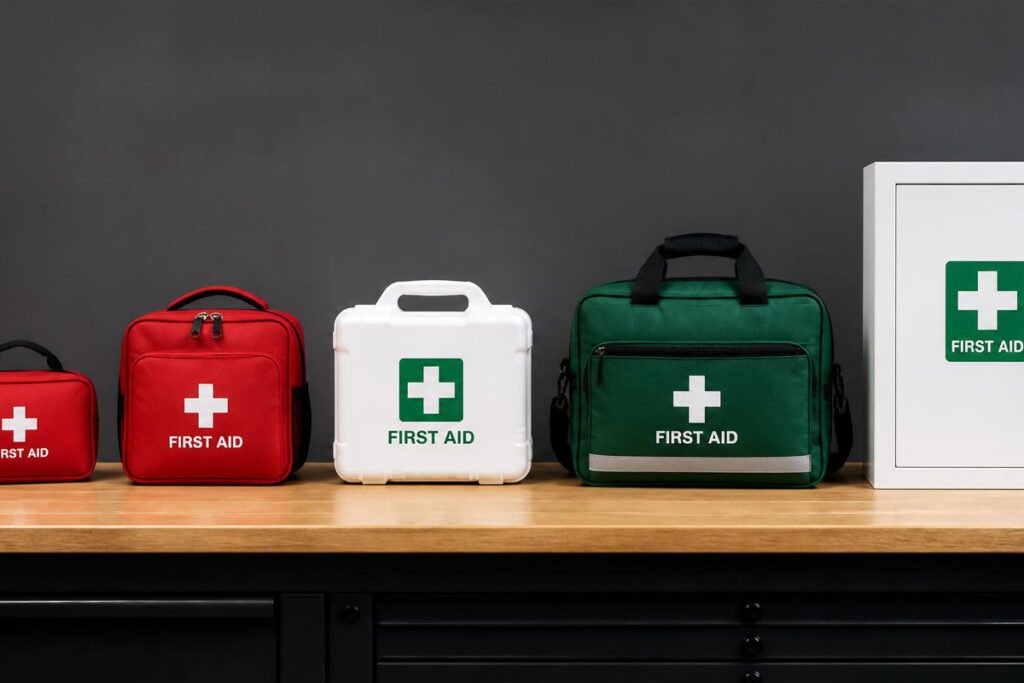
Will more than one person be working in the space? A garage that hosts family members, hobby partners, or employees benefits from a wall-mounted, clearly labeled cabinet everyone can find quickly, rather than a bag that might be tucked away or borrowed and not returned.
What specific hazards does your workshop actually have? Woodworking generates splinters; metalworking and welding generate burns and eye hazards; automotive work adds chemical exposure from fluids and battery acid. Match supply emphasis — burn gel, eye wash, precision tweezers — to what you actually do.
For general first aid training resources beyond the kit itself, the American Red Cross offers independent, non-commercial guidance and courses that pair well with having the right supplies on hand.
Best First Aid Kits Available
1. Johnson & Johnson All-Purpose Portable Kit — Best Overall Value
Overview: This kit earns its reputation as a trusted, affordable foundation — a broad assortment of bandage sizes, gauze pads, and cleansing wipes from a brand people have relied on for generations, at a fraction of the cost of more specialized kits. It’s a great base for anyone doing occasional garage projects rather than running a full workshop.
Key Features:
- Broad assortment of bandage sizes and wound-care basics
- Includes trusted Band-Aid brand bandages and Neosporin ointment
- Compact, affordable, easy to store on a shelf
- Simple, no-frills organization
Best For: Occasional DIY projects and general household use that extends into the garage.
Pros: ✅ Trusted, name-brand supplies at a low price ✅ Covers the essentials for common cuts and scrapes ✅ Compact enough to store almost anywhere
Cons: ❌ Lacks workshop-specific tools like real trauma shears or precision splinter tweezers ❌ No eye wash included, a gap for anyone working with chemicals or debris
Our Verdict: For light, occasional garage use, this is a perfectly reasonable starting point — just plan to supplement it with a few workshop-specific items like precision tweezers and eye wash if your projects get more involved.
2. Surviveware Large First Aid Kit — Best for Serious Workshops
Overview: Surviveware’s standout feature is organization — laminated, clearly labeled interior pockets marked by function (“Cuts & Scrapes,” “Wound Cleaning,” and so on) so you’re never digging through a jumbled pile mid-injury. The Large size adds enough supply volume and higher-quality tools, including real trauma shears and precision tweezers, to genuinely serve a regular workshop.
Key Features:
- Clearly labeled, compartmentalized interior organization
- Durable, water-resistant soft-sided case
- Includes precision tweezers and trauma shears, not flimsy plastic substitutes
- Large size covers a genuinely active workshop’s needs
Best For: Anyone doing regular woodworking, metalworking, or automotive projects where splinters, cuts, and minor mechanical injuries happen often.
Pros: ✅ Best-in-class organization for fast access under pressure ✅ Higher-quality tools than most competitors at this price ✅ Durable case holds up to genuine workshop conditions
Cons: ❌ Pricier than basic all-purpose kits ❌ Larger size needs a dedicated shelf or wall spot, not a drawer
Our Verdict: For a genuinely active workshop, the organization alone is worth the upgrade — finding the right supply in seconds matters more than most people realize until they’re the one bleeding and rummaging.
3. First Aid Only 299-Piece Kit — Best Budget Bulk Option
Overview: This kit leans on sheer quantity — 299 pieces at a price that undercuts most competitors by a wide margin, making it hard to beat if raw supply volume and value matter more than premium organization or specialty tools. It’s a sensible pick for stocking a garage without a big upfront investment.
Key Features:
- 299 pieces covering a broad range of common injuries
- Low price relative to piece count
- Basic organizational trays inside a hard case
- HSA/FSA-eligible in most cases
Best For: Budget-conscious homeowners who want real supply volume without paying premium prices for organization or specialty tools.
Pros: ✅ Excellent quantity-to-price ratio ✅ Hard case offers more protection than a soft bag ✅ Reasonable starting point for a garage that sees moderate use
Cons: ❌ Organization is more basic than premium kits like Surviveware ❌ Supply quality is adequate but not premium-grade
Our Verdict: If the goal is simply having plenty of basic supplies on hand without spending much, this delivers real volume for the price — just don’t expect the same tool quality as a higher-end kit.
4. First Aid Only 25-Person ANSI Wall Cabinet — Best for Multi-Person Workshops
Overview: Built around ANSI/ISEA Z308.1 compliance, this wall-mounted metal cabinet is designed for a workshop where multiple people regularly work — always visible, always in the same spot, and stocked to a recognized standard rather than an arbitrary piece count. It’s the kind of kit you’d expect to find in a small commercial shop, scaled for home use.
Key Features:
- ANSI/ISEA Z308.1-compliant contents
- Wall-mounted metal cabinet, always visible and accessible
- Stocked for a defined group size (25-person rating)
- Refillable — individual items can be restocked rather than replacing the whole kit
Best For: A dedicated workshop with regular visitors, a home-based business, or anyone who wants a fixed, always-ready station rather than a portable bag.
Pros: ✅ Meets a recognized compliance standard, not just a marketing claim ✅ Always mounted and visible — no searching for where the kit went ✅ Refill system extends the kit’s life well beyond a single-use box
Cons: ❌ Fixed installation means it’s not portable if you need supplies elsewhere ❌ Overkill for a garage used only occasionally for light projects
Our Verdict: For a workshop that functions almost like a small shop — regular use, multiple people, real tool traffic — this brings a level of preparedness a portable bag doesn’t quite match.
5. Be Smart Get Prepared 100-Piece Kit — Best for Family Garages
Overview: This kit strikes a middle ground between the bare-bones Johnson & Johnson option and the premium Surviveware kit, with a broader supply range at a moderate price — a sensible fit for a garage that doubles as a family space, whether that’s kids’ bikes, a home gym corner, or general household overflow alongside actual project work.
Key Features:
- 100 pieces covering a broad range of common household and minor workshop injuries
- Moderate price point between budget and premium tiers
- Reasonably organized interior layout
- Compact enough for a shelf or drawer
Best For: A garage that serves double duty as family space and light workshop, where injuries could come from anything — a bike scrape, a tool nick, or general household activity.
Pros: ✅ Broad, general-purpose coverage suited to mixed-use garages ✅ Reasonable price for the supply range included ✅ Compact enough to store without dedicating major space
Cons: ❌ Not specialized enough for serious, frequent workshop use ❌ Lacks the premium organization of higher-end kits
Our Verdict: For a garage that’s as much family space as workshop, this general-purpose balance is a sensible middle ground — enough for real coverage without overbuying specialty tools you won’t use.
Comparison Table
| Product | Best For | Piece Count | Format | Approx. Price |
|---|---|---|---|---|
| Johnson & Johnson All-Purpose | Best Overall Value | Moderate | Soft case | $10–$20 |
| Surviveware Large | Best for Serious Workshops | 200+ | Organized soft bag | $50–$70 |
| First Aid Only 299-Piece | Best Budget Bulk | 299 | Hard case | $20–$30 |
| First Aid Only 25-Person ANSI Cabinet | Best Multi-Person Workshop | ANSI Class A rated | Wall-mounted metal cabinet | $40–$60 |
| Be Smart Get Prepared 100-Piece | Best for Family Garages | 100 | Soft case | $15–$25 |
Prices are approximate and vary by retailer. Piece counts vary by specific SKU within a product line — confirm exact contents before buying.
Best Kits for Different Garage Setups
Occasional DIY and Light Projects
The Johnson & Johnson All-Purpose kit or the Be Smart Get Prepared 100-Piece kit both handle the basics well for a garage that isn’t in constant use. Either pairs naturally with the broader safety basics in our garage safety guide.
Active Woodworking or Metalworking Shop
The Surviveware Large kit’s precision tools and organization earn their price here — splinters, cuts, and minor burns happen often enough in an active shop that fast, organized access genuinely matters. This is a good moment to also review your PPE and workshop organization as a full safety system rather than the first aid kit alone.
Shared or Multi-Person Workshop
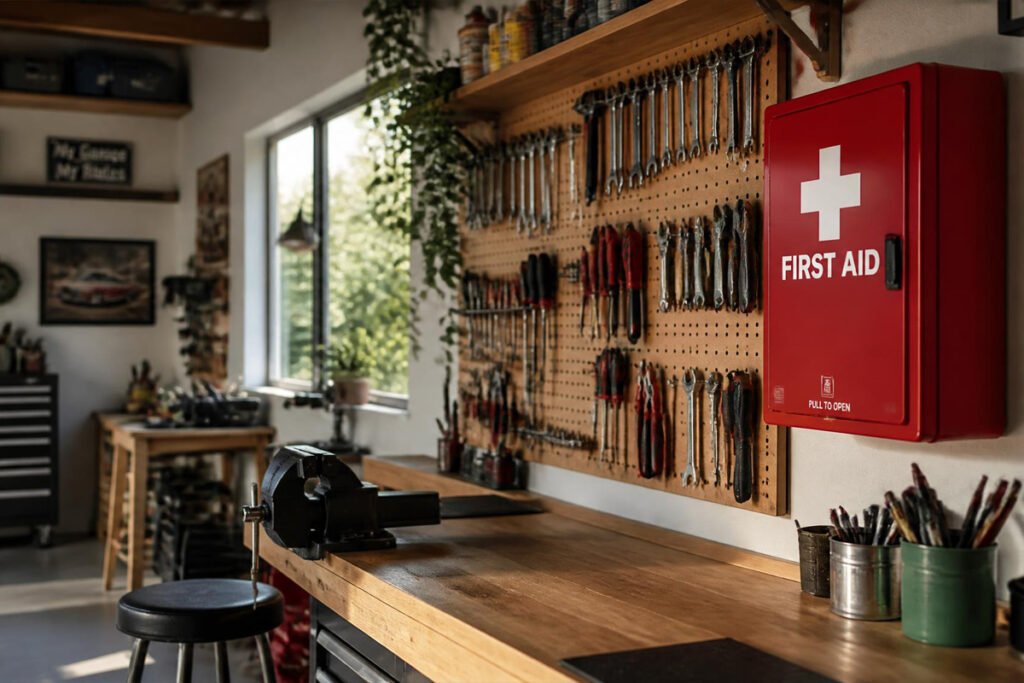
If more than one person regularly works in the space — family, hobby partners, or a home-based business — the wall-mounted First Aid Only ANSI cabinet keeps supplies visible and consistent, rather than relying on whoever last used the portable kit to put it back.
How to Position and Maintain a Garage First Aid Kit
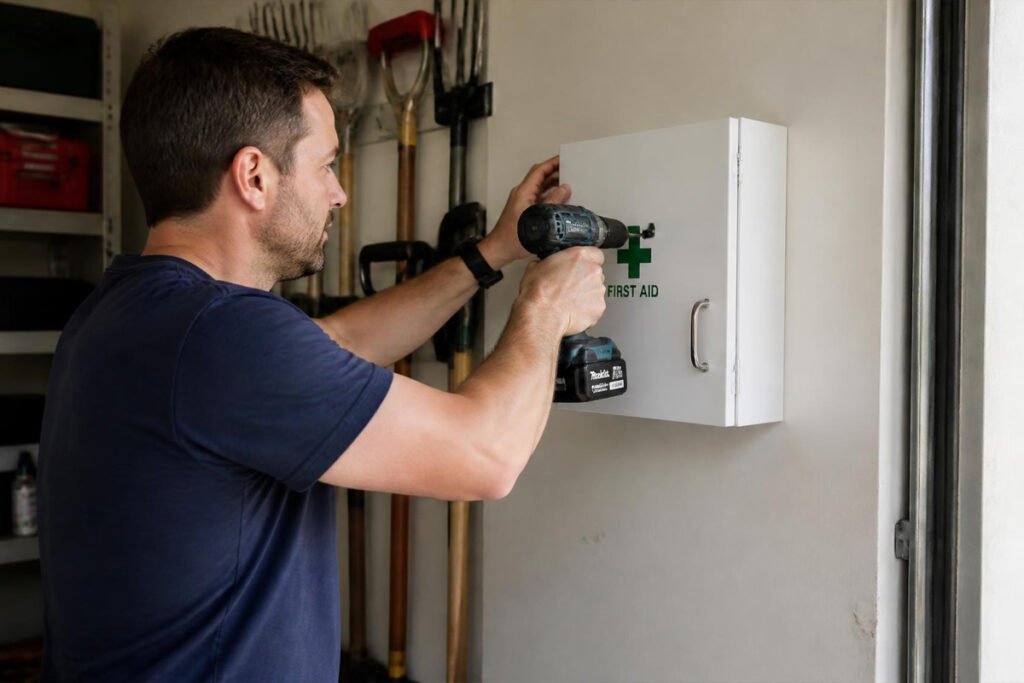
Step 1: Mount It Near the Highest-Risk Area, Not Just Anywhere
Position the kit close to the workbench, table saw, or wherever most cuts and scrapes are likely to happen — not tucked in a far corner where reaching it wastes precious time during an actual injury.
Step 2: Make Sure Everyone Who Uses the Garage Knows Where It Is
A kit only helps if the person who needs it knows exactly where to find it. If the garage is shared, point it out explicitly rather than assuming it’s obvious.
Step 3: Check Contents Every Few Months
Bandages get used, ointments expire, and gloves get borrowed for other tasks. A quick quarterly check keeps the kit actually ready rather than a box with gaps you discover mid-emergency.
Step 4: Add Workshop-Specific Supplies the Kit Might Be Missing
Precision splinter tweezers, burn gel, and eye wash are common gaps in general-purpose kits. Supplement based on what your specific projects actually generate.
Step 5: Keep a Basic First Aid Reference Nearby
A simple printed reference card or app on hand helps in the moment, especially for less common situations like a chemical splash to the eyes or a deeper cut that needs proper wound care before a doctor visit.
Common Mistakes
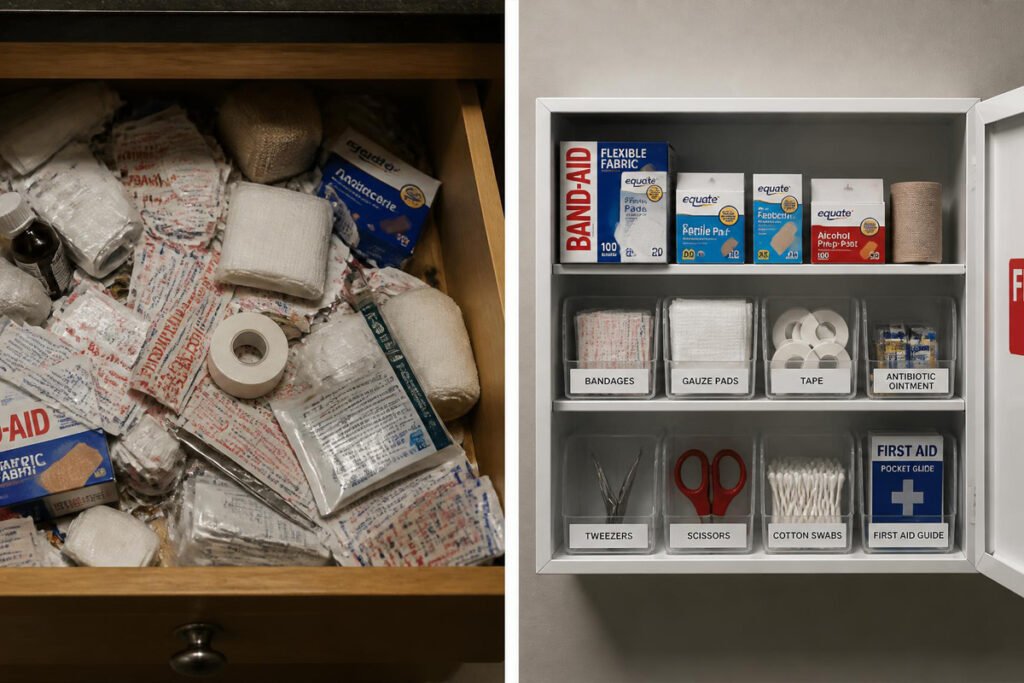
Relying on the kitchen or bathroom first aid box. A household kit is built around domestic injuries, not workshop-specific ones like splinters, mechanical cuts, or chemical exposure. Keep a dedicated kit in the garage itself.
Letting the kit go unchecked for years. Expired ointments, used-up bandages, and missing gloves are the most common reasons a first aid kit fails exactly when it’s needed. Build a check into your regular garage maintenance routine.
Storing the kit somewhere hard to reach quickly. A kit buried behind storage bins or on a high shelf defeats the purpose — position matters as much as contents. This is worth revisiting alongside your broader garage tool storage setup whenever the layout changes.
Expert Tips
Add real trauma shears and precision tweezers if your kit doesn’t include them. The flimsy plastic tools included in many basic kits genuinely struggle with a stubborn splinter or cutting through a bandage cleanly — a small upgrade that matters more than it seems.
Keep eye wash on hand if you work with chemicals, dust, or grinding. Many basic kits skip this entirely, and it’s one of the more important workshop-specific additions for anyone doing metalworking, painting, or automotive fluid work.
Combine the kit with basic first aid knowledge, not just supplies. A well-stocked kit is only as useful as the person using it — a short first aid course or even a good reference card meaningfully improves outcomes beyond what supplies alone provide.
Final Thoughts
Best Overall Value: The Johnson & Johnson All-Purpose kit is a trusted, affordable foundation for anyone with light, occasional garage use.
Best for Serious Workshops: The Surviveware Large kit’s organization and tool quality genuinely earn their higher price for anyone doing regular hands-on project work.
Best for Shared Spaces: The First Aid Only ANSI Wall Cabinet brings a level of consistency and visibility a portable bag can’t match once more than one person is using the garage regularly.
Whichever kit you choose, position and maintenance matter as much as the contents — pair it with the broader safety basics in our garage safety guide so the garage is covered on every front, not just first aid.
Frequently Asked Questions
Do I really need a separate first aid kit for the garage, or is a household one enough? A dedicated garage kit is worth it if you do regular projects — household kits are built around domestic injuries and often lack workshop-specific tools like precision splinter tweezers, real trauma shears, or eye wash for chemical exposure.
What should a garage first aid kit include that a basic one doesn’t? Precision tweezers for splinters, burn gel or dressings, eye wash for dust or chemical exposure, and real trauma shears are the most common workshop-specific gaps in general-purpose kits.
How often should I check or restock my garage first aid kit? Every few months is a reasonable check-in — bandages get used, ointments expire, and gloves have a way of disappearing for unrelated tasks. Build it into a regular garage maintenance check.
Is a wall-mounted first aid cabinet better than a portable kit? It depends on how the garage is used — a wall-mounted cabinet is more visible and consistent for a shared or regularly used workshop, while a portable kit offers more flexibility if you need supplies elsewhere, like in a car or at a job site.
What does ANSI/ISEA Z308.1 compliance actually mean? It’s a recognized industry standard defining minimum contents for workplace first aid kits, split into Class A (minor, common injuries) and Class B (higher-risk environments). Most homeowners don’t need formal compliance, but it’s a useful benchmark for what “adequately stocked” looks like.
Can a first aid kit expire? Yes — ointments, antiseptic wipes, and some adhesive bandages have expiration dates and can lose effectiveness over time. Check dates during your periodic kit review, not just supply quantity.
Do I need eye wash in a garage first aid kit? If your projects involve grinding, chemicals, solvents, or fine dust, yes — eye exposure is a common workshop injury that many basic kits don’t address at all.
How much should I expect to spend on a good garage first aid kit? Basic kits run $10–$30, mid-range organized kits with better tools run $40–$70, and dedicated wall-mounted ANSI-compliant cabinets typically fall in a similar $40–$60 range depending on size and rating.
Should kids’ bikes or family activity in the garage change what kit I buy? It’s worth leaning toward a broader general-purpose kit like the Be Smart Get Prepared option if the garage doubles as family space, since injuries in that context aren’t limited to tool-related ones.
What’s the difference between a first aid kit and a trauma or IFAK kit? A standard first aid kit covers common minor injuries — cuts, scrapes, splinters, burns. A trauma or IFAK (Individual First Aid Kit) is built around serious, potentially life-threatening injuries and typically includes tourniquets and hemorrhage control supplies most home garages don’t need.
Author: Danial Marquez Last Updated: September 2026