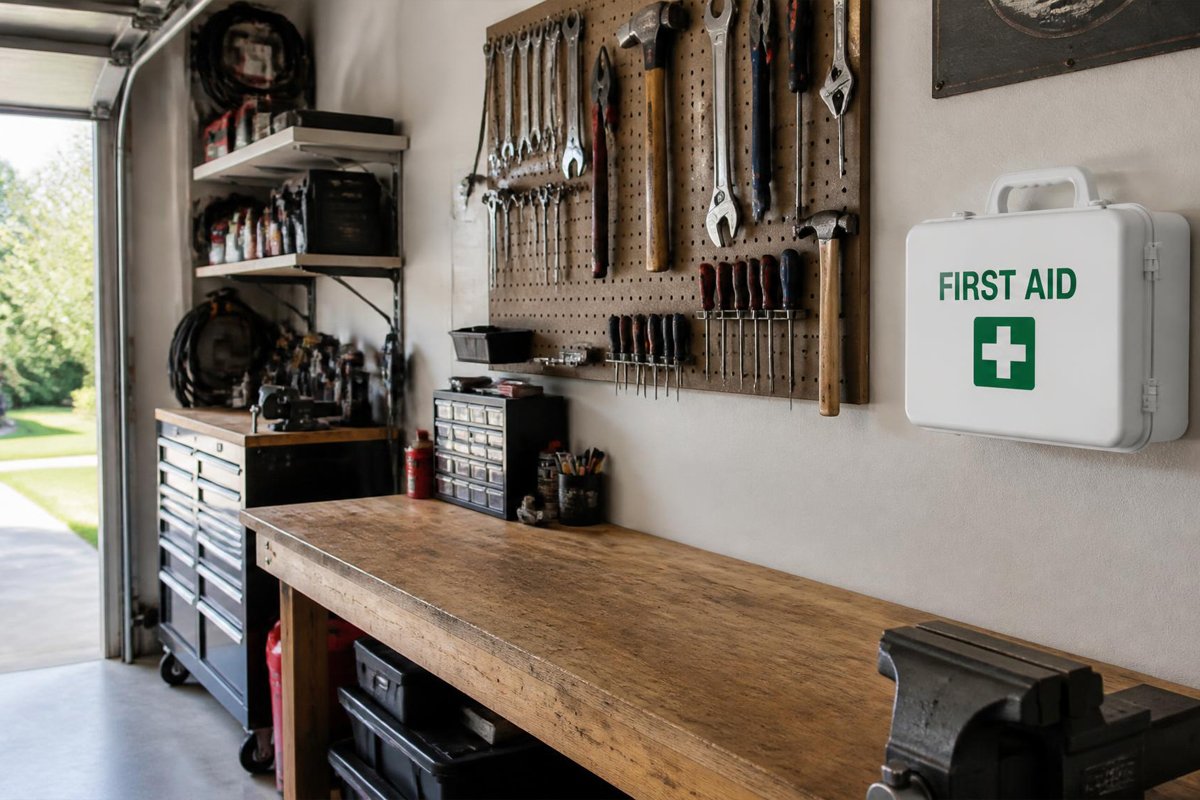
Garages hold some of the most stealable items in a house — bikes, power tools, sometimes a second car — behind a door that’s often the least secure entry point on the property. A camera doesn’t replace the physical security covered in our garage door security guide, but it adds deterrence, evidence, and remote visibility that a lock alone can’t.
Quick answer: for most garages, a wire-free camera with local SD storage like the Tapo MagCam C425 delivers the best combination of easy installation, no subscription requirement, and genuinely long battery life. If your garage is already wired or you want whole-property coverage, a PoE system like Reolink is worth the extra installation effort. Full picks and a buying guide follow below.
We compared products on video resolution, night vision performance, power source (battery vs. wired vs. PoE), storage type and ongoing cost, and how well each is genuinely suited to garage-specific conditions — wide brightness swings from an open door, motion patterns around vehicles, and often spotty WiFi in detached structures.
Quick Comparison
| Product | Best For | Power / Storage | Approx. Price |
| Tapo MagCam C425 | Best Overall / Best Value | Battery (300-day), local SD, no subscription needed | ~$50–$70 |
| Ring Indoor Cam | Best Budget/Simple Entry Point | Wired, cloud storage (subscription) | ~$60–$80 |
| Reolink 4K PoE System | Best for Whole-Property Wired Coverage | PoE wired, local NVR storage | ~$200–$400 (multi-cam kit) |
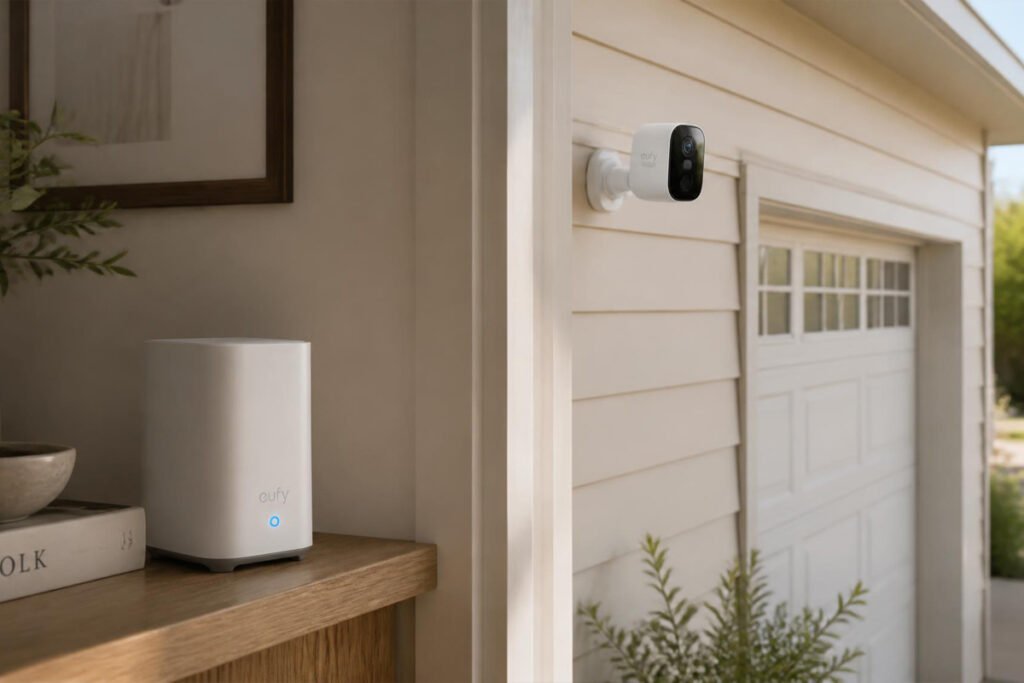
| eufyCam (eufy Security) | Best No-Subscription Local Storage | Battery, local HomeBase storage | ~$150–$200 per cam |
| myQ HD Smart Garage Camera | Best for Garage Door Opener Integration | Wired, cloud storage | ~$70–$100 |
Note: prices and specs are approximate and based on typical current listings — confirm exact storage requirements and subscription costs before you buy.
1. Tapo MagCam C425 — Best Overall / Best Value
⭐ Best Overall
2K resolution | IP66 weatherproof | 10,000mAh battery (up to 300 days) | Magnetic base | Subscription-free local SD storage | ~$50–$70
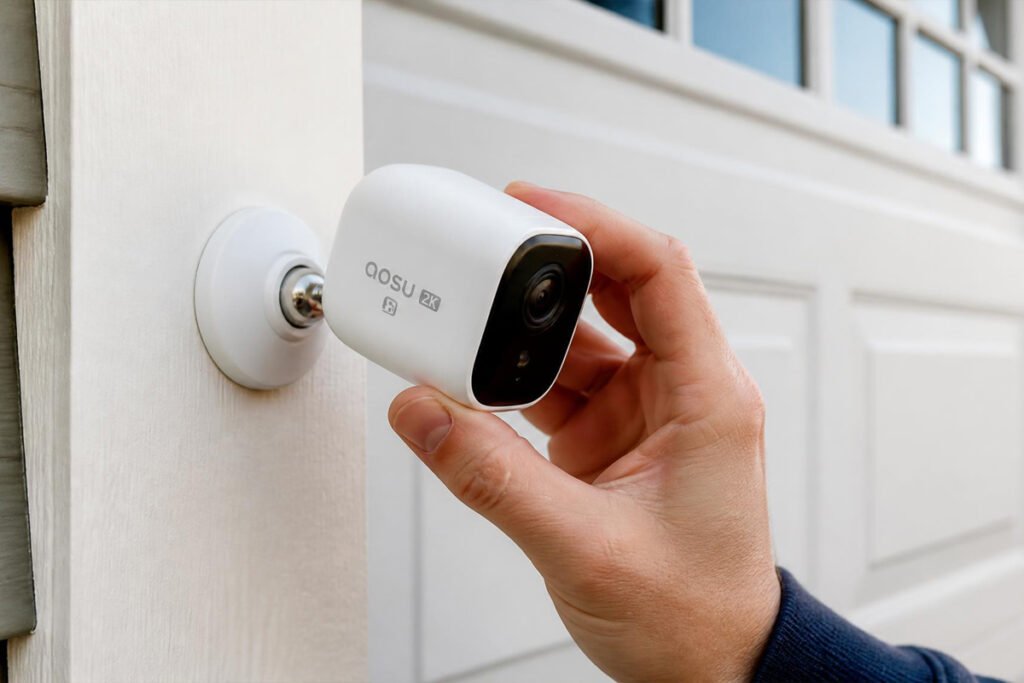
Named a top outdoor security camera pick industry-wide, this hits a genuinely hard combination to find at this price: 2K resolution, real weatherproofing for mounting outside the garage door if needed, and a battery that reasonably lasts up to 300 days per charge. The magnetic base is a small detail that matters a lot in practice — it lets you adjust the angle after the initial install without redrilling mounting holes, which garage cameras often need once you see what the first angle actually captures.
Why buy it
- No monthly subscription required for local SD card storage — genuinely useful footage without ongoing cost
- 300-day battery life means minimal maintenance once it’s mounted and configured
- IP66 weatherproofing works equally well mounted inside or outside the garage door
Worth knowing
- Cloud storage is available but requires a paid plan if you want off-site backup beyond the local SD card
- Color night vision, while good, isn’t quite as sharp as some pricier wired alternatives in very low light
Verdict: the strongest all-around pick for most garages — easy installation, no required subscription, and battery life long enough to mostly forget about it.
2. Ring Indoor Cam — Best Budget/Simple Entry Point
💰 Best Budget
1080p HD | Color Night Vision | Wired power | Manual privacy cover | Cloud storage requires subscription | ~$60–$80
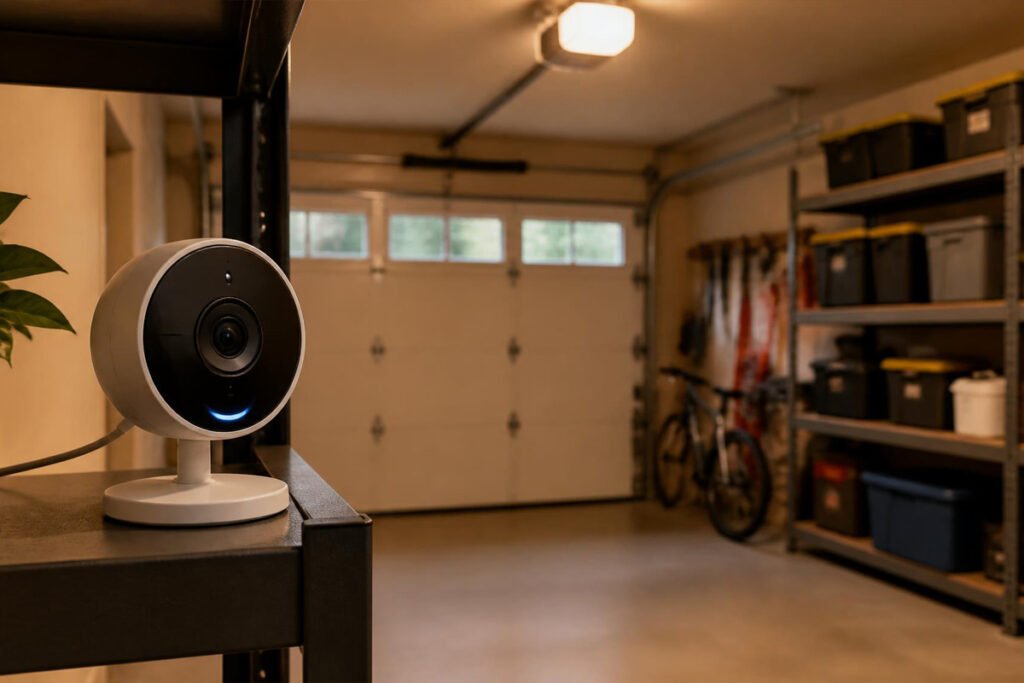
A genuinely no-frills entry point into garage monitoring — straightforward setup, clear enough 1080p video for day-to-day monitoring, and Color Night Vision that performs reasonably well even in a garage without much ambient light. The manual privacy cover is a thoughtful touch if you share the space with family members who’d rather the camera be visibly off at certain times, which matters more for an interior garage camera than an outdoor one.
Why buy it
- Simple, well-documented setup with broad smart-home ecosystem support
- Manual privacy cover offers a physical, visible way to disable recording
- Clear 1080p video with usable color night vision for typical garage lighting conditions
Worth knowing
- Requires a paid Ring subscription to access recorded video history beyond live view
- Wired power only — needs a nearby outlet, less flexible for placement than a battery unit
Verdict: a solid, affordable starting point if you’re already in the Ring ecosystem or want the simplest possible setup — factor the subscription cost into your real total price.
3. Reolink 4K PoE System — Best for Whole-Property Wired Coverage
🔌 Best for Wired Coverage
4K/5MP resolution options | Power over Ethernet (PoE) | Night vision up to 100 feet | Local NVR storage | ~$200–$400 for a multi-camera kit
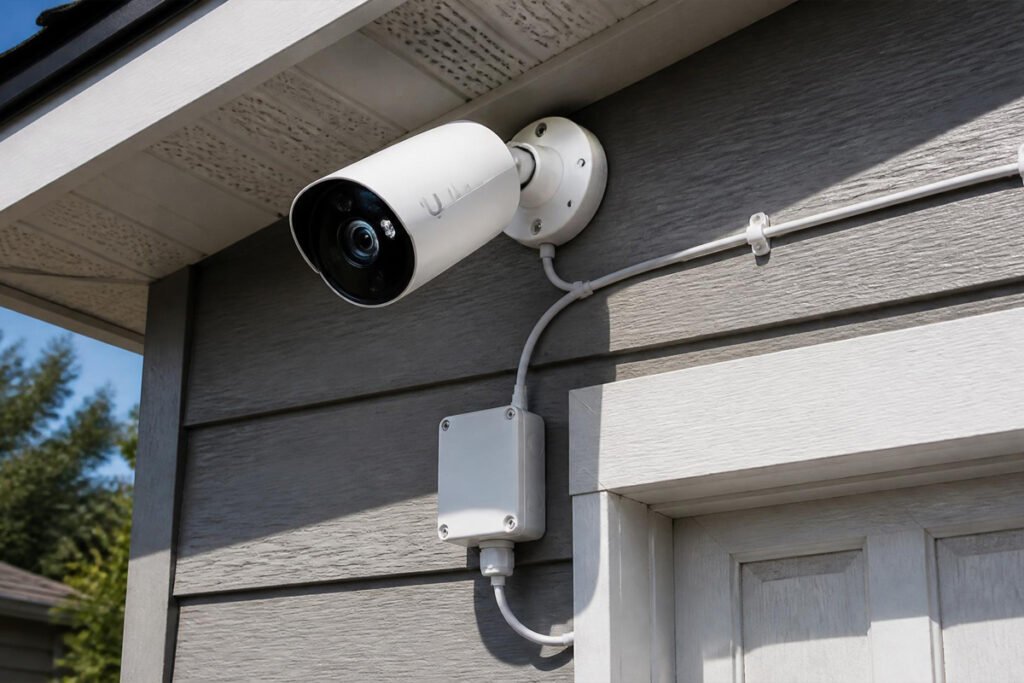
If you’re covering more than just the garage itself — driveway, side yard, other entry points — a PoE system is a fundamentally more capable approach than a single battery camera. Power and data run over a single Ethernet cable, which means no battery to recharge and no WiFi dead zones to fight, and the resolution options genuinely deliver license-plate-readable detail at range, which single-camera wireless systems often can’t match. If you’re already running new wiring for a workshop build-out or an EV charger installation, it’s worth planning an Ethernet run for cameras at the same time to save a separate project later.
Why buy it
- No battery to maintain and no WiFi reliability concerns — power and data over one cable
- Highest resolution and longest-range night vision on this list, suited to covering more than just the garage
- Local NVR storage avoids ongoing subscription costs entirely for most configurations
Worth knowing
- Requires running Ethernet cable, which means more installation effort than a wireless camera
- Higher upfront cost, especially for a multi-camera kit covering more than one area
Verdict: the right choice if you’re covering a larger property or want the most reliable, highest-resolution option and don’t mind the extra installation work.
4. eufyCam (eufy Security) — Best No-Subscription Local Storage
💾 Best Local Storage
Battery-powered | Enhanced night vision | Motion detection tuned for garage doors/driveways | Local HomeBase storage, no required subscription | ~$150–$200 per camera
Eufy built its reputation specifically around local storage without a mandatory subscription, using a HomeBase unit inside the house to store footage rather than relying on the cloud. The motion detection is specifically tuned for the kind of movement that happens around garage doors and driveways — vehicles, people walking up, a door opening — rather than generic motion sensing that triggers on every passing shadow or blowing leaf.
Why buy it
- Local HomeBase storage genuinely works without a required monthly subscription
- Motion detection tuned specifically for garage-door and driveway activity reduces false triggers
- Enhanced night vision performs well in the low-light conditions typical of most garages
Worth knowing
- Requires purchasing the separate HomeBase unit if you don’t already own one from another eufy camera
- Per-camera price is higher than simpler budget options like the Ring Indoor Cam
Verdict: the right pick if avoiding subscription fees long-term matters most to you — the HomeBase investment pays for itself over a few years compared to ongoing cloud storage costs.
5. myQ HD Smart Garage Camera — Best for Garage Door Opener Integration
🚪 Best Opener Integration
1080p HD | HDR + night vision | Integrates with myQ-compatible garage door openers | Cloud storage | ~$70–$100
If your garage door opener is already myQ-compatible, this is the camera built specifically to work with it rather than alongside it — tying video directly to door open/close events so you get a clip of exactly who or what triggered the door, not just generic motion in the room. That tight integration is the whole reason to pick this over a more generic camera, and it matters less if your opener isn’t already part of that ecosystem.
Why buy it
- Ties video directly to garage door open/close events for myQ-compatible openers
- HDR and night vision deliver clear footage across the wide brightness range typical of a garage with a door open to daylight
- Purpose-built for garage use rather than adapted from a general indoor/outdoor camera
Worth knowing
- The door-integration value proposition only applies if you already have or plan to add a myQ-compatible opener
- Cloud storage requires an ongoing subscription for full video history access
Verdict: worth choosing specifically if you’re already in or planning to join the myQ ecosystem — otherwise a more general camera likely serves you just as well for less complexity.
Which Camera Fits Your Garage?
- Standard single or two-car garage, want the easiest setup: the Tapo MagCam C425 covers this with no subscription required.
- Already using Ring products elsewhere in the home: the Ring Indoor Cam keeps everything in one app and ecosystem.
- Covering the whole property, not just the garage: the Reolink PoE system scales to multiple cameras with the most reliable connection.
- Want to avoid subscription fees for the long term: eufyCam’s local HomeBase storage pays off over a few years.
- Already have or are adding a myQ-compatible garage door opener: the myQ camera ties directly into that system.
Common Mistakes When Buying a Garage Security Camera
Ignoring the subscription cost in the total price
A $60 camera that requires a $5–$10 monthly cloud subscription to actually access recorded footage isn’t really a $60 camera over a few years of ownership. Factor ongoing costs into the real comparison, not just the sticker price.
Mounting it without considering glare and lighting
A camera pointed directly at where headlights sweep across the garage, or positioned to catch glare off a shiny car hood, can produce washed-out or unusable footage exactly when it matters most. Test the angle before finalizing the mount.
Assuming WiFi will reach reliably
Garages, especially detached ones, are notorious WiFi dead zones. If you’re set on a wireless camera, verify signal strength at the actual mounting location before buying, or consider a PoE system that doesn’t depend on WiFi at all.
Overlooking local privacy and legal considerations
If the camera’s field of view captures a neighbor’s property or a public sidewalk, check local regulations on recording — rules vary by location. Pairing a camera with the physical security covered in our garage door security guide gives more complete protection than a camera alone.
Fast Buying Guide
Battery vs. wired power
Battery cameras install faster and don’t need an outlet nearby, but require periodic recharging (though modern units like the Tapo pick can go months between charges). Wired cameras never run out of power but need an outlet or PoE run to the mounting location.
Local storage vs. cloud subscription
Local SD card or NVR storage avoids ongoing fees but means footage is lost if the physical storage is stolen along with the camera. Cloud storage costs a recurring fee but keeps footage safe even if the camera itself is taken — worth weighing based on how much a subscription genuinely bothers you versus that specific risk.
Resolution and night vision
1080p is sufficient for general monitoring; 2K or 4K matters more if you need to read a license plate or identify fine detail at a distance. Color night vision generally outperforms traditional infrared black-and-white for actually identifying who or what triggered an alert.
Where to mount it
Cover the door itself and the immediate approach, angled to minimize direct headlight glare. If you’re planning a broader security upgrade, pair camera placement with the door hardware improvements in our garage door security guide for complete coverage rather than relying on the camera alone.
Frequently Asked Questions
Do I need a subscription for a garage security camera?
Not necessarily — cameras with local SD card or NVR storage, like the Tapo, eufyCam, and Reolink picks on this list, work without a required subscription. Cloud-storage-first options like Ring and myQ generally need a paid plan to access recorded footage history.
Will WiFi reach my detached garage reliably?
It depends heavily on distance and obstructions. Test actual signal strength at the mounting location before committing to a WiFi camera, or consider a PoE wired system, which doesn’t depend on WiFi at all.
What resolution do I actually need for a garage camera?
1080p covers general monitoring and deterrence well. Step up to 2K or 4K specifically if you want to read license plates or identify fine detail at a distance, such as covering a driveway in addition to the garage itself.
Can a garage camera integrate with my existing garage door opener?
Some can — the myQ camera specifically ties into myQ-compatible openers to link video with door events. Most other cameras operate independently of the opener and rely on their own motion detection instead.
How long do battery-powered garage cameras last on a charge?
This varies significantly by model and usage, but modern units like the Tapo MagCam C425 can reasonably last up to 300 days per charge under typical use, while older or heavier-traffic setups may need recharging every 1–3 months.
Should I get one camera or multiple for my garage?
A single camera covering the main door and approach is sufficient for most single-car garages. Larger garages, detached structures, or anyone wanting driveway and side-entry coverage typically benefit from a multi-camera system like the Reolink PoE kit, which scales more cost-effectively than buying several standalone battery cameras.
The Bottom Line
If you buy just one thing from this list, make it the Tapo MagCam C425 — it covers most garages with no subscription requirement and minimal ongoing maintenance. Step up to Reolink’s PoE system if you’re covering more than the garage itself, and pair whichever camera you choose with the physical door security covered in our companion guide for genuinely complete protection rather than relying on a camera alone.
Last Updated: July 2026

![A standard smoke detector is the wrong tool for a garage — dust, vehicle exhaust, and temperature swings trigger enough false alarms that most people eventually just disable the unit, which defeats the purpose entirely. A heat detector solves that by responding to actual temperature change instead of airborne particles. For related garage fire and safety context, see our carbon monoxide and garage safety guide. This roundup focuses specifically on which heat detector to buy. Quick answer: for most attached garages, a hardwired, interconnectable unit like the First Alert HD6135FB is the most reliable choice, since it ties into your home's existing smoke/CO alarm system rather than operating as an isolated device. If wiring isn't an option or you want app alerts when you're not home, a smart or wireless model further down this list covers that instead. We compared products on detection method (fixed temperature vs. rate-of-rise), operating temperature range, interconnection capability, installation type, and price — specifically for garage use, where dust, exhaust, and wide temperature swings rule out options that work fine in a bedroom or hallway. [IMAGE 1 — THUMBNAIL: heat detector mounted on garage ceiling with LED indicator visible — full professional photo brief in SEO package] Quick Comparison Product Best For Detection Type Approx. Price First Alert HD6135FB Best Overall 135°F fixed + rate-of-rise ~$25–$35 Kidde HD135F Best for Whole-Home Interconnection 135°F fixed only ~$25–$35 X-Sense XH02-M Best Smart/App-Connected Heat + app alerts (needs base station) ~$30–$40 + base station RiSol Commercial Heat Detector Best for Large or Extreme-Range Garages Dual fixed + rate-of-rise, –4°F to 135°F ~$50–$80 Honeywell 5809SS Best Wireless (No Hardwiring) Fixed + rate-of-rise, 345MHz wireless ~$40–$55 Note: prices are approximate and based on typical current listings — confirm exact specs and compatibility before you buy. 1. First Alert HD6135FB — Best Overall ⭐ Best Overall 135°F fixed temperature + rate-of-rise (15°F/min) | Hardwired 120VAC with 9V battery backup | 85dB horn | UL539 compliant | ~$25–$35 [IMAGE 2 — First Alert HD6135FB mounted on garage ceiling, white housing visible — full professional photo brief in SEO package] This is the most widely stocked and referenced heat detector for exactly this use case, and the dual-sensing approach is the reason why: it triggers either when the temperature hits a fixed 135°F or when it rises more than 15°F in a single minute, whichever comes first. That rate-of-rise sensing catches a fast-developing fire earlier than a fixed-temperature-only unit would, without the false-alarm sensitivity of a smoke detector. Why buy it • Dual detection (fixed + rate-of-rise) catches fast-developing fires earlier than fixed-only units • Microprocessor control specifically reduces nuisance alarms from dust and temperature swings • Interconnects with other First Alert/BRK hardwired alarms so a garage fire triggers alarms throughout the house Worth knowing • Requires hardwiring into a 120V circuit — not a simple battery-only install • Not rated for extreme cold below –20°F or heat above 115°F, which covers the vast majority of garages but is worth checking for extreme climates Verdict: the safest default pick if your garage is already wired or you're comfortable having an electrician add the circuit — the interconnection with the rest of your home's alarm system is the real value here. 2. Kidde HD135F — Best for Whole-Home Interconnection 🔗 Best for Interconnection 135°F fixed temperature only | Hardwired with 9V battery backup | Interconnects up to 24 Kidde devices | 2 status LEDs | ~$25–$35 [IMAGE 3 — Kidde HD135F heat detector on ceiling with visible LED status lights — full professional photo brief in SEO package] If your home already runs on Kidde smoke and CO alarms, this is the natural fit — it interconnects with up to 24 other Kidde AC-interconnect devices, meaning a garage fire trips every alarm in the house, not just the one nearest the fire. The trade-off against the First Alert pick above is that this unit is fixed-temperature only, without rate-of-rise sensing, which means it won't catch a fast-developing fire quite as early. Pair it with our carbon monoxide safety guide if you're building out a full Kidde-based alarm ecosystem across the house. Why buy it • Seamless interconnection if the rest of your home already runs Kidde alarms • Two LED indicators make status checking simple at a glance • UL 539 certified with a straightforward, well-documented hardwired install Worth knowing • Fixed temperature only — no rate-of-rise detection, so it triggers slightly later on a fast-developing fire • Only interconnects with other Kidde AC-interconnect devices, not mixed brands Verdict: the right choice specifically if you're standardizing on Kidde across the house — otherwise the First Alert's rate-of-rise sensing is the stronger technical pick. 3. X-Sense XH02-M — Best Smart/App-Connected 📱 Best Smart Option Heat sensing + WiFi app alerts | Requires SBS50 base station (sold separately) | Push notifications, battery status alerts | ~$30–$40 + base station [IMAGE 4 — X-Sense XH02-M heat detector with smartphone showing app alert notification — full professional photo brief in SEO package] This is the pick if you want to know about a problem while you're at work or on vacation, not just when you're standing in the garage. It connects to X-Sense's SBS50 base station over 2.4GHz WiFi and pushes alerts, battery status, and incident updates straight to your phone through the X-Sense Home Security app — genuinely useful for anyone who travels or has a detached garage/workshop they don't check daily. Why buy it • Remote push notifications mean you find out about a problem even when you're away from home • Battery status alerts prevent the detector from silently going dead without your knowledge • Straightforward app setup compared to a full hardwired interconnect system Worth knowing • Requires the separate SBS50 base station to function — factor that cost into the total price • Depends on home WiFi and the manufacturer's app/cloud service staying online to deliver remote alerts Verdict: worth the added cost and setup if remote monitoring genuinely matters to your situation — skip it if you're rarely away from the property for long stretches. 4. RiSol Commercial-Grade Heat Detector — Best for Large or Extreme-Range Garages 🌡️ Best for Extreme Ranges Dual fixed + rate-of-rise thermistor sensing | Operating range –4°F to 135°F | Covers up to 900 sq ft | 85dB alarm | ~$50–$80 [IMAGE 5 — RiSol commercial heat detector mounted in a large workshop-style garage — full professional photo brief in SEO package] Built with commercial and industrial spaces in mind, this steps up both the coverage area and the operating temperature range compared to standard residential units — rated down to –4°F, which matters for an uninsulated garage in a genuinely cold climate. The wider 900 sq ft coverage also means a large two-car garage or combined garage/workshop can often get by with fewer total units than standard residential detectors would require. Why buy it • Wide operating range handles genuinely extreme cold better than standard residential units • Larger 900 sq ft coverage area reduces the total number of units needed for a big space • Dual-sensor design matches the fixed + rate-of-rise approach of the best residential picks Worth knowing • Costs more than standard residential heat detectors, reflecting the commercial-grade build • Overkill for a small single-car garage — sized for larger spaces specifically Verdict: the right pick for a large garage, detached workshop, or genuinely harsh climate where standard residential units are pushed past their comfortable operating range. 5. Honeywell 5809SS — Best Wireless (No Hardwiring) 📡 Best Wireless Fixed + rate-of-rise detection | 345MHz wireless | Requires a compatible security panel/receiver | ~$40–$55 [IMAGE 6 — Honeywell 5809SS wireless heat detector mounted with no visible wiring — full professional photo brief in SEO package] For a garage that isn't wired and where running new electrical isn't practical, this is a genuine wireless alternative — it communicates over 345MHz radio to a compatible security system receiver rather than needing a hardwired connection. The catch is real and worth stating plainly: this only works if you already have, or are willing to add, a compatible security panel. It's not a fully standalone battery unit that works on its own out of the box. Why buy it • No electrical work required — genuinely useful for an unwired detached garage or workshop • Same fixed + rate-of-rise dual detection as the best hardwired picks on this list • Integrates with an existing home security system if you already have compatible Honeywell/Resideo equipment Worth knowing • Requires a compatible 345MHz security panel or receiver — it will not function as a true standalone device • Adds an ongoing dependency on your security system staying powered and functional Verdict: the right pick only if you already have, or plan to add, a compatible security system — otherwise the hardwiring cost for a First Alert or Kidde unit is usually simpler. Which Heat Detector Fits Your Garage? • Standard attached garage, already wired: the First Alert HD6135FB is the safest, most tested default. • Home already runs Kidde smoke/CO alarms: the Kidde HD135F keeps the whole system on one interconnected brand. • You travel often or have a detached workshop you don't check daily: the X-Sense XH02-M's app alerts are worth the extra setup. • Large two-car garage, workshop, or genuinely cold climate: the RiSol commercial unit's wider range and coverage area earn the higher price. • Garage isn't wired and running new electrical isn't practical: the Honeywell 5809SS is the realistic wireless option, provided you have or plan to add a compatible security panel. If you're installing a detector alongside other garage upgrades — an EV charger, new overhead storage, or a full workshop build-out — it's worth planning detector placement at the same time rather than as an afterthought once everything else is installed. A Quick Reality Check on “Battery-Only” Heat Detectors If you've searched for a simple, standalone battery-powered heat detector with no wiring and no base station required, you've likely noticed there aren't many well-established options from major brands — that's not an oversight on this list, it reflects the actual market. Most “battery operated” heat detectors marketed online are either wireless units requiring a compatible security panel (like the Honeywell above) or generic, unbranded products without established testing history. If a fully standalone, no-ecosystem battery unit is a hard requirement, expect to do extra due diligence on UL listing and brand reputation before buying, since this is a thinner and less-regulated part of the market than hardwired or panel-based options. Common Mistakes When Buying a Garage Heat Detector Installing a smoke detector instead This is the single most common mistake, and the reason this guide exists — a standard smoke detector in a garage will false-alarm from dust and exhaust often enough that most people eventually disconnect it, leaving the garage with no working fire detection at all. Assuming any heat detector interconnects with any brand Interconnection is almost always brand-specific — a Kidde heat detector won't trip a First Alert smoke alarm elsewhere in the house, and vice versa. If whole-home interconnection matters to you, match the brand to what's already installed. Skipping the operating temperature range Standard residential units are typically rated for roughly –20°F to 115°F. An uninsulated garage in a genuinely extreme climate can exceed that range, which is exactly the gap a wider-range commercial unit like the RiSol pick is built to cover. Forgetting it's not a substitute for a CO detector A heat detector responds to fire risk, not carbon monoxide. Both belong in or near a garage, but they're solving different problems — see our carbon monoxide safety guide for the CO side of garage safety. Fast Buying Guide Fixed temperature vs. rate-of-rise Fixed-temperature detectors trigger at a set threshold, typically 135°F. Rate-of-rise detectors trigger when temperature climbs quickly, regardless of the absolute number, which catches a fast-developing fire earlier. Dual-sensor units combine both and are the stronger choice whenever the price difference is small. Where to mount it Ceiling-mounted, centered in the garage or near the highest-risk area (workbench, electrical panel), away from HVAC vents and garage door tracks that could cause airflow interference. If your garage doubles as a workshop, position it to cover the hot-work or highest-risk station specifically rather than just the geometric center of the room. Interconnected vs. standalone An interconnected unit (hardwired or app-based) alerts the rest of the house when the garage detector trips, buying more time to react. A standalone unit only sounds locally in the garage, which is a real limitation if no one is nearby to hear it. Interconnection is worth the small added cost or setup effort for most attached garages. How many detectors does a garage need A single-car garage under about 500 sq ft typically needs just one unit, centered on the ceiling. A two-car garage or workshop over that size may need two, especially if there's a distinct high-risk zone like a hot-work station on one side of the room. Frequently Asked Questions Why not just use a smoke detector in the garage? Dust, vehicle exhaust, and temperature swings cause frequent false alarms in a standard smoke detector, which tends to end with the unit being disabled entirely — the opposite of what you want. A heat detector responds to actual temperature change instead, avoiding that false-alarm problem. Do I need a hardwired or battery-powered heat detector? Hardwired units are generally more reliable for a garage that already has wiring nearby, and interconnect with the rest of the home's alarm system. If wiring isn't practical, a wireless option paired with a compatible security panel is the realistic alternative — true standalone battery-only heat detectors from major brands are uncommon. What temperature should a garage heat detector trigger at? 135°F is the standard fixed-temperature threshold used by most residential heat detectors, paired with rate-of-rise sensing (commonly 15°F per minute) on better units to catch fast-developing fires earlier. Can a heat detector replace a smoke detector everywhere in my house? No — heat detectors are specifically recommended for spaces where smoke detectors perform poorly, like garages, attics, and crawl spaces. Living areas and bedrooms should still use smoke detectors, which respond faster to smoldering fires that a heat detector wouldn't catch until much later. How often should I test or replace a garage heat detector? Test monthly using the built-in test button, and replace the unit every 10 years regardless of apparent condition, consistent with standard smoke/heat alarm replacement guidance — sensors degrade with age even when a unit still appears to power on correctly. The Bottom Line If you buy just one thing from this list, make it a hardwired dual-sensor unit like the First Alert HD6135FB — it solves the actual problem (a garage with no reliable fire detection) for most households without complicated setup. Go wireless only if hardwiring genuinely isn't an option, and step up to a commercial-grade unit only if your garage is unusually large or exposed to genuinely extreme temperatures. Last Updated: July 2026](https://garagedaily.com/wp-content/uploads/2026/08/Best-Heat-Detectors-for-the-Garage-Top-5-Picks-Buying-Guide-1.jpg)